





Jan. 28 – Some boards hit your opponents’ range hard. When you flop a monster you should maximize through LARGE betting.
Most of the money won in live no-limit games is through maximizing value with the best hand. If you watch world-class players, they are constantly dragging in huge pots with their nutty hands. An important skill that you should learn in order to improve your game is betting large with a big hand when you know that your opponent also has a strong, second best hand.
One of the best examples of this is when you flop something big on an ace-high, broadway board and the ace smacks your opponent’s range. Let us look at an example. Say in a $5-$5 game an under-the-gun (UTG) player makes it $25, two people call and you close the action by calling with J 10 on the button. The board comes put A
 K Q giving you the nut straight. The UTG player comes out and bets $90 into the $100 pot. The action folds back around to you. Let us say that you and the under the gun raiser are $1,300 effective. What should we be thinking here?
Obviously, yes we have flopped the nuts and that is a very exciting, but what we should really be thinking about is what our opponent has. First, he raised to $25 under the gun, which usually represents a strong hand. Second, and most importantly, he has bet close to pot into three other people. Unless the guy is a total maniac, he is not making a continuation bet here with something like 7 6. This board and his action absolutely smacks his range and even though a small portion of the time he may have A-10 or A-J (we have blockers to these hands as well) his most likely holdings are A-K, A-Q, A-A, K-K or Q-Q. His large bet sizing indicated that he is trying to protect against the draws and possibly get value from some second best hands. Knowing this, what is out best play with these stack sizes? It is almost always to raise. No one at the $5-$5 level is going to fold A-K on the flop (and probably not even A-Q) so it is best to start building the pot up against his probable second best hand. Your opponent will most likely call the raise on the flop followed by a bet on the turn, and, depending on the board, you have a good chance to stack him by the river.
Even when you flop a hand as big as quads or a straight flush you should always be thinking about what your opponent has. If he is calling large flop bets you can be fairly certain that he has a large hand or large draw. Squeeze out the most value that you possibly can.
Feb. 4 – Just because you flop trips doesn’t give you the right to stack off. Especially in limped pots or >150 big blinds and deep
The deeper that you play the more comfortable that you have to be with folding big hands. If you find yourself getting in huge amounts of money with flopped trips and bad kickers, especially in limped pots, you are going to be going broke quickly. This type of bad play is rampant in deep $5-$5 games and below.
I saw the following hand go down at the Bicycle Casino last week where the cap is a $1,000 buy-in. Six people limped in the pot and the blinds checked. The flop came out 8 8 2. A good player led out for $30 UTG, an early position player called and the cutoff raised to $125. Everyone folded and the UTG player then reraised to $325. The early position caller released and the cutoff called. Both players had another $1,200 behind. The turn was the 4 and now the UTG bet $400. The cutoff thought for a while and called. The river brought the K and the UTG now shoved. The cutoff proclaimed, “I can’t fold,” called and tabled 8 5. The small blind rolled over 2-2 and scooped a huge pot — over 300 big blinds.
The fact that the cutoff player couldn’t fold his trips was definitely not surprising to me. Even though he basically could not beat any possible eight or a full house, his poker thinking isn’t much past the first level of “what do I have?” Players like this haven’t evolved to thinking about their hand versus their opponent’s range and thus cannot fold big hands. This is also why similar types will check strong hands on the river that they could bet-fold for value. They are not capable of laying down so they do not put themselves in a spot where they are put to a decision.
You have to realize, especially when playing deep, trips with a bad kicker is unlikely to be good and is just a bluff catcher when facing certain action. In essence, the cutoff’s hand in the previous example is no different from having 7-7, for example. UTG either has him beat or he is bluffing trying to represent an eight. The only difference is that combinatorically, it is less likely that the UTG has an eight when the cutoff has one, but with the given action it is almost impossible for the UTG to be bluffing.
You also must realize that even in single raised pots, especially against another field caller (not the preflop raiser), that your trips may not be good. Now, it is extremely difficult to fold a hand like trips with an ace kicker, but if you are finding yourself in a spot with A-8 on an 8-8-7-6-3 type of board facing a lot of heat certain situations dictate a release. You can learn more about these concepts through my live cash-training site Seatopenpoker.net.
Feb. 8 – ”You shouldn’t berate bad players at the table. I made that mistake last night during the tournament”-@AllenKessler
This was the quote that Alan Kessler shared with me while playing in a $40-$80 Omaha eight-or-better game in Los Angeles. He had just berated a player during an $1,100 Omaha eight-or-better tournament a few hours before for opening K-J-9-9 double-suited from up front. Apparently Kessler scooped the hand but still felt it necessary to share his opinion. Then he realized he had made a mistake.
Some of the biggest value in split-pot events comes from people overplaying high-only hands. Usually this comes from players that do not have a ton of experience playing in these special forms of poker. Why on earth then would you want to say something to a player that is obviously playing a hand in a non-optimal way?
At the higher stakes, usually $5-$10 and above, rarely do you hear players discussing strategy. But at the mid-stakes, especially at the $5 blind level, you hear this kind of thing all of the time. It is like the person that is discussing the hand needs to make himself feel smart by expressing his knowledge. I have said this many times before — poker is about making money, not educating someone else. One of the few things that really ticks me off at the table is when some nit takes a bad beat and then proceeds to berate the fish. A lot of the times this drives the fish away. I’ve actually seen this from some world-class players as well. It is as if they believe that they have the right to win every pot because they are intellectually superior. They do not seem to realize that the money that they win from poker is mostly from other people’s bad mistakes, not their superior play. The next time you feel like expressing something about someone’s lack of good play you should think twice and keep your mouth shut. ♠
Want Card Player and Bart to provide analysis on a cash game hand you played? Send full hand details (blinds, stacks, street-by-street action) to
@CardPlayerMedia. If we choose your hand, we’ll send you a Card Player subscription.
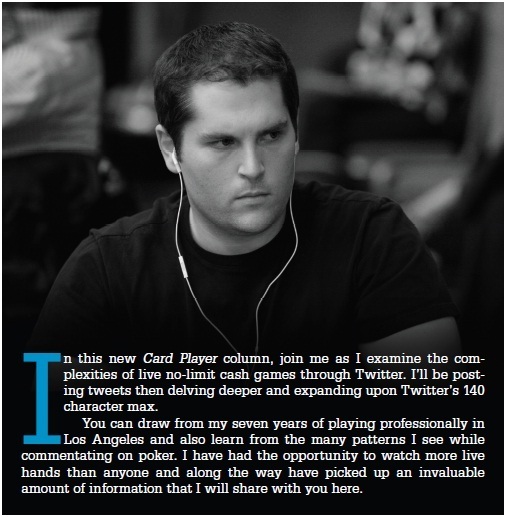
Follow Bart for daily strategy tips on twitter @barthanson. Check out his podcast “The Seat Open Podcast” on seatopenpoker.net and his video training site specifically for live No Limit players —CrushLivePoker.com. He also hosts Live at the Bike every Tuesday and Friday at 10:30 pm ET at LiveattheBike.com
Jerry Buss Vol. 26, No. 6
-
Final-Table Takedown: Casey Jarzabek
-
Head Games: Check Your Ego at the Door and Ask Yourself: Are You Ready to Move Up to Higher Stakes In Cash Games?
-
Men of Action: Big Sid Wyman
by Bob Pajich
-
Poker Strategy For The Rest Of Us: Mike McDonald
by Steve Schult
-
A Poker Life: Joe Tehan
by Logan Hronis
-
Crushing Live Poker With Twitter
by Bart Hanson