Free poker has many of the same games, formats, and action as real-play poker, but the key is that you don’t risk any of your own cash. Most sites have Texas Hold’em tables and sit-n-gos available all day, where you can use your play money chips. And if you lose them, you can usually reload after a short wait, either every few hours or once a day.
We tried free-play lobbies on several sites, and they all offer quick, simple ways to get started. You simply create an account, get your starting chips, and can join a table in less than five minutes. It’s the easiest way to learn the game without making a deposit, or to see if a site’s software suits your needs.
In This Guide
- What Is Free Poker and How Does It Work?
- Basic Poker Rules & Terminology
- Best Free Poker Games to Play Online
- Free Poker vs Freeroll Poker
- Free Poker Tips for Beginners
- How Play Money Chips Work
- Play Free Online Poker With Friends
- Free Poker vs. Real Money Poker: Key Differences
- Transitioning From Free Poker to Real Money Play
- FAQs
What Is Free Poker and How Does It Work?
Free poker is, as the name suggests, completely free. It’s a web- or app-based poker option where you don’t have to make a deposit and instead play with free chips, sometimes called play money or play chips. You get a stack when you sign up, and if you use it all, most sites let you top up so you can keep playing.
There are two ways to play free poker online. One is through your browser, often called ‘no download’ poker, where you play right on the website just like the CoinPoker free poker game below. Visit theCoinPoker free poker game for optimal experience.
The other is to download software, like the CoinPoker app, which gives you a more complete poker room experience with practice tables.
No matter which option you choose, free with fake money lets you play under real poker rules and gameplay, without risking any actual funds.
Using CoinPoker as an example, here’s how to get started playing free poker:
- Download the software. Head to CoinPoker’s homepage and download the app for your device. You’ll find both desktop and mobile options, plus the option to play in the browser on your phone.
- Sign up and create an account. You’ll need an email address and a username to get started.
- Click on “Practice Games.” You’ll find a dedicated lobby section for play-money tables, separate from the real money games.
- Choose your buy-in. Pick a play chip stack size that matches the table stakes you want to try.
- Click “Buy-In” and take your seat. You’re now ready to play free online poker with zero financial risk.
If you do end up playing cash games and generate rake, an offer like the one below could also see you get some free credit in the form of rakeback.

Basic Poker Rules & Terminology
If you’re brand new to the game, we recommend checking out our guide on how to play poker, which covers everything general rules to hand rankings and more. But here’s a quick rundown of how a hand of free Texas Hold’em works from start to finish:
- Blinds are posted. The two players to the left of the dealer post the small and big blind to start the action.
- Hole cards are dealt. Everyone gets two private cards, face down.
- Preflop betting. Starting left of the big blind, players call, raise, or fold based on their hole cards.
- The flop. Three community cards are dealt face up, followed by another round of betting.
- The turn. A fourth community card is dealt, followed by another betting round.
- The river. A fifth and final community card is dealt, followed by the last round of betting.
- Showdown. Remaining players reveal their hands, and the best five-card combination wins the pot.
And if any of those terms seem unfamiliar, knowing them will make things much easier:
- Call: Matching the current bet to stay in the hand.
- Fold: Giving up your cards and leaving the hand.
- Check: Passing the action without betting, and it is only possible if nobody has bet yet.
- Raise: Increasing the size of the current bet.
- Bet: Putting chips into the pot first in a betting round.
- Flop: The first three community cards that are dealt face up.
- Turn: The fourth community card.
- River: The fifth and final community card.
Best Free Poker Games to Play Online
Most free poker games online are No Limit Texas Hold’em, which is great for beginners. NLH is easy to learn, moves quickly, and has enough strategy to stay interesting as you improve. Since it’s the main game on most sites, it’s also the easiest to find if you want to play free poker.
There are other poker variants, of course, that are popular at these poker sites. But they might not be the easiest to find in the free-play format. They’re worth knowing about, though, in case they catch your interest:
- Omaha: This is another hugely popular variant at poker sites, which is played with four hole cards instead of two. With so many potential hand combinations, Omaha has a steeper learning curve and isn’t ideal for beginners. You might find some free Omaha poker options, though, with the fast-paced action pulling players in.
- PLO5/PLO6: These are Omaha variants, one a five-card version and the other with six. Understandably, this adds even more possible hand combinations that can quickly complicate things. These are niche picks and rarely available outside real-money rooms.
- Short Deck: Played with all 2s through 5s removed from the deck, Short Deck shifts hand values around and is mostly found at higher-stakes tables rather than free play.
- 7-Card Stud: An older format without community cards, Stud is rare in free play and generally not the best starting point for beginners.
Free Poker vs Freeroll Poker
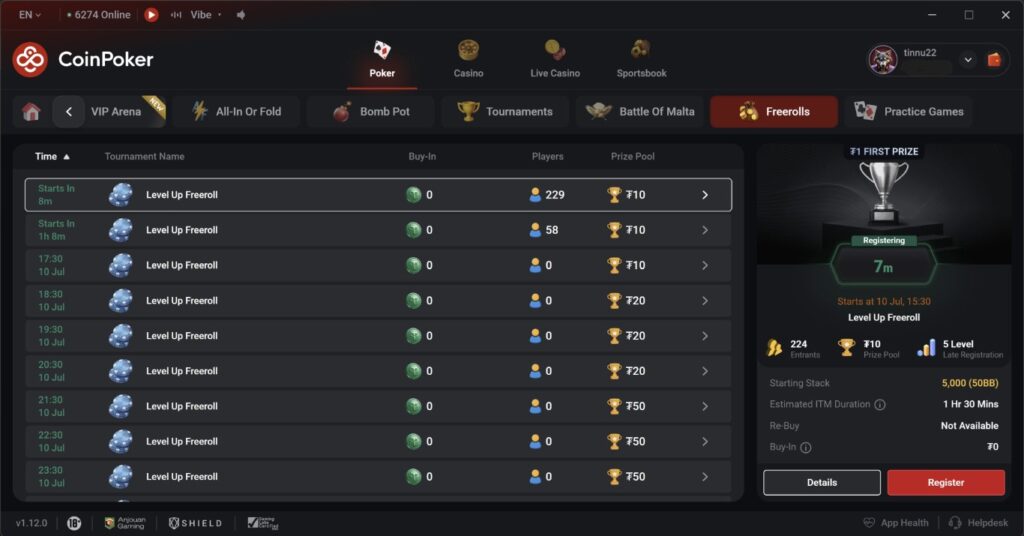
Free poker and freerolls both let you play without spending money, but they’re not quite the same thing. Free poker uses play chips with zero value attached, while a poker freeroll is a free-to-enter tournament that pays out real cash or prizes like entries to bigger MTTs to those who finish near the top.
If you want to learn the game without any pressure, free poker is a better starting point. Once you’re comfortable with the basics and how the software works, freerolls are worth checking out too, since they give you a real shot at winning something without needing to deposit a cent. Sites like ACR Poker have eight freerolls a day, each with a $50 prize pool.
Free Poker Tips for Beginners
Free poker is helpful for practice and learning, not just for passing the time. You won’t have the exact same experience at real-money tables, but it’s a good way to learn the basics and get familiar with the software. Here are some tips to make the most of these sessions:
- Set learning goals. You can use free poker to learn the rules properly and pay attention to things like how your position at the table affects which decisions make sense, how blinds and betting work, and how to check, bet, or raise on the app.
- Test free tools. You can try tools like a Texas Hold’em odds calculator in a completely risk-free environment to get comfortable using them.
- Decide your progression path. If you’re planning to move to real-money poker, free poker is the first step on your journey. Once you’ve got a handle on things, freerolls are a natural next step. And ultimately, low-stakes cash tables.
- Get more practice. Free poker games usually move faster than real-money tables because people make decisions more quickly since nothing’s at stake. This lets you play more hands per hour and get more practice.
How Play Money Chips Work
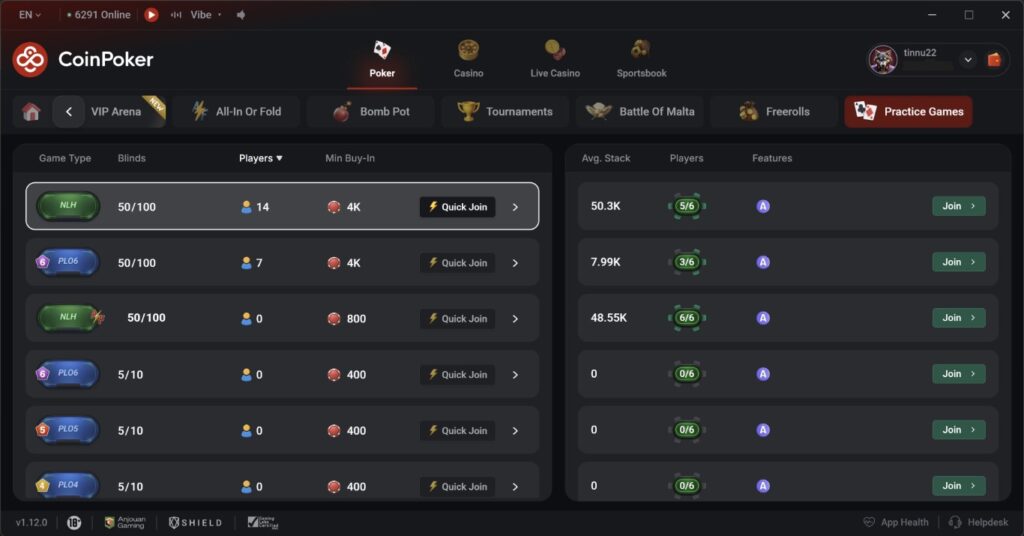
Play money is the virtual currency you use for free poker, but you’ll see it called by a few different names depending on the site. Play money, practice chips, fun chips, and free chips all mean the same thing. On sites like Global Poker, they use a coin-based system instead of standard play chips, which works similarly.
Even though free poker tables look just like the real thing, remember that you aren’t actually spending any real money. It doesn’t matter if you lose chips again and again. The main benefit of free online poker with fake money is that you can practice without risk.
Most sites let you reload your chips as many times as you like. There’s usually a short cooldown before you can claim more, ranging anywhere from 30 minutes to 24 hours. On CoinPoker, you’ll need to click “Claim Chips” to top up your play money balance once it runs low, with a “bank” of 500k chips available to you.
Play Free Online Poker With Friends
Playing free poker online with friends is possible on several sites, including CoinPoker, but you’ll need some coordination to set things up. Make sure that everyone has set up their accounts, and then agree on a time to join a table in advance.
While you can set up a private game with a small buy-in at some sites, this isn’t an option with free poker. So, while it won’t just be you and your friends, make sure to pick a relatively empty table so everyone has a seat. But remember that anyone can join free games, so you might still have strangers filling out the rest of the table.
Either way, poker with friends tends to feel more like a real home game than sitting down with strangers. It’s also a good way to introduce a friend to the game for the first time. Since nothing’s at stake, they can ask questions, make mistakes, and get comfortable at their own pace.
Free Poker vs. Real Money Poker: Key Differences
The main difference between free poker and real poker is what you can win or lose. Play chips have no value, so there is less pressure, and mistakes don’t cost anything. At real-money tables, the stakes are higher, opponents are tougher, and everyone takes each hand more seriously since there’s actual cash at stake.
Free poker is best for learning and casual play, and you can find games anytime. Real money poker is for more serious competition and bigger rewards.
| Category | Free Poker |
Cash Games
|
| Prizes | None, play chips only | Real cash payouts |
| Number of Players | Very high, usually no entry restrictions | Depends on stakes; reduces as stakes get higher |
| Game Types | Mostly Texas Hold’em “cash” games | Texas Hold’em, Omaha, PLO5, PLO6, Short Deck, 7-Card Stud – cash games and MTTs |
| Accessibility | Instant, no deposit required | Needs a minimum deposit and might require some ID or account verification |
| Quality of Opponents | Casual and loose | Tighter and more focused, even at low stakes. Opponent quality improves significantly with bigger MTTs and signature events |
| Fun Factor | No pressure, good for learning | Actual money at stake. Fun factor can swing depending on your run |
Transitioning From Free Poker to Real Money Play
Moving from free poker to real money tables is a bigger step than you might think. Even at the lowest stakes, like $0.01/$0.02, you will face tougher opponents because everyone has something on the line. This is very different from playing free poker, where people rarely fold, can bet or raise without consequence, and generally play really loose.
Freerolls are a solid bridge between the two. Moving from free poker to no-entry-fee tournaments gives you a path to real-money action without risking your own cash. You’ll still often find half the tabling shoving all-in on the first hand preflop. But things get serious eventually as people get closer to the prizes, which can be anything from tournament entries to actual, withdrawable cash.
Wagering real cash also comes with perks once you’re ready. You’ll find far more tournaments and tables running throughout the day, a wider range of game formats to choose from, and much higher traffic overall, so you’re rarely stuck waiting around for a seat.
This also opens up the world of online poker bonuses, with a solid welcome bonus and other promos letting you significantly stretch your bankroll as you find your feet.
These tips should help you make the jump more easily:
- Manage your bankroll carefully. A common rule of thumb is to have 100 big blinds at your chosen cash-game stake, or enough cash for a handful of tournament buy-ins, before moving up. Since you’re finally using real cash, it’s important to stay vigilant. If you’re losing too much at the start, it’ll be best to go back to freerolls and use poker tools to improve your game.
- Use simple tools to sharpen your decisions. Tools like odds calculators are a good way to double-check tricky spots without slowing down your game, and the best poker software can help you track your results as you go.
- Learn some poker lingo. Terms like “3-bet,” “c-bet,” or “GG” come up constantly in chat boxes, and knowing them helps you follow what opponents.
- Always start at the lowest stakes available. There’s no rush to move up, and starting small gives you room to adjust to proper online poker action without hurting your bankroll too much. The same rule applies to tournaments as well. The million-dollar MTT might seem tempting, but the player skill level is very high, and so is the buy-in you’ll likely lose.
- Keep track of your results. Even a simple note on a phone note-taking app of hands you’re winning or losing can help you spot patterns in your game. And there are proper poker trackers available if you’re looking for significantly more detail.