






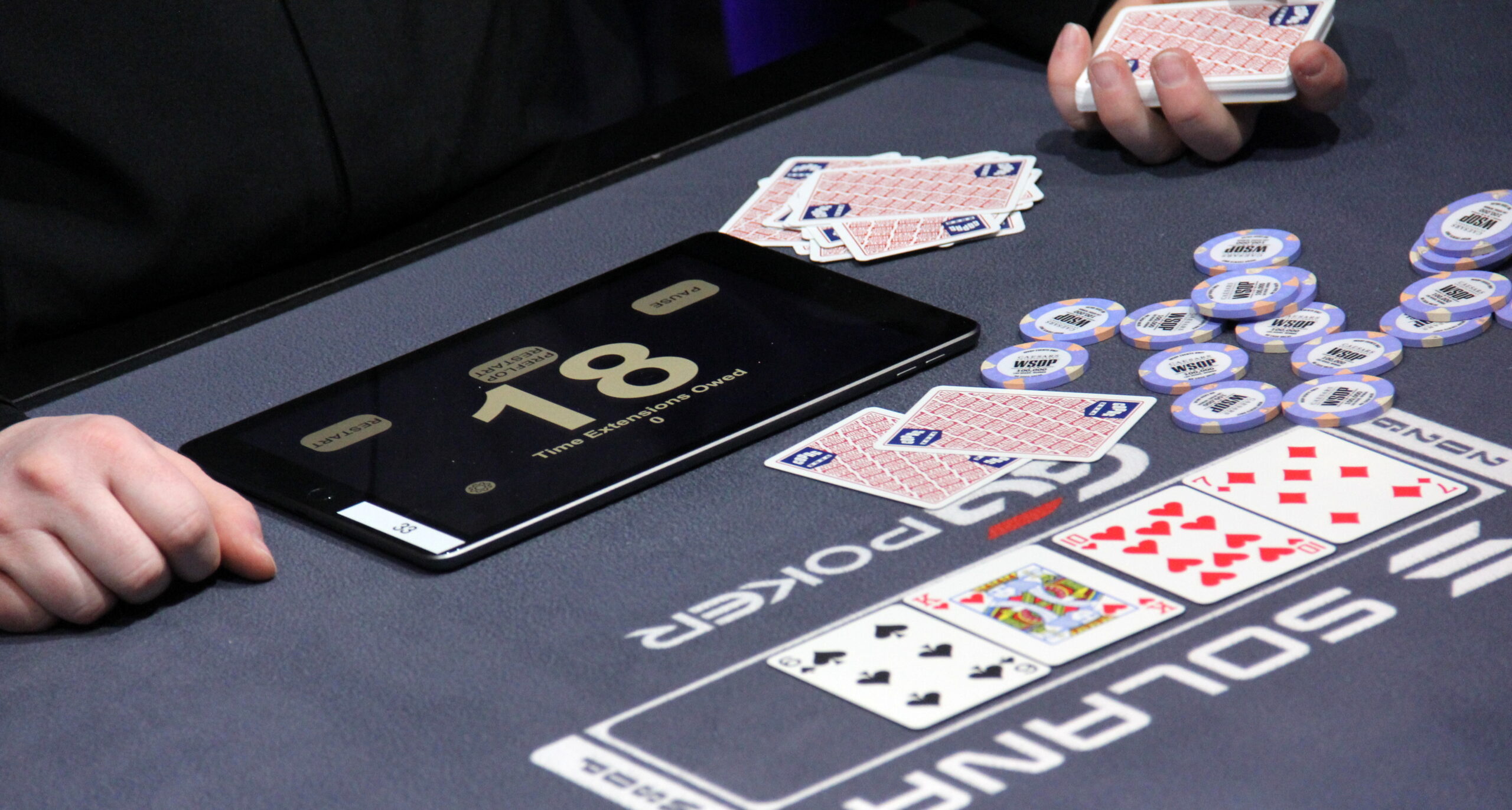
Poker fans tuning into the broadcast of day 7 the World Series of Poker main event were surprised to see the sudden implementation of shot clocks. The rule change, which is a first for the WSOP, came on the heels of some egregious stalling the day before.
While adding shot clocks certainly helps with the pace of play, many in the poker community are criticizing the decision’s timing and its effect on recreational players.
15 Minute Tank in Main Event
Loren Klein was looking to survive another pay jump on Day 6 of the 2026 WSOP Main Event as he went into one of the longest tanks of the summer. pic.twitter.com/RxbON81Pc3
— WSOP – World Series of Poker (@WSOP) July 12, 2026
The 15-Minute ‘Tank’
The spark that may have prompted the rule change came on day 6 with just 72 players remaining. Four-time bracelet winner Loren Klein was short stacked and raised to 975,000, leaving himself with just one 25,000 chip behind.
Tyler Gaston decided to call from the small blind, telling Klein, “I will let you stall for the pay jump.”
“I appreciate that,” replied Klein, who needed to outlast one more player for an additional $20,000.
The flop came down A♥7♥6♥, and Gaston bet. Klein, sitting with just one chip, didn’t act. Instead, he was allowed to stall for a full 15 minutes before the floor eventually stepped in and called the clock.
With just seconds to spare, Klein called with K♣4♥, and failed to come from behind against Gaston’s A♣6♦. Nobody else was eliminated during the hand, so Klein settled for 72nd place and $105,000.

The Shot Clock Response
With an entire table essentially colluding for one player’s pay jump, WSOP tournament officials decided to add shot clocks for day 7.
Players are now given 20 seconds to act on their hand, or be forced to use a time extension. Each player is given six time extensions to use at the start of the day, worth 30 seconds each. If a player runs out of time and extensions before acting, their hand is declared dead.
Although shot clocks have been used elsewhere on the poker circuit, most notably on the PokerGO Tour, Triton Poker Series, and World Poker Tour, this was the first use at the WSOP.
The Poker World Reacts
The addition of a shot clock has the poker community divided.
“It should have been [implemented] a lot sooner,” Shaun Deeb said to Gaston on the broadcast. “Every update I read about the tanking yesterday… my table was never like that. It’s bad. If I was out there and saw it, I would have called clock from another table.”
When Gaston tried to defend himself, Deeb responded, “It’s not a dick move [to call the clock.] I understand it’s a big spot, and everyone is happy to get $20,000 pay jumps. But when you [stall], you’re literally stealing from the other tables.”
ESPN commentator Maria Ho wasn’t so sure, however. She pointed out that shot clocks give pros like Deeb a significant advantage over amateur players who have never used them.
High-stakes pro Chris Brewer agreed, calling the decision “completely awful and insanely unfair to ever recreational still in the field.”
Heard they added shot clock to main event with 20 seconds pre…. Completely awful decision and insanely unfair to every recreational still in the field
— Chris Brewer (@Chris_D_Brewer) July 12, 2026
The Rules Already Cover Stalling
David Williams was among those with the opinion that the shot clocks were “a bad idea.” He pointed out that the floor should have gotten involved sooner in the Klein situation.
Shot clocks are more of a solution to excessive tanking than stalling. Although the players weren’t willing to call the clock, Klein and Gaston’s actions were entirely preventable.
WSOP rules allow the floor to act in the best interest of the game. Once it became clear after a couple minutes that Klein was stalling, the clock could and should have been called by the tournament director.
Jumping The Gun?
In the past, the WSOP has historically faced criticism for being too slow to react.
When Jonathan Tamayo consulted his team on the rail of his 2024 main event win, they responded by adding a ‘no coaching, no technology rule’ the next summer. When a ClubWPT Gold promotion resulted in collusion in the 2025 Millionaire Maker, they responded by adding a ‘no unapproved patches rule’ this summer.
The WSOP acted quickly in this case, eager to nip a problem in the bud before it got out of hand and was showcased to the world. But perhaps it was too quick. (Or maybe it should have been considered last summer, when Will Kassouf was terrorizing the field with his antics.)
Apparently a shot clock was added today to the @WSOP main event.
Anyone know the exact rules?
This was needed because no one will call clock on a huge pay jump.
The whole table benefits from one player tanking without a clock.
Good decision @shaundeeb https://t.co/iafiI8kpzv
— Allen Kessler (@AllenKessler) July 12, 2026
The WSOP implementing shot clocks on day 7 is one of the worst decisions I’ve ever seen a tournament operator ever make. Their standards are underground and they keep sinking.
— Sam Greenwood (@SamGreenwoodRIO) July 12, 2026
There are many good reasons for shot clocks. But much of the ‘death of poker personalities’ is down to the fact that every time we’re on stream we’re under such time pressure. Introducing shot clocks rules out any ‘Check your privilege’ ‘You call it’s gonna be all over’ moments. https://t.co/xNF6B0YzOt
— Sam (@SquidPoker) July 12, 2026
Did the main event really add a shotclock on day7??? When everyone is playing for millions?? What the fuck are they thinking?
This is a 9000 person tournament with tons of recreational players who have zero experience with this. This is insanely unfair
— Bryce Yockey (@SuddenlyBryce) July 12, 2026
I’ve played the @WSOP main event for over 20 years. I have multiple top 1-2% finishes. I finished 127th yesterday.
The tanking this year was beyond anything I’ve ever seen. The main event absolutely needs a shot clock with time banks at some point maybe starting day4.
Putting…
— David Paredes (@gaucho2121) July 12, 2026
This needs to be reconsidered immediately. This is so unbelievably unfair to the amateur players.
Playing for $10mil and adding this in mostly so it looks good on TV is outrageous.
Even the pressure of not having experienced using a shot clock before can be overwhelming.… https://t.co/pCSNEQo7rG
— Chance Kornuth (@ChancesCards) July 12, 2026
How can the WSOP really change the rules of the Main event on day 7 and add a shot clock? That’s absurd and unfair to rec players who are still in and have never used a shot clock! #fixit #wsop2026
— Mike Matusow(code:Mouth) (@themouthmatusow) July 12, 2026
There are two arguments being made:
1. Recs are hurt by timebanks
2. Surprise process change mid tournament is badLet me address the second one first. It’s not ideal. But operators need to adapt when necessary. Someone tanked 15 fkn mins for a pay jump when we FINALLY got back… https://t.co/KV9sj3XyeE
— Derek Kwan (@kwansfull) July 12, 2026
Happy w/ this absurd @WSOP rule change on adding shot clock mid Main Event. Extent to which pros frack the fuck outta the game for ev at all costs has gotten absurd. Seeing bad starting table & then unreg & reReg, 15min tanks, solver briefs between hands. (1/2) #WSOP
— ComedicGamble (@BrahsWorld84) July 12, 2026
As insane as it is for WSOP to completely change the format of the event with no notice, by adding shot clocks, we shouldn’t forget the annual “the world series needs shot clocks!!” outrage due to excessive tanking (almost exclusively by pros, as a means to hunt EV). https://t.co/Zu8MQWaQiB
— Matt Berkey (@berkey11) July 12, 2026
 Julio Rodriguez is Editor-In-Chief for Card Player Media, having started as a live tournament reporter at the 2006 WSOP. Originally from Miami, Florida, he now lives in Las Vegas with his wife and daughter.