










No Phones! No Coaches! WSOP Changes The Game
New Rules Aimed At Protecting Game Integrity, But Are They Too Restrictive?
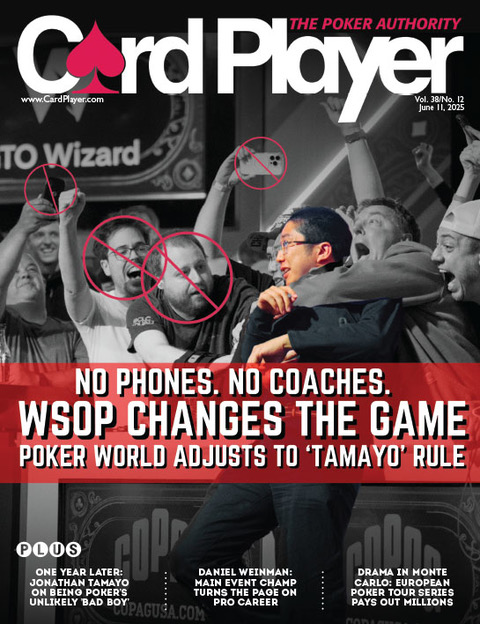
Over the last two decades, phones, tablets, and other electronic devices have become commonplace in poker rooms.
Between the ability to play online, the sheer boredom of doing nothing in between hands after folding, and the basic necessity of being connected to the world outside the casino, phones are usually found either in a player’s hand or sitting on top of the rail.
That visual will not be repeated this year at the World Series of Poker. The WSOP released their rulebook for the 2025 series in May, which gives the staff the option to heavily restrict the use of phones at this year’s series.
Most of the published rules were identical to last year’s, but Rules 63 and 64 put heavy restrictions on outside coaching, and the use of electronic devices.
The move was most likely a reaction to Jonathan Tamayo’s main event victory last year, where 2015 main event champion Joe McKeehen and high-stakes tournament crusher Dominik Nitsche had a laptop in plain sight on the rail to help relay any strategy changes to Tamayo in between hands.
Although within the rules and commonplace since the inception of the November Nine delayed final table, it generated a lot of discussion and blowback on social media.
Then, about a month after Tamayo’s $10 million score, a pair of poker pros were arrested in France after they were caught in a high-tech, high-stakes cheating scam using a cell phone.
With game integrity on the line, plus the optics of last year’s final table, the WSOP opted to make some changes.

Phone Cameras Gave Players Superuser Ability
Last August, a 37-year-old Lithuanian and a 63-year-old Ukrainian were arrested at a lakeside casino in Enghien-les-Bains on fraud charges for their actions in the casino’s poker game.
The casino and the police alleged that one player put a microscopic camera on his phone and placed it on the rail. The filming angle allowed the camera to pick up the bottoms of the cards as the dealer pitched them around the table.
Those images were relayed to their partners at another location. The offsite team would track the cards and relay that information back to the players through microscopic earpieces that were so small they could only be removed using a magnet.
Since the equipment was incredibly sophisticated, The Times of London spoke to a source that said it was likely an organized crime ring, but high-stakes poker pro Matt Berkey believed that this type of cheating was occurring for as long as five years prior to the arrest.
As a result of the scandal, many European casinos no longer allow phones to rest on the table’s rail, and a major tour has taken security measures even further.
European Poker Tour Introduces Slide Dealing
The EPT banned electronic devices from being placed on the table’s playing surface or rail as well, but players are allowed to keep their phone in their possession or on a side table.
On the other hand, the EPT prohibit players from using laptops, tablets, or computers in the tournament area. Additionally, the tour “reserves the right to ask players to cease using any and all electronic devices” if the staff believes their presence is slowing down the pace of play.
Additionally, the EPT retrained its dealers to slide cards to players instead of using a traditional pitch, where the cards are slightly airborne. PokerStars has since implemented the procedure for all their live events worldwide.
U.S. tours were slower to react. Stateside of the Atlantic, Tamayo’s “laptop gate” received most of the scrutiny and the blatant European cheating scandal was overlooked by most casual poker fans.
The World Poker Tour didn’t make any substantial changes, and continue to simply lock up player phones during televised and live streamed final tables.
 The WSOP Circuit didn’t implement any changes to its rulebook for the subsequent season, but the WSOP test ran their new phone rules during the WSOP Paradise festival in the Bahamas last December.
‘Laptop Gate’ Provided Poor Optics For Poker’s Future
Just like some of his other opponents in the 2024 WSOP main event, and countless others that came before, Jonathan Tamayo had some help in his corner. He would occasionally visit his friends on the rail, where he would confer with them about any strategy adjustments he should make.
Photos on social media showed a laptop displaying a hand matrix on the screen with certain preflop hand selections highlighted, most likely used for visualization purposes so that Nitsche and McKeehen could quickly and easily show Tamayo which hands needed to be included or cut from his ranges.
The laptop on Tamayo’s rail was situated in plain sight. Nitsche and McKeehen weren’t trying to hide their actions, because it was clear they didn’t think the laptop broke any rules. If they had been, the tournament staff could have and would have forced them to stop.
But even if it wasn’t cheating, those who believed that it was just a bad look for poker on its biggest stage held a valid point.
For poker to have a healthy ecosystem over the long run, it requires a steady influx of new players coming into the game. And having a player, much less the eventual champion, going to the rail and checking his strategy against a computer just doesn’t look good to potential newcomers.
The poker boom was sparked by personalities, not solvers. Players fell in love with the game by watching tournaments and cash games with eccentric characters relying solely on their wits to get by.
When the champion was a Tennessee accountant who won a satellite to get in, it felt like anybody could win. But when a seasoned pro is showcasing a finely-tuned, computer-assisted strategy, the dream becomes harder to sell.
New Rule Cites Nevada Law
Rule 64 is where the major changes have been implemented. The rule tries to curb three things:
- Players using charts or solvers
- Players receiving coaching from spectators
- Players outright cheating
It states clearly that coaching from the rail or receiving information from outside sources is strictly prohibited. And by giving staff the ability to take away phones or electronic devices once the field gets down to the final three tables, it limits the opportunity for players to engage in any foul play.
But there’s just a few problems.
These practices have been commonplace for quite some time. In fact, you can argue it was even somewhat promoted by the WSOP. (It’s hard to find a rail photo of Tamayo and his team last year without GTO Wizard prominently advertised in the foreground or background, for example.)

From its inception in 1970 until 2008, the $10,000 no-limit hold’em main event was played straight through to completion in consecutive days. In 2008, however, the WSOP implemented the November Nine format. The field would play down to the final nine before they paused the tournament and gave the players a three-month break before coming back to Las Vegas in November to finish the event.
Tournament officials said the delay was to help generate buzz and hype around the final table while ESPN aired weekly recaps of each day of the tournament.
In some sense, they were right. Those players were able to coordinate with friends and family to come to Sin City after the pause and watch the tournament. The rails became bigger and louder than they were before.
But it also allowed those same players to improve their game in the interim timeframe.
In 2008, former Card Player publisher Jeff Shulman was part of the inaugural November Nine and publicly hired Phil Hellmuth to help coach him during those three months. Other players picked coaches as well and the downtime became less about media appearances and more of a three-month study session.
In 2012, Jacob Balsiger hired Mike “Timex” McDonald, while Russell Thomas hired Jason Somerville. These arrangements were not hidden and most of the time, the hired guns would show up and support their player on the rail.
As part of Thomas’ interim training, Somerville brought in a slew of other poker pros to run simulated final tables and help Thomas nail down his strategy. The group included high-stakes cash game grinder Matt Berkey, who discussed the coaching operations on his now-defunct Only Friends podcast in the aftermath of Tamayo’s controversy.
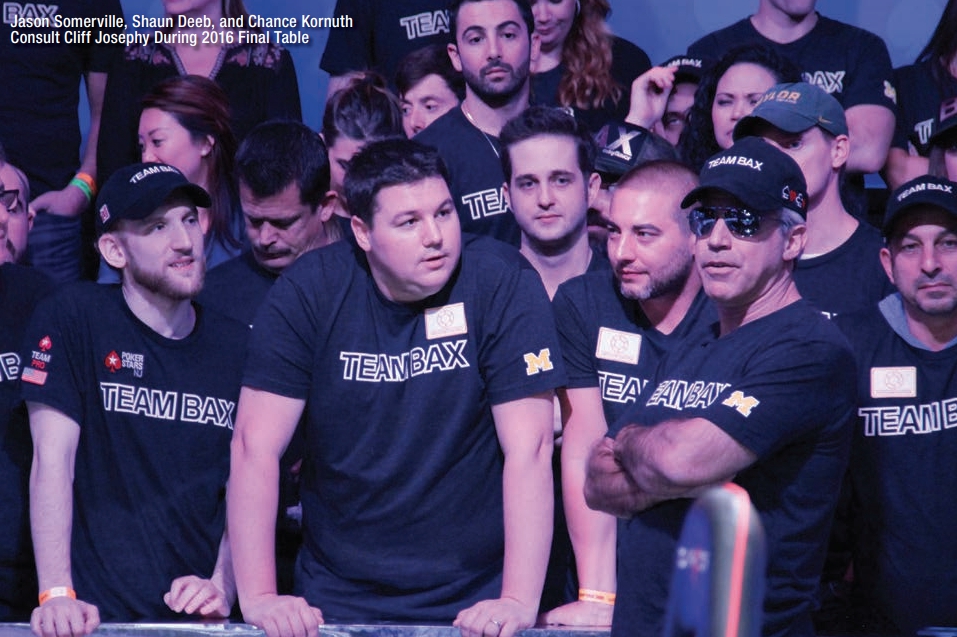
Not only did Berkey discuss the practices, he pulled up a screenshot of the 2016 final table. And with four players left, one of the rails had a laptop squarely on the rail, showing that these practices were the norm for about a decade.
“It’s nothing new for main event final tablists to have teams of people behind them,” said Berkey.
Patrick Leonard echoed those sentiments, pointing out that plenty of respected players like Scott Seiver, Shaun Deeb, and Chance Kornuth have been spotted at the final table over the years.
“Every year I’ve watched the WSOP final table, the most prominent members of the community have been there with laptops and/or headphones,” Leonard said. “It was never an issue, previously. Players would always go to their rails between hands and get advice on what to do next. It was almost always celebrated and seen as a cool part of the final table.”
A Questionable Carveout
The timing of the rule makes it appear that the WSOP is making this rule change in response to the social media backlash from Tamayo’s detractors. But a dubious carveout in rule 64(g)(1) makes it more likely that these changes are more about security theater instead of a genuine effort to shore up any game integrity leaks.
The subsection of the rule, which was confirmed by WSOP’s social media liaison Kevin Mathers, allows players to bypass any possible phone ban if they are playing on the WSOP online platform or betting with the Caesars Sportsbook.
Yes, this allows players to multi-table online while in live events, but it also creates a difficult situation for tournament officials to police.
- Photos by PokerGO, Card Player