







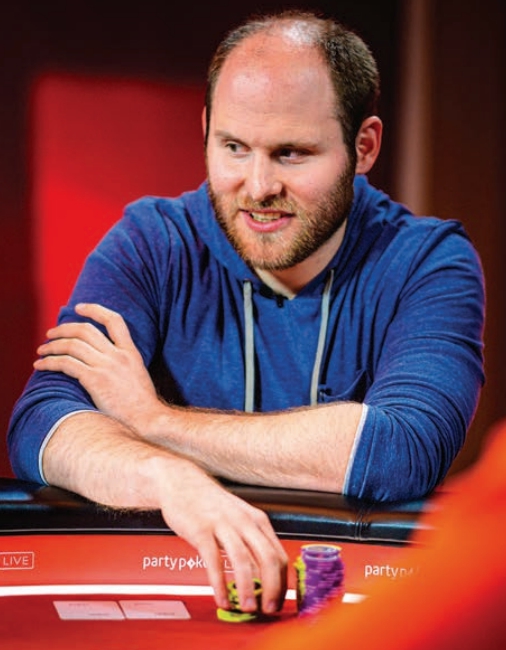
 Even the best players in the world make mistakes. Join Sam Greenwood as he breaks down and analyzes hands played from the high roller circuit on his Punt Of The Day Substack.
My first Punt of the Day column (Vol. 38, Issue 11) featured a hand where I had an easy continuation-bet strategy and played it correctly, but got myself into trouble barreling a hand that was too weak on the turn and too strong on the river. I ended up losing around a quarter of my stack.
In today’s hand, I also make an ambitious turn barrel that doesn’t lose EV, but the big error in the hand stems from me not understanding what my flop strategy should look like.
Let’s dive into it!
Event: 2024 WSOP Paradise – Triton $500,000 Invitational
The Hand
It is day 2, tournament registration is closed and about half the field remains with 46 remaining from 96 entries. The final 17 will make the money.
The blinds are 25,000-50,000 with a 50,000 big blind ante. The average stack sits at 2,100,000, while I am slightly below that with 1,800,000.
It folds around to Alex Foxen in the lojack and he raises to 100,000. I look down at A♦J♠ in the hijack and three-bet to 270,000. It folds around back to Foxen, who calls.
Flop: Q♠5♥3♠ (Pot: 665,000)
Foxen checks, and I bet 130,000. Foxen calls.
Turn: 3♦ (Pot: 925,000)
Foxen checks. I bet 350,00, and Foxen folds.
What Was I Thinking?
My preflop play with A-J offsuit is a mix. I rolled an aggressive number and decided to three-bet, but there were a couple factors that made me want to three-bet more often than I would at equilibrium.
Foxen was opening into Ferdinand Putra and Wai Kin Yong, who are strong, experienced poker players, but less aggressive preflop than most pros. So, I thought Foxen would be opening wider than normal.
Wai Kin is a loose defender in the big blind and A-J offsuit doesn’t play well in multiway pots. With this lineup, I’d rather three-bet bluff more often with offsuit combos like A-J offsuit, A-10 offsuit, and K-Q offsuit, and flat call with more suited combos like A-9 suited and K-10 suited.
The flop was dry, and I thought I’d always bet dry flops as the preflop aggressor. I considered betting a variety of sizes, but settled on a split between either 20% or 50% pot. I figured that betting half-pot with my range would only work if I could get pocket pairs to fold on the flop, and I wasn’t sure if I could do that, so I chose 20%.
I thought having the J♠ made barreling the turn appealing for me because I blocked some flush draws he might check-raise all-in with, and it also allows me to bluff when a spade hits the river. I didn’t think I’d three-bet K-J offsuit preflop very often so I thought this was my worst hand with the J♠, which also made it a good hand to bet.
I didn’t think I needed to bet big because my value bets don’t need much protection and the stack-to-pot ratio is so small I can comfortably shove any river for value. Betting 40% seemed like a size that could get some pocket pairs to fold, but still left enough behind that my river shove would be capable of generating folds. Plus, I’d still be left with a starting stack if I gave up on the river.
What Did I Get Wrong?
My preflop logic remains sound, but my flop logic is lazy.
A common mechanic in three-bet pots is that specific ranks of cards matter a lot more. Dry boards are good for the three-bettor, but queen-high boards are not.
I rarely three bet A-Q offsuit or A-Q suited because they are indifferent to calling a four-bet shove and I’d rather three-bet a more polar range. Foxen will frequently call a three-bet with A-Q/K-Q so he will show up with top pair more often than I do. He also never has A-K, a hand I have a lot.
A-J with a spade is the exact type of hand that has a lot of pot share, but has trouble calling a check-raise. Betting the flop doesn’t lose EV from me, but pure c-betting this flop with all of the middle of my range will lose EV in the long run against players who exploit this strategy.
On the turn, I overweighted the value of having the J♠ in my hand. If I wasn’t dealt it myself, Foxen would only have it in his range around 5% of the time, and he would continue against a 40% pot bet on the turn 70% of the time with it, and 80% of the time with his entire range. Basically, it’s a card he would rarely have and his hands with it actually fold more often than a random hand in his range.
Betting doesn’t lose substantial EV, but if I bet hands like this too often, he should never fold pairs on the turn. Fortunately, I got him to fold this time.
Types Of Errors I Made
- Misunderstanding range strategy
- Defaulting to lazy play
- Misunderstanding blocker effects
Grade
I made a lazy, obvious play that didn’t lose EV, but could be exploited in the future. But I got Foxen to fold 7-7 and looked smart on the livestream, so I’ll give this one a B.
He did get the last laugh, however, busting me one level later after I ran A-K into his pocket aces preflop.
 Sam Greenwood is one of the winningest tournament poker players ever and is third on Canada’s all-time money list, having cashed for $42 million and counting in high roller events all over the world. The former stock trader-turned-champion has played millions of poker hands and is breaking them down street by street on his Punt Of The Day Substack. You can reach out to the Run It Once coach on Twitter/X for private coaching @SamGreenwoodRIO.