
PLO poker is a four-card poker game beloved for its fast pace and big action. In this article, we explain the poker PLO rules and explore the differences between PLO and Texas Hold’em.
PLO Poker Rules: Key Points
- PLO stands for Pot-Limit Omaha.
- PLO is played with four hole cards and five community cards.
- Players must use exactly two hole cards and three community cards.
- In Pot-Limit Omaha, the bet sizes are capped at the size of the pot.
In This Guide
What is PLO Poker?
PLO stands for Pot-Limit Omaha, a poker format where each player receives four hole cards. The goal is to make the best poker hand using exactly two of your hole cards and three of the five community cards.
PLO poker rules follow the standard poker hand rankings, with a royal flush being the highest possible combination.
One of the core rules of PLO poker is that no player can bet more than the size of the pot, hence the term pot-limit.
PLO vs Texas Hold’em: Key Differences
PLO poker is found alongside Texas Hold’em around the world, and can be played on all Omaha poker sites alongside a full range of other poker variants. However, there are three key differences between Hold’em and PLO poker rules:
- PLO is played with four hole cards. This results in nearly 100 times as many unique starting hands in PLO.
- While a player can go all-in at any time in no-limit Hold’em, in PLO, a bet is capped at the size of the pot.
- In Hold’em, players can use one or zero of their hole cards to make a hand. Meanwhile, PLO poker rules require players to make a hand using exactly two hole cards and three community cards.
Understanding the rules of PLO poker is straightforward once you grasp the two key differences from Hold’em: four hole cards and pot-limit betting. The next section covers a more detailed explanation of some rules of PLO poker.
Essential PLO Rules
If you want to know how to play PLO poker, the most important thing to understand first is the exactly-two-cards rule.
The “Exactly 2 Cards” Rule
One of the most essential PLO poker rules is the “exactly two cards” rule, meaning a player must use exactly two of their four hole cards in combination with three of the five community cards to make a hand at showdown.
To illustrate, to make a flush in PLO, a player must have two hole cards of the same suit and combine them with three identically suited community cards; combining one hole card with four community cards is impossible.
The Four Betting Rounds
If you’re wondering how to play Omaha poker, the short answer is: like Hold’em, but with four hole cards and a mandatory two-card rule. PLO poker has a button and blinds, and four betting rounds:
- Preflop: Each player is dealt four cards, and the player to the left of the big blind acts first.
- Flop: Three community cards are placed on the table. The player closest to the button, starting on the left, has the first decision.
- Turn: One additional community card is added, after which another betting round occurs.
- River: One final community card completes the board, followed by the last betting round.
After the final action, any remaining players table their cards to determine a winner.
Understanding Pot Limit Betting
PLO poker rules cap bet sizes to the size of the pot. How this works differs slightly depending on the situation.
- If the bet is the first bet in a betting round, it can’t exceed the amount in the pot. For example, if there is $100 in the pot on the flop, a player’s bet must be $100 or less.
- If faced with an earlier bet, the maximum raise will be three times the initial bet plus the amount in the pot before the bet. For example, if a player bets $50 into a $100 pot, their opponent’s raise is capped at $250.
When playing live PLO poker, it can be difficult to keep track of the pot. Luckily, PLO poker rules allow players to ask the dealer the current pot size or the maximum allowed raise.
Best Starting Hands in PLO
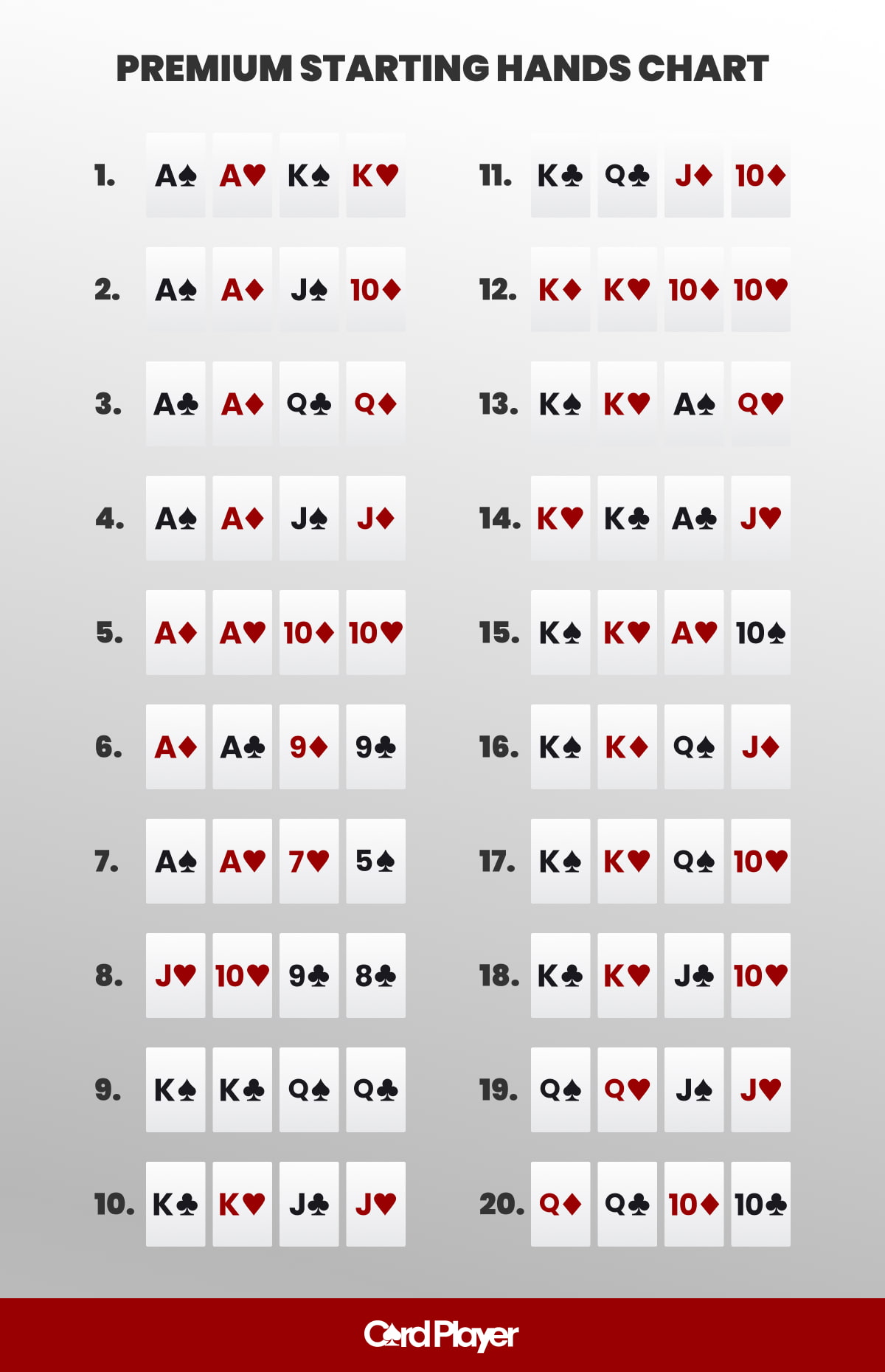
Omaha poker hand rankings follow the same structure as Hold’em, from high card at the bottom to royal flush at the top. Let’s go over a few features every premium PLO poker starting hand has.
- Double-suitedness: Having two suits doubles the chance of hitting a flush.
- High cards & pairs: The best PLO starting hands contain high cards, with all the best hands containing pocket aces.
- Connectivity: Having cards close in value makes it easier to make straights.
Keeping this in mind, the very best PLO starting hand is A-A-K-K double-suited, as it provides two chances to hit the nut flush, two chances to make top set, and a chance to make a straight.
Be mindful that in PLO poker, hand equities run way closer than in Hold’em. In Hold’em, pocket aces have 80% equity or more against any other hand. Meanwhile, according to the CardPlayer Omaha Odds Calculator, A-A-K-K double-suited is only a 61% favorite against J-T-9-8 double-suited.
PLO Hand Example Walkthrough
To help clarify PLO poker rules, we’ve written a step-by-step walkthrough of a hand where Jenny, Chris, and David are playing a cash game with blinds of $5/$10.
- Preflop: Jenny posts her small blind of $5, and Chris posts his big blind of $10, making David the first to act on the button. David makes a pot-sized raise to $35. Jenny folds, while Chris calls.
- Flop (Board: A♠J♠7♥, $75 in pot): Chris is now first to act and checks. David bets $50, which Chris raises to the maximum of $225. David calls.
- Turn (Board A♠J♠7♥3♠, $525 in pot): Chris checks, and David also checks.
- River (Board A♠J♠7♥3♠3♥, $525 in pot): Chris checks again, David bets the pot of $525, and Chris calls.
David shows A♥A♣K♥K♣ for a full house and defeats Chris, who plays A♦K♠T♠9♣ for a flush.
Common PLO Mistakes to Avoid
Omaha poker strategy differs significantly from Hold’em, with position and drawing to the nuts being far more important. When first starting out playing PLO poker, it is common to make some mistakes, such as:
- Forgetting the “Exactly 2 Rule”: Remember that one hole card can’t make a flush, and three hole cards of the same rank are not considered trips.
- Overvaluing low cards: All the best PLO starting hands contain high cards, making hands such as 5-5-4-3 worse than they seem.
- Playing out of position: Equities run very close in PLO poker, making position much more important.
Avoiding these common mistakes will help a great deal when sitting down at a PLO poker game.