










Straight in Poker: Definition, Rankings & Types of Straights
What Is a Straight in Poker?
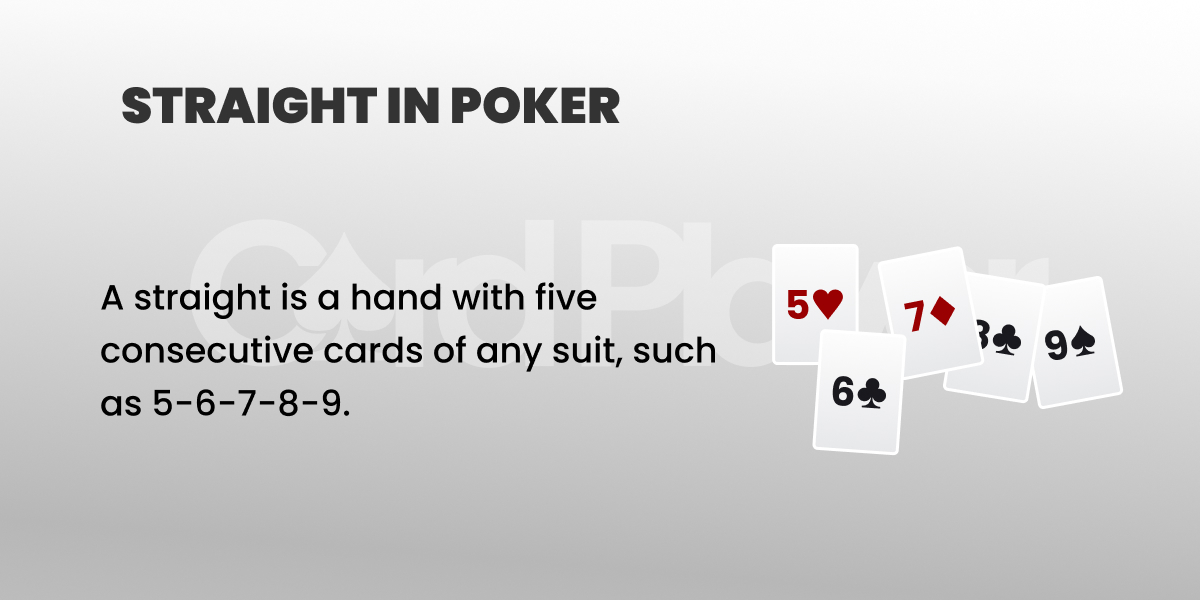
The term “straight” in poker refers to a run of five consecutive cards in order, for example, 5♥️6♠️7♥️8♣️9♥️. The cards must follow sequential rank order, but don’t need to be of the same suit.
In standard poker hand rankings, a straight beats pairs, two pairs, and three of a kind, but loses to flushes and higher hands. This middle-tier ranking creates interesting strategic decisions, as straights are strong, yet often difficult for opponents to defend.
Some of the common terms used for specific straights are “the wheel” or “bicycle” for the weakest straight (A-2-3-4-5) and “Broadway” for the strongest straight.
A Straight in Poker: Key Points
- A straight is five cards of sequential rank, like 8-9-T-J-Q. The suits are irrelevant.
- The best straight is A-K-Q-J-T (Broadway). The lowest is A-2-3-4-5 (The Wheel).
- Playing the low end of a straight, the “idiot end,” is one of the most common and costly mistakes in poker.
A Straight in the Poker Hand Rankings
Understanding where the straight fits in the poker hand rankings is crucial for making profitable decisions at the table. In the standard hand hierarchy, a straight ranks as the sixth-best hand.
Here is how the straight compares to the rest of the made hands in poker:
| Hands a straight beats | Hands that beat a straight |
|---|---|
| Three of a kind (three cards of the same rank) | Royal flush (A-K-Q-J-10 of the same suit) |
| Two pair (two different pairs) | Straight flush (five consecutive suited cards) |
| One pair (two cards of the same rank) | Four of a kind (four cards of the same rank) |
| High card (no made hand) | Full house (three of a kind plus a pair) |
| Flush (five cards of the same suit) |
When multiple players have straights, the winner is determined based on the highest card in the sequence. An ace-high straight beats a king-high straight, which beats a queen-high straight, and so on down the line.
If two players hold identical straights, the pot is split equally between them.
Examples of Different Straights in Poker
The different straights in poker vary based on their highest card, and categorizing them helps you quickly assess the strength of your hand.
Types of straights in poker:
- The Wheel (A-2-3-4-5). This is the lowest possible straight where the ace plays as a one.
- Mid-range straights (6-high through 9-high) are common but vulnerable to higher combinations.
- Strong straights (10-high through King-high). These carry significantly more value since they will usually come on top in straight vs straight scenarios.
- Broadway (10-J-Q-K-A). The strongest possible straight is also called the “ace-high straight.” This hand can only be beaten by flushes or better.
Recognizing where your straight falls in this hierarchy helps you determine whether to play aggressively for value or proceed with caution to avoid costly confrontations.
Probability of Making a Straight in Poker
Knowing the mathematical likelihood of completing a straight in Texas Hold ’em helps you make +EV decisions throughout a hand. The probability varies significantly depending on your starting cards and the community cards.
- Preflop probability: Your hole cards determine your potential for a poker straight before the flop. Connected cards (such as 9-8 or J-10) have significantly higher straight-making ability than disconnected cards. Suited connectors give you approximately a 1.31% chance of flopping a straight, while you’ll flop a straight draw (four cards to a straight) about 10.4% of the time.
- Postflop scenarios: If you flop an open-ended straight draw (eight outs), you have roughly a 31-5 chance of completing your straight by the river. With a gutshot (inside) straight draw (four outs), your probability drops to approximately 16.5% by the river.
- Turn and river: With an open-ended straight draw on the turn, you have about a 17.4% chance (roughly 4-to-1 odds) of hitting on the river. A gutshot straight draw gives you approximately 8.7% (approximately 10-to-1 odds) to complete your hand.
Understanding these probabilities in poker straight rules helps you balance risks versus rewards, ensuring you’re not chasing draws with insufficient pot odds or folding draws that offer positive expected value. If you are not sure about whether to play a draw in a certain spot, you can also put your hand into online poker software to check.
Straights in Cash Games vs Tournaments
When it comes to playing straights, the poker strategy shifts dramatically between cash games and tournaments, primarily due to differences in stack depth that affect the amount of value that can be extracted.
Cash Game Strategy
Cash games typically feature deep stacks of 100 big blinds or more, creating ideal conditions for playing straight.
These deeper stacks allow you to speculate with connected cards like 8-9 or J-10 because when you hit your straight, there is enough money behind to justify the initial investment. You can extract multiple streets of value, building substantial pots that make chasing straight draws mathematically profitable.
Tournament Strategy
Tournaments are the total opposite. As blinds increase in size, stacks typically shrink below 100 big blinds, usually reaching 20-40 big blinds.
With shallow stacks, there simply isn’t enough money behind to make speculation for straights worthwhile. Even when you successfully complete a straight, a limited stack depth prevents you from extracting sufficient value to justify the preflop and flop investment. You might risk 15-20% of your stack chasing a straight draw, only to win a pot that barely compensates for the risk.
Iconic Straights From Poker History
The straight is at the center of perhaps the most famous hand ever televised. In the 1988 World Series of Poker Main Event, Johnny Chan, the stoic defending champion, was heads-up on the final table with Erik Seidel.
Let’s take a look at how it went down postflop:
Flop:
- Chan has J-9.
- The flop comes Q-8-T.
- Chan has flopped the unbeatable nut straight.
- Chan checks the nuts.
- Seidel has the top pair and bets.
- Chan just calls.
Turn:
- The trap is set. The turn is a blank.
- Chan checks again.
- Seidel, sensing weakness, moves all-in.
- Chan calls before Seidel’s chips have even settled on the felt.
Chan flipped over his straight and claimed his second consecutive world championship in poker’s most prestigious event, the WSOP Main Event. His flopped straight, combined with ice-cold composure and an incredible read on his opponent, resulted in one of the most masterful traps in poker history.
FAQs
What does a straight mean in poker?
A straight in poker means having five cards in sequential order, like 4-5-6-7-8. At least one of the cards needs to be of a different suit.
In poker, does a straight beat a flush?
No. In poker, a flush always beats a straight. This is one of the most important hand rankings to remember.
What beats a straight in poker?
The hands that beat a straight in poker are a flush, a full house, four of a kind, and a straight flush.
How strong is a straight in poker?
A straight is a very strong hand, ranking above three of a kind and two pair. However, its absolute strength depends on the board texture.
Can an ace be used in a straight?
Yes, an ace is unique in that it can be used at the top of a high straight (T-J-Q-K-A) or at the bottom of a low straight (A-2-3-4-5).
How do straights compare against each other?
When two players both have a straight, the winner is the player whose straight includes a higher card. A Queen-high straight beats a Jack-high straight.