







Full House in Poker: Definition, Hand Rankings, Odds & Strategy
What Is a Full House in Poker?
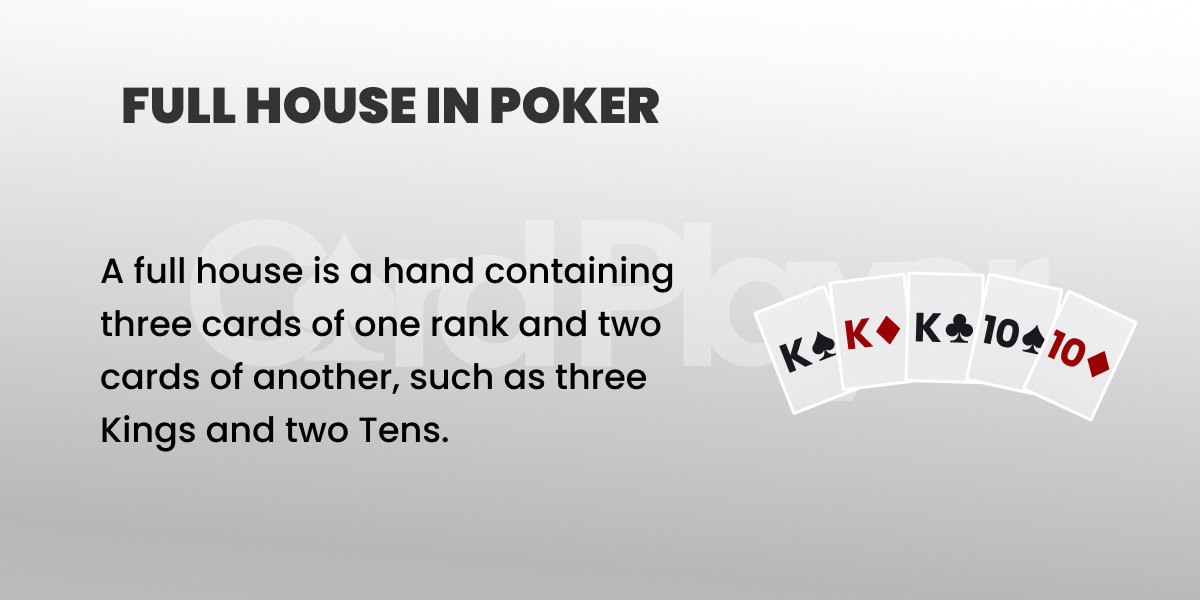
A full house in poker is a hand that consists of three of a kind, plus a pair.
This hand is also referred to as a “boat”. It is one of the strongest five-card combinations in poker, ranking above hands like straights and flushes.
However, not all full houses are created equal. Aces full is a monster, whereas deuces full on a scary, coordinated board is not always a guaranteed win. Knowing how to maximize value and get away when beat separates the sharks from the fish.
Let’s break down the full meaning of a full house in poker.
Full House in Poker: Key Points
- A full house in poker consists of three of a kind, plus a pair.
- A full house is very strong, ranking fourth out of all poker hands.
- Full houses are usually monsters, but lower full houses can be vulnerable depending on board texture.
- Full house strategy usually focuses on winning big pots while avoiding trouble if your hand is beaten.
What Does a Full House Look Like in Poker?
A full house in poker contains five cards: three of one rank and two of a different rank.
There are 3,744 distinct combinations of full houses in a standard 52-card deck, which form 156 ranks. An example of a full house is K♠️K♦️K♥️5♣️5♦️. That’s kings full of fives. The trips (the three kings) do the heavy lifting at showdown, while the pair only matters if someone else has the same trips. When it comes to full houses in poker, suits are irrelevant.
Another example of a full house is 8♣️ 8♠️ 8♦️ A♥️ A♠️. In this case, you’d have eights full of aces.
Where Does a Full House Rank in Poker Hand Rankings?
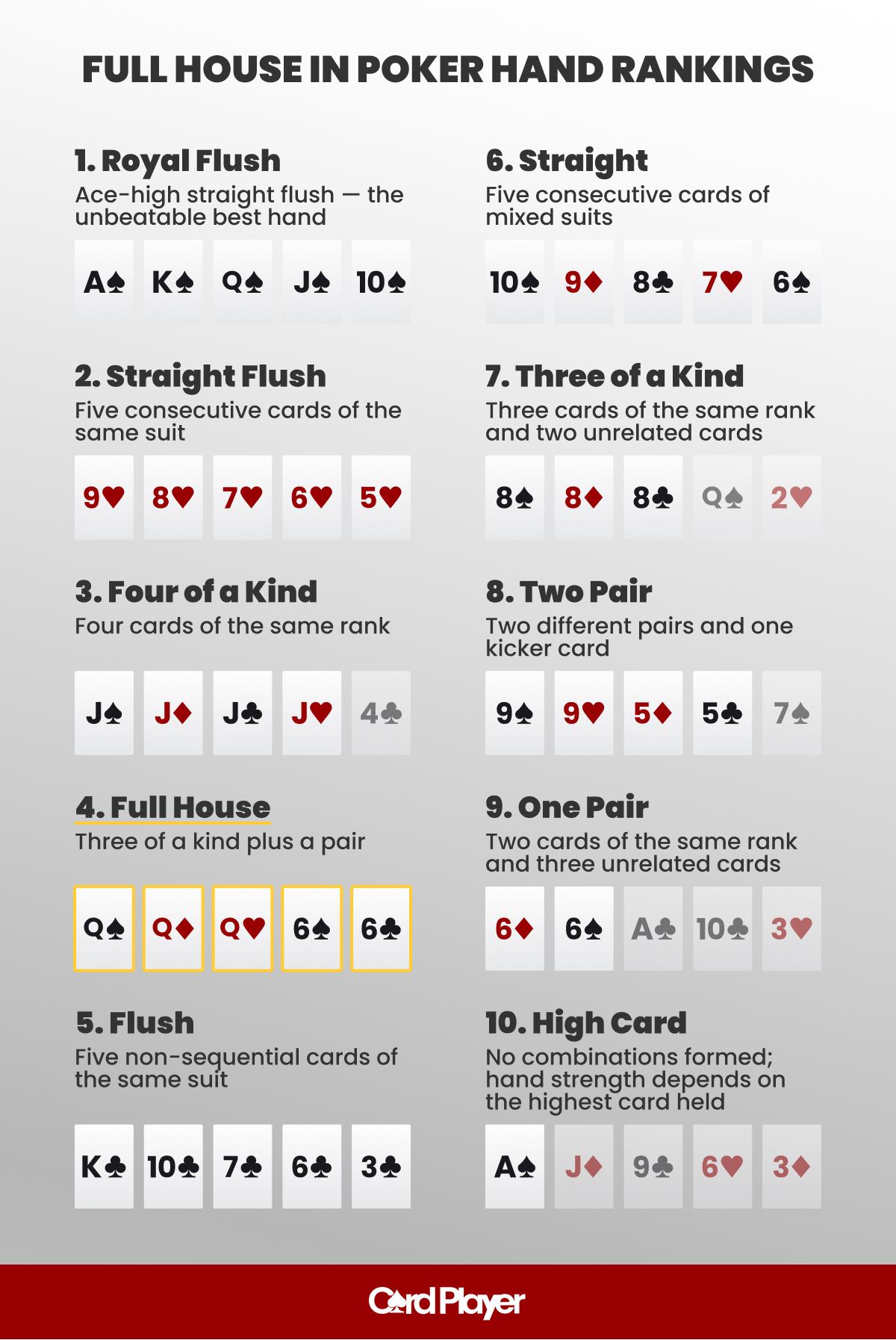
A full house ranks fourth in the standard poker hand rankings, making it one of the strongest hands you can have.
What Beats a Full House in Poker?
Only three hands beat a full house in poker: a royal flush, a straight flush, and four of a kind. These are all incredibly rare hands to make. For example, you’ll only make four of a kind an average of once every 594 hands.
Does a Full House Beat Four of a Kind?
A full house loses to four of a kind. In the poker hand rankings, four of a kind sits directly ahead of a full house. So, look out for quads, as it’s one of the few hands that can cause you any trouble.
What Does a Full House Beat in Poker?
When you make a full house, you’re crushing the vast majority of holdings.
A full house beats straights, flushes, three of a kind, two pairs, one pair hands, and high cards. This is why a full house is so strong. You’ll often be ahead in the pot and looking to get paid off by some of these weaker hands.
How Are Full Houses Ranked Against Each Other?
If two or more players have a full house, the winner is the player who has the highest trips. So, aces full beats kings full, which beats queens full, and so on.
If players have the same trips, the hand is decided by the pair. For example:
Player A: A♠️ T♥️
Player B: A♦️ J♣️
Board: A♣️ A♥️ T♣️ T♦️ J♠️
Both players have trip aces as part of their full house. Player A has aces full of tens. Player B wins the pot because they have a higher pair for aces full of jacks. If both players have the exact same hand, the pot is split.
Full House in Short Deck Poker
In most poker variants, full house poker rankings are the same. In Short Deck Hold’em, however, the order is flipped: due to the missing cards from the deck, flushes are rarer and ranked higher than full houses. This subtle change affects hand values, so take care when reading board texture in Short Deck.
Probability of Making a Full House
The reason a full house ranks where it does comes down to probability. So, how often do full houses actually show up? In a seven-card game like Texas Hold’em, the odds of getting a full house are 2.6% with a random seven-card hand. Not a unicorn, but not exactly every orbit either.
If you start with a pocket pair, you’ll flop a full house in poker a little less than one percent of the time – specifically, once in 102 deals.
The magic happens when you flop a set.
From there, you have about a one-in-three chance of improving to a full house or quads by the river. That’s where the money is. Flopping two pair is also a decent path, since you’ve got about a 16% odds of making a full house by the river.
While these percentages remain constant regardless of where you play, you’ll encounter full houses more frequently when playing online poker simply because the pace is much faster and you get to see more hands per hour.
| Scenario | Odds of making a full house |
|---|---|
| Any 7-card hand | ~2.6% |
| Pocket pair flops full house | ~0.98% |
| Flopped set → full house or better by river | ~33% |
| Flopped two pair → full house by river | ~16% |
Full House in Texas Hold’em vs Full House in Omaha
A full house ranks exactly the same in Texas Hold’em as it does in Omaha.
It loses to a royal flush, straight flush, and quads, while beating every other hand. The key difference is that both you and other players will make strong hands more often in Omaha.
Full houses occur more frequently in Omaha than in Texas Hold’em due to the extra hole cards. In Hold’em, a full house is often the nuts. In Omaha, a full house is still very strong, but is not always dominant, especially if there’s a higher possible full house or quads out there.
| Feature | Texas Hold’em | Omaha (PLO) |
|---|---|---|
| Hand Ranking | Same (Beats Flush; loses to Quads). | Same (Beats Flush; loses to Quads). |
| Frequency | Less frequent. | Slightly more frequent due to four hole cards. |
| Relative Strength | Often the nuts or close to it. | Very strong, but less dominant. |
| Risks | Lower full house beaten by higher full house on double-paired board. | Higher risk of a full house being beaten by a higher full house or quads. |
| Strategy Focus | Focus on maximizing value. | Focus on nut potential and board texture. |
Common Full House Scenarios
Let’s check out some classic full house scenarios that happen in poker.
A Monster House
Imagine you’re holding A♠️ A♥️. The board comes A♦️7♥️7♣️4♣️2♦️. Aces full. It’s a beautiful sight. You have a huge hand, only beaten by quad sevens. You’re ahead of all other full houses. Your main goal is to figure out how to extract the maximum number of chips from your opponent.
A More Vulnerable Full House Situation
Now, consider a different scenario. You’re holding 9♣️7♣️, and the board runs out 9♦️9♥️7♦️K♠️K♠️. You flopped the nuts with nines full of sevens, but the turn puts out a potentially bigger flush in K-9. The river then pairs, so any king now has you crushed.
A hand that looked invincible on the flop became vulnerable on the turn, then collapsed into a second-tier hand by the river. When the board double-pairs like this, the relative value of a lower full house can shrink faster than you think.
A Community Boat
Then there’s the full house on the board, also known as the community boat. The board reads A♠️A♦️8♥️8♠️8♦️. Everyone has eights full of aces. Your pocket kings are just pretty decorations. Keep in mind, however, that someone could have a higher full house here if they had an ace for aces full of eights.
Pro Tip: One of the best scenarios for making a full house is when you have a high pocket pair that makes a set on the flop. You’ll already have a very strong hand, and if you improve on the turn or river, you’ll likely have the nuts.
Playing Strong vs Weak Full Houses
Not all full houses are played the same. When you have the top full house on the board, you’ll nearly always bet for value. If you make a full house with a pocket pair, your hand will be well hidden, allowing you to get paid off by weaker hands.
But what about a smaller full house? In particular, double-paired boards make it more likely that an opponent has a higher full house, as they only need one hole card to complete the hand. In this case, more caution and pot control is required.
Always think about your hand strength relative to what your opponent could have on the board when making your decisions.
Tournament vs Cash Game Full House Strategy
A full house is a very strong, playable hand in both tournaments and cash games.
In tournaments, stacks are often shallow, so you should often be looking to play for stacks with a higher full house as soon as you can. Extracting value is the name of the game in full house poker strategy.
The exception is high ICM situations, such as near the money bubble. In this case, you’ll want to slow down with your vulnerable full houses to avoid busting.
Cash games, on the other hand, are a different world. Stacks are often deep, and there are no pay jumps. If you have a strong full house against a capped range, your goal is to get the other player’s entire stack.
On the other hand, with deeper stacks, you have more chips to lose when your low full house is beat, so pot control becomes even more important on a double-paired board.
Common Full House Mistakes
Here are the most common mistakes players tend to make with a full house in poker:
- Not betting or raising: A full house, especially a higher one, is often a winning hand. If you don’t bet, you’ll be missing out on loads of value.
- Slowplaying on wet boards: Sometimes checking one street can help you gain value later. But you shouldn’t slowplay a vulnerable full house on a wet board, as you’ll be giving away free cards.
- Overplaying weak full houses: Although full houses in poker are highly ranked, other players can still have you beat, particularly if you have a low full house on a double-paired board and someone is betting hard. Slow down and control the pot, or even be prepared to fold if you’re beat.
Why Is a Full House Called a “Boat”?
Players call a full house a “boat” or “full boat” in poker slang. The term connects to 19th-century poker circles, tracing back to riverboat gambling. The phrase full boat has stuck and is now used interchangeably with full house in poker.
FAQs
What does full house mean in poker?
A full house in poker is three cards of one rank and two of another. The trips determine the strength. Suits are irrelevant.
How strong is a full house in poker?
A full house in poker is very strong, but context is everything. Aces full is often the nuts. Lower full houses can be vulnerable depending on the board texture and action.
What beats a full house in poker?
A full house in poker is beaten only by four of a kind, a straight flush, and a royal flush. It beats everything else.
Does a full house beat a flush in poker?
Yes. A full house in poker beats a flush, and it also beats a straight, three of a kind, two pair, one pair, and high card. A full house is a monster hand.
Which full house is the strongest?
The strongest full house that can be made in poker is A-A-A-K-K, aces full of kings.
Does a Full House Beat a Straight Flush?
No, a full house does not beat a straight flush in the poker hand rankings. A straight flush is the second strongest poker hand, behind only the royal flush.
What are the odds of getting a full house in poker?
A full house in poker appears about 2.6% of the time in Hold’em in a random seven-card hand. Not super common, but you’ll see it every now and then. If you flop a set, you’ll improve to a full house or better about a third of the time.