Badugi may not be as popular as some other major poker variants, but that’s exactly what makes it worth learning. Since fewer players know the game well, it offers opportunities you won’t find elsewhere.
As competition in formats like Texas Hold’em and Omaha grows tougher every year, exploring a niche variant like Badugi can give you an edge. This lowball game is fun, challenging, and full of strategic twists you can turn to your advantage.
In this guide, we explain the rules of Badugi and provide practical strategies to help you get started.
How to Play Badugi Poker: Key Points
- Badugi is a draw poker game played with four cards.
- The goal is to make the lowest four-card hand with all different suits and no pairs.
- Hands are ranked by lowball rules – Ace is always low.
- Players can draw up to three times to improve their hands.
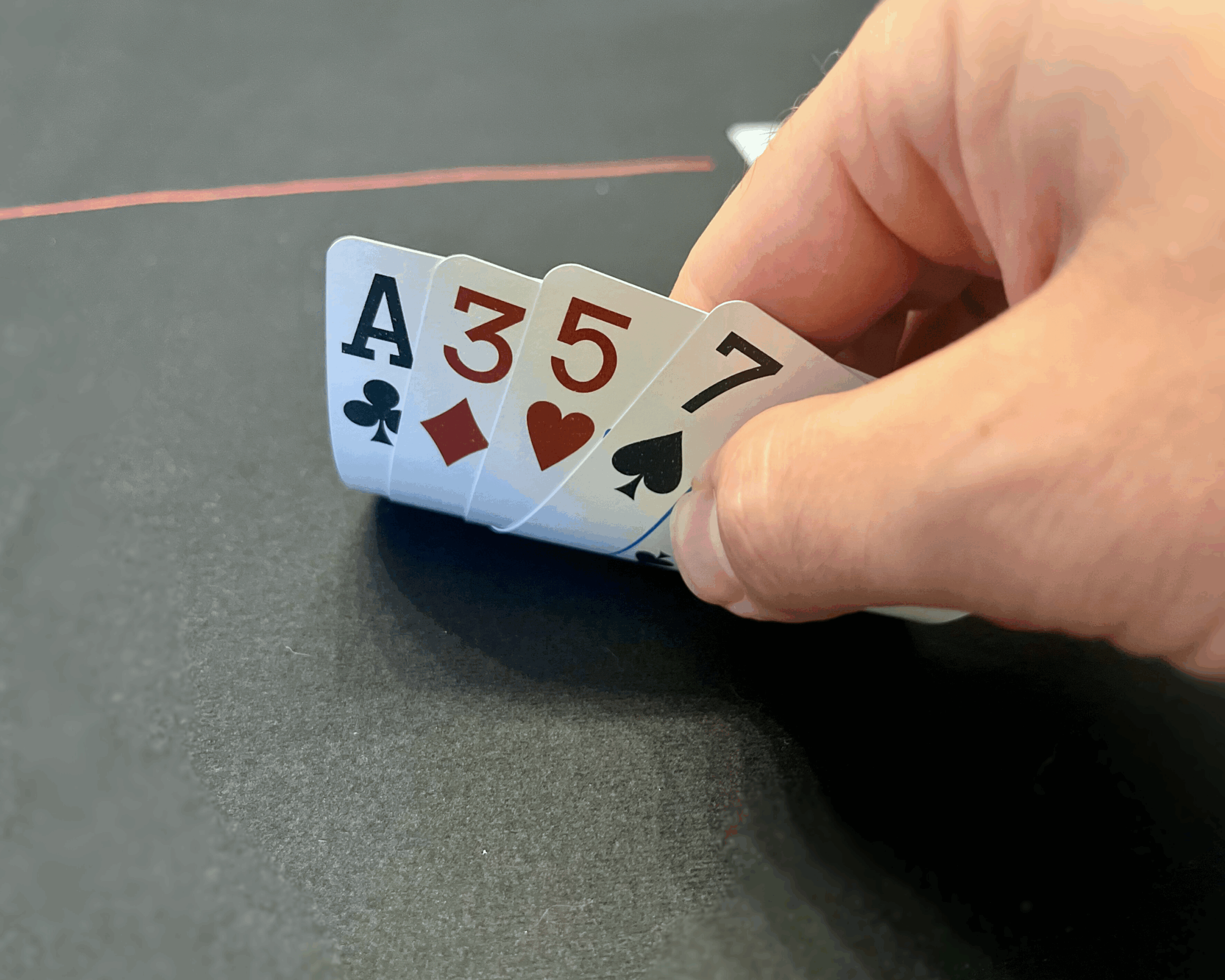
- A perfect Badugi hand is A-2-3-4 in four suits.
In This Guide
What Is Badugi Poker?
Badugi is a unique lowball poker variant that originated in Asia and has grown in popularity online. Unlike traditional poker or Texas Hold’em, the objective is to create the lowest hand possible with four unsuited, unpaired cards. A four-card “Badugi” is the strongest hand, while incomplete three- or two-card hands are weaker.
Badugi vs High-Hand Poker
Badugi is a lowball poker variant where the hand rankings are very different from high-hand games like Texas Hold’em. In lowball formats, low-value cards trump high-value cards.
For example, in Razz, a popular lowball game, the strongest possible hand is A-2-3-4-5. By contrast, the best hand in Hold ’em is a royal flush (A-K-Q-J-10 suited). This shows how lowball variants differ from their high-hand counterparts.
Like Razz, the best Badugi poker hands are made up of low-value cards. The very best hand is four different suits with no pairs. The ultimate holding is A-2-3-4, all unsuited. These contrasting goals and mechanics show why Badugi feels so different from Hold’em or Omaha.
The table below highlights the key differences:
| Aspect | Badugi | Poker (General) |
|---|---|---|
| Goal | Aim for the lowest unsuited hand | Aim for the highest-ranked hand |
| Draws | Allows up to 3 draws | Most formats do not allow drawing |
| Popularity | Niche; mainly played online | Very popular; dominates live casinos |
Badugi Poker Rules
If you’ve played Texas Hold’em or Five-Card Draw, you’ll pick up the basics of Badugi quickly. The betting structure works is identical to Hold’em, and the way you make hands is similar to Five-Card Draw.
Badugi isn’t exactly a hybrid of these two games, but keeping them in mind will make it easier to follow the rules and understand how the game flows.
Before we look at the example hand, let’s go over the rules of Badugi poker.
The Set-Up
- A betting round starts with one player posting the small blind and the player to their left posting the big blind.
- The dealer button is placed directly in front of one player, and this position rotates clockwise after every hand. The small blind is always immediately to the left of the dealer, and the big blind is to the left of the small blind.
- The blinds continuously move clockwise around the table.
Betting Structure
- Badugi poker games typically use a fixed-limit betting structure.
- The first two betting rounds use the value of the Big Blind as the minimum bet; e.g., in a $1/$2 game, the minimum opening bet is $2.
- In the final two betting rounds, the bet size doubles (in the same $1/$2 game, bets are $4.)
- Each player receives four cards dealt face down after the blinds have been posted.
- The player immediately to the left of the big blind is first to act.
The Action
- On their turn, every player has the option to call, raise, or fold. Additionally, players can check if a bet hasn’t already been made (the blinds count as a bet during the initial round of action).
- Players can hold or discard as many cards as they like. Discarded cards aren’t put back into the deck.
- There are three drawing rounds in total, and players must match the last biggest bet to remain active in a hand. Each draw is followed by a betting round, giving four betting rounds overall.
- To remain in the hand, a player must match the current bet before each draw.
Winning Hands
- A player wins the pot by being the last active person in the hand (i.e., they’ve made everyone else fold) or by having the best four-card hand at a showdown.
- Aces are low according to standard Badugi poker rules.
- Pairs and suited cards count against your hand. Therefore, the aim is to have low-value, unsuited, and unpaired cards.
Badugi Hand Rankings
Forget everything you thought you knew about traditional poker hand rankings – Badugi turns everything upside down and inside out.
As we’ve mentioned, Badugi is a lowball variant, which means low-value cards are better than high-value cards. The other caveat to remember is that pairs and suited cards count against the value of your hand.
The final rule governing the ranking of Badugi poker hands is what we call the four-three-two hierarchy. The best possible hand in Badugi is A-2-3-4. However, any four-card hand is desirable because it always beats a three-card or two-card hand.
Similarly, a three-card hand always beats a two-card hand, even if the two-card hand contains four low-value cards.
Hand Examples
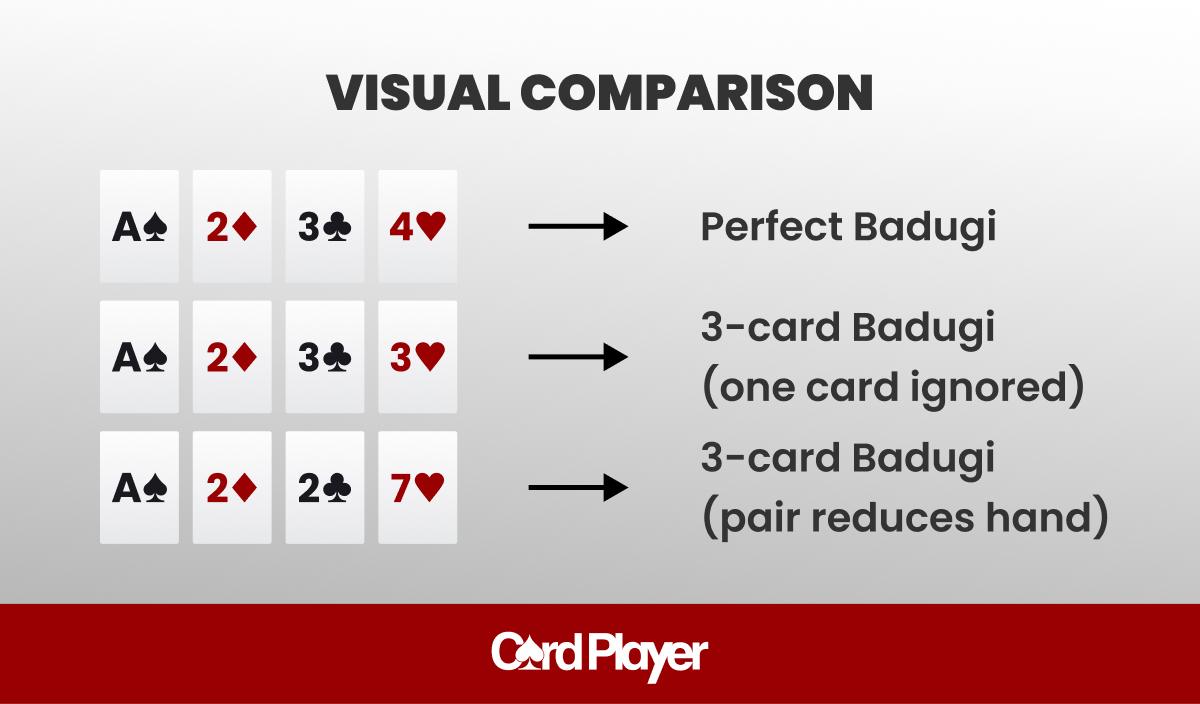
To illustrate this point, here are three Badugi poker hands:
- Hand 1: A♠️2♦️3♣️4♥️
- Hand 2: A♠️2♦️3♣️3♥️
- Hand 3: A♠️2♦️2♣️7♥️
Hand 1 is the best because all four cards are unsuited and unpaired. That’s a four-card Badugi.
Hand 2 is the second best. Since it contains a pair of 3s, one of them must be ignored. That leaves A♠️2♦️3♣️, which is a three-card Badugi.
Finally, Hand 3 is the weakest. It has a pair of 2s, so one of them must be ignored. The next possible Badugi here is A♠️2♦️7♥️ – also a three-card Badugi, but weaker than Hand 2 because the 7♥️ is higher than 3♥️.
Top 10 Badugi Poker Hands
Listing every possible Badugi hand would mean ranking all four-card, three-card, and two-card combinations – far too many for our guide. Instead, we will focus on the 10 strongest Badugi poker hands:
| Rank | Example |
|---|---|
| 1 | A♦️ 2♣️3♥️4♠️ |
| 2 | A♦️ 2♣️3♥️5♠️ |
| 3 | A♦️ 2♣️4♥️5♠️ |
| 4 | A♦️ 3♣️4♥️ 5♠️ |
| 5 | 2♣️3♥️ 4♠️5♦️ |
| 6 | A♦️ 2♣️3♥️6♠️ |
| 7 | A♦️ 2♣️4♥️6♠️ |
| 8 | A♦️ 3♣️4♥️6♠️ |
| 9 | 2♣️3♥️4♠️6♦️ |
| 10 | A♦️ 2♣️5♥️6♠️ |
The way Badugi poker hands are ranked is based on the highest-value card. If two hands contain the same high-value card, the next highest card is taken into account. That’s why A♦️ 2♣️3♥️5♠️ beats A♦️2♣️4♥️5♠️.
This rule applies all the way down, so take this into account when it comes to all holdings, including three-card and two-card Badugi hands.
Badugi Poker in Action
Those are the basic rules of Badugi poker. Now, let’s see them in action.
Sample Hand Walkthrough
- Blinds = $1/$2
- Number of Players = 6
- Small Blind = Seat 1
- Big Blind = Seat 2
- Button = Seat 6
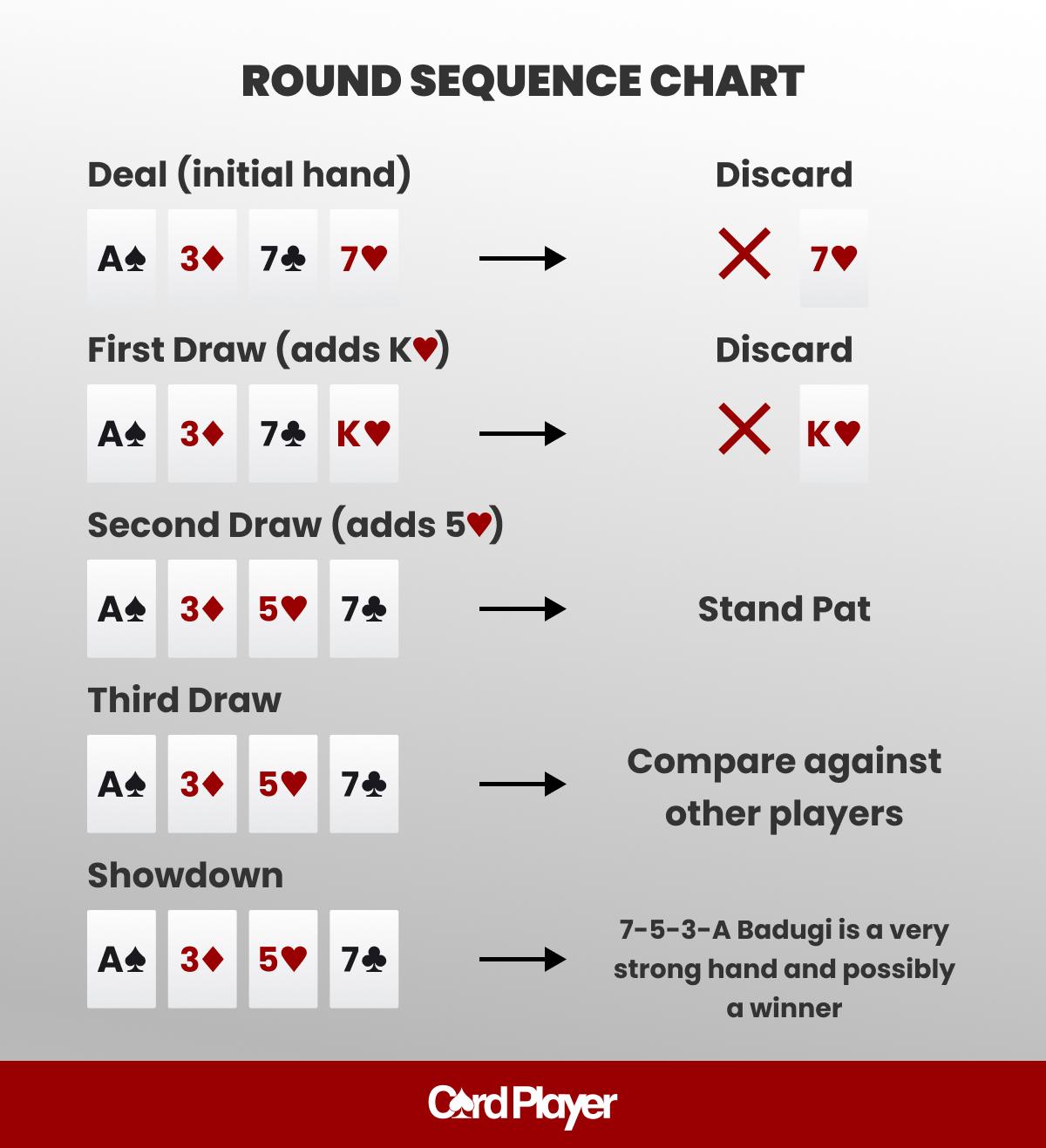
That’s the set-up.
Here’s an example hand using the above table dynamics:
Result = Seat 4 wins with a four-card Badugi since no suit repeats. A Badugi (four-card hand) always beats any three-card hand.
Badugi Poker Strategy
Like any form of poker, Badugi is a game of timing, logic, deception, and luck. While the game has unique rules, many universal poker concepts, such as position and bet sizing, still apply. With this in mind, here are some essential Badugi strategy tips for beginners.
1. Start Strong, Not Weak
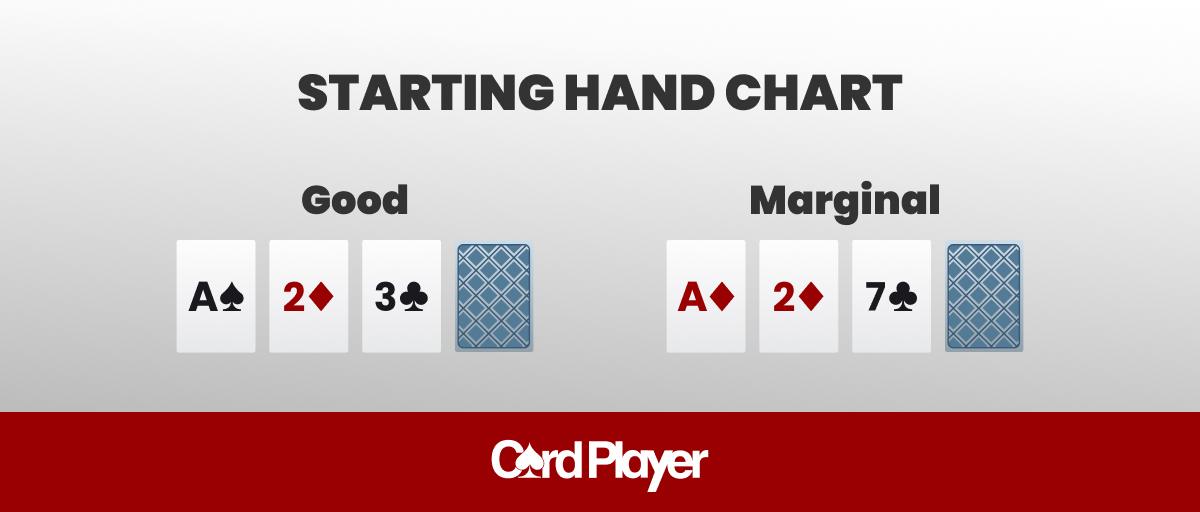
A strong starting hand in Badugi contains few suited cards or pairs. This means the very best starting hands don’t contain any matching suits or pairs.
A simple decision-making hierarchy for assessing starting hands is as follows:
- Does it contain at least two low-value cards?
- Does it contain no more than two suited cards or a pair?
If the answer to those two questions is yes, the hand is generally worth playing. If only the first condition is true, the decision often depends on table position and previous betting action.
One final thing to note is that you should always be aiming for a four-card Badugi hand. Even if you shoot for the stars and miss, you could still end up with a strong three-card hand that might win a showdown.
2. Know Your Badugi Poker Odds
If we look at some Badugi odds, you can see that you’re more likely to have a three-card hand on the first draw than anything else:
- Four-Card Badugi Hand = 6.3%
- Three-Card Badugi Hand = 57.0%
- Two-Card Badugi Hand = 35.6%
- One-Card Badugi Hand = 1.1%
You’ve got a 51% chance of turning a three-card hand into a four-card Badugi by the final draw. However, in all likelihood, you’ll finish with a three-card hand. That’s where you need to think about the cards you’re holding.
If we assume that, on average, you’ll finish with more three-card hands than any other, you should make sure the three cards are as low as possible.
3. Use Position to Your Advantage
Play more hands in position than out of position. It really is that simple. Playing in position, i.e., in a spot that’s close to the button, gives you the power of information. Watching other players act gives you a better idea of what they might have, and in turn, what might happen in the future.
For example, holding a weak hand on the button after everyone else has folded creates an opportunity to raise. The blinds are forced to act with random hands, and will be out of position, making them more likely to fold.
In contrast, if there’s been a bet, raise, and re-raise before the action gets to you on the button with the same hand, it’s an easy spot to fold. The key principle is to maintain a tight range in early position but be willing to widen that range the closer you are to the button.
4. Don’t Be Afraid to Bluff
The secret to bluffing in poker is being able to tell a consistent and convincing story. Position is also important, but you can tell a believable story from any spot at the table if you’re willing to play a high-risk strategy.
A common strategy is to raise pre-flop from a late position and stand pat. This signals to your opponents that you’ve got a strong hand, even if you’ve got four weak cards. Starting on the front foot allows you to continue being aggressive on subsequent betting rounds, adding to the consistent story you’re telling (i.e., that you’ve got a good hand).
Of course, this approach will not succeed every time. However, if you choose the right time and opponents, bluffs like this have the potential to pay off. Several of the best online poker sites also feature Badugi games, giving players a chance to practice these moves in real situations.