







How to Play 5 Card Draw Poker: Five Card Draw Rules & Strategy Guide
Five Card Draw is one of the simplest poker formats to pick up, and a home game favorite. There is always a lot of nostalgia around this poker variant, mainly because, before Chris Moneymaker and the rise of televised WSOP coverage in the early 2000s, it was the first poker game most players learned to play.
This guide breaks down Five Card Draw rules step by step, making it easy for beginners and experienced players alike to understand how the game works.
Five Card Draw: Key Points
- 5 Card Draw is easy to learn but offers strategic depth for all skill levels.
- With all the cards hidden, you must read opponents based on their draw decisions.
- Winning requires selecting strong starting hands, smart discards, and deceptive play.
- This fast-paced game is ideal for learning poker fundamentals and is the basis of video poker and many popular variants.
What Is 5 Card Draw Poker?
5 Card Draw is a classic draw poker game where each player is dealt five private cards and has one opportunity to discard and replace cards in an attempt to make the best possible hand.
The game traces back to 19th-century American saloons and riverboats and was one of the earliest games featured at the WSOP.
Editor Tip:
Five Card Draw is poker in its most straightforward form. Because it’s so simple, it’s perfect if you are just starting to learn the game.
It’s easy to pick up, with intuitive Five Card Draw rules and a quick pace that keeps both newer and experienced players engaged. The game is really just about your own cards, one chance to swap them, and simple betting.
While it’s no longer as popular in casinos today as Texas Hold ’em or Omaha variants, Five Card Draw remains a staple in home games, online poker rooms, and, of course, video poker machines.
This comprehensive guide helps you explore how to play Five Card Draw poker – we’ll go through 5 Card Draw poker rules, standard hand rankings, talk about some beginner strategy tips, cover common mistakes you’ll want to avoid, and even throw in some online play advice.
Five Card Draw Poker Rules (Quick Overview)
Five Card Draw is a draw poker game where each player is dealt five private cards.
You use a regular 52-card deck and usually play with anywhere from 2 to 6 players. No extras, no special cards, just regular poker the way it was meant to be played. After the initial betting, players discard cards they don’t want for fresh ones, then there’s another betting round, and then the hands are revealed to determine who won.
Other rules of Five Card Draw are quite flexible, and there are many different ways to set up the game.
Since all the cards in Five Card Draw are private, players need to use the number of cards the other players draw and the way they bet their hands before and after that draw to try and glean a little info about what they might be holding.
It’s a deceptively simple format that you can learn in 10 minutes, but it will take time to master.
How Do You Play Five Card Draw Poker? (step by Step)
Here is a step-by-step breakdown of the rules, from how to deal 5 Card Draw to showdown.
Step 1: The Ante & the Deal
Forced bets are always used in poker to start the action.
Games usually begin with either all players chipping in a little bit or two people making the required bets. Sometimes both blinds and antes are used to generate more action (most common in tournaments).
While this can happen in poker 5 Card Draw, it’s not the most common setup.
After blinds or antes are posted, each player receives five private hole cards. Everyone gets a turn being the dealer – it just moves one player to the left each time.
Step 2: The First Betting Round
In the few times we have seen 5 Card Draw spread in a casino, the under-the-gun spot is left of the Big Blind, but in the hundreds of home games we’ve seen, action begins to the dealer’s left in ante games, or under-the-gun in blind games. In a fixed-limit game, there can usually be up to 4 bets (a bet and three raises) per betting round. A player may check, bet, raise, or fold.
Step 3: The Draw (exchanging Cards)
You can keep all your cards or swap out as many as five.
Players take turns getting rid of cards, beginning with whoever’s sitting left of the dealer, and they get new cards in the same order. Some places have rules that limit you to swapping just 3 or 4 cards instead of all 5.
Some casual games have a rule where you need to prove you have an ace if you want to swap four cards.
Step 4: The Second Betting Round
After the draw, another round of betting follows, in the same order.
Step 5: The Showdown & Winning the Hand
When at least two players are still in after all the betting, everyone shows their cards. The last player to bet or raise shows their hand first. If no one has bet that round, the showdown starts left of the dealer. The highest poker hand wins. Identical hands (rare for winning hands in 5 Card Draw split the pot.
Hand Rankings in 5 Card Draw Poker
To succeed, you first need a rock-solid understanding of 5-card poker hand rankings. Here are the hands from strongest (Royal Flush) to weakest (high card):
- Royal Flush – A♠ K♠ Q♠ J♠ 10♠
- Straight Flush – Five consecutive cards of the same suit.
- Four of a Kind – e.g., 9♥ 9♦ 9♣ 9♠ J♠
- Full House – e.g., Q♥ Q♣ Q♠ 7♦ 7♠
- Flush – Five non-sequential cards of the same suit.
- Straight – Five consecutive cards, any suits. A-2-3-4-5 is a valid straight, with the Ace playing low.
- Three of a Kind – e.g., 5♥ 5♦ 5♣ K♠ 2♠
- Two Pair – e.g., J♥ J♣ 4♦ 4♠ 9♦
- One Pair – e.g., A♣ A♦ 7♠ 5♥ 2♣
- High Card – No pair or better; ranked by the highest card.
These hand rankings are standard, and knowing them is the basis not just for 5 Card Draw but for most variants of poker.
Betting Structures in 5 Card Draw Poker
5 Card Draw can be played in several formats:
- Fixed Limit: Bet sizes are pre-determined. In a typical fixed-limit game (e.g., $2/$4), the small bet is used before the draw, and the big bet is used after. Alternatively, one bet size can be used for both betting rounds. In fixed-limit games, betting rounds are typically capped at one bet and three raises.
- Pot Limit: Players may bet up to the current size of the pot.
- No Limit: Players can bet any amount up to their entire stack of chips.
Each structure affects your strategy and overall risk. With Fixed Limit, the pots stay smaller, and people bluff less often. You can play more aggressively with No Limit, but you’d better be good at managing your chips.
No matter which betting style you choose, Five Card Draw rules don’t change – just the bet amounts.
Five Card Draw Drawing Strategy
Learning how many cards to keep and how many cards to draw is one of the pillars of a good Five Card Draw strategy.
How Many Cards Should You Draw?
The number of cards you should draw primarily depends on the cards that you are holding.
Most of the time, you’re trying to give yourself the best chance at getting a strong hand. However, the advanced 5 Card Draw strategy may include deceptively drawing fewer cards than mathematically optimal in order to represent a stronger or weaker hand than the one we are actually holding.
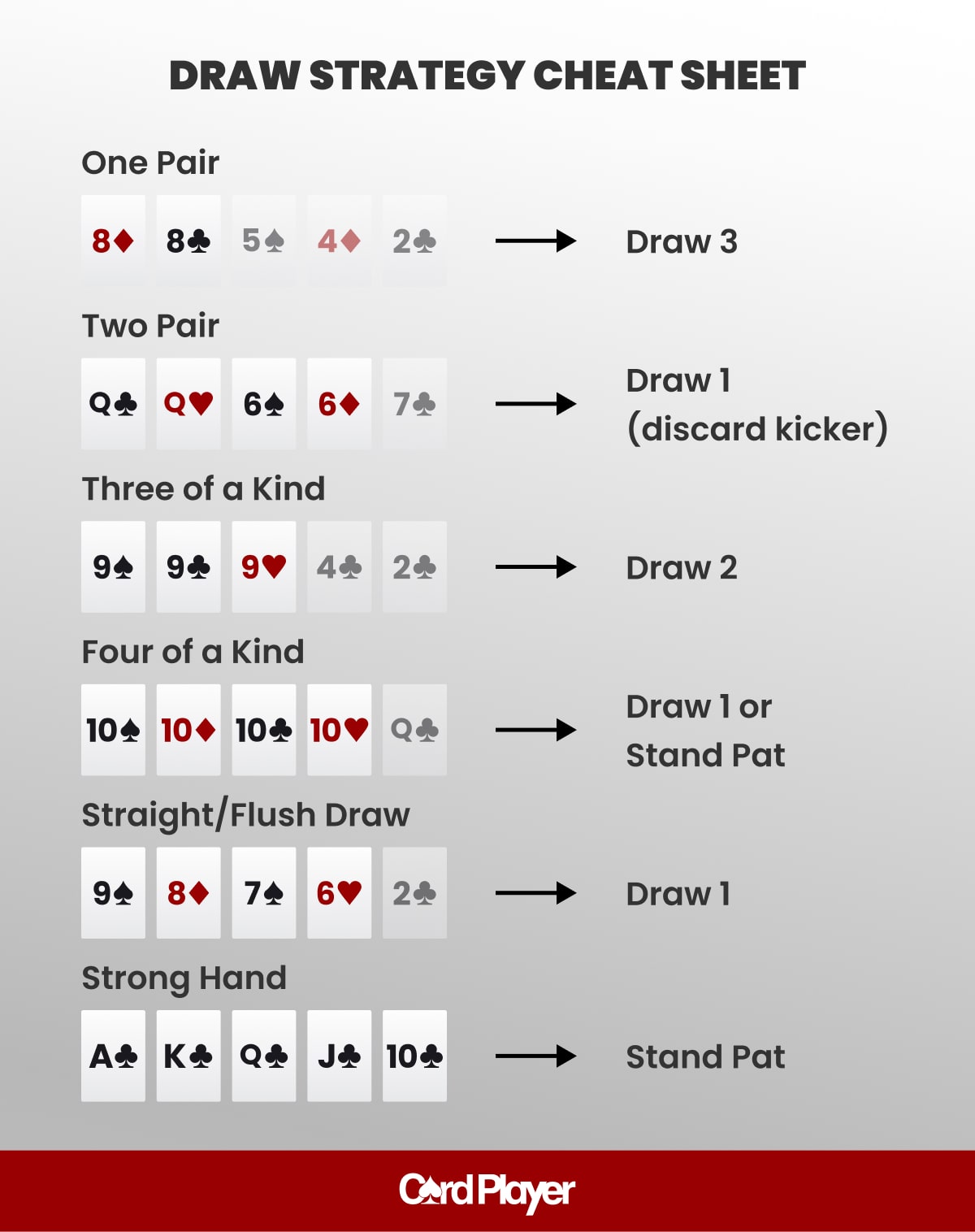
Drawing Strategy by Starting Hand
- One Pair: Discard three cards and draw three.
- Two Pair: Discard the kicker and draw one.
- Three of a Kind: Discard two and draw two to go for a full house or four or a kind.
- Four of a Kind: You cannot improve this hand significantly, but drawing one card is often better than standing pat because it disguises the strength of your hand and looks more like you are on a draw.
- Straight/Flush Draws: Discard one if you’re one card away; don’t fall for inside straight draws; they only hit 8.5% of the time. Four-card open-ended straight draws have about a 17% chance of hitting; flush draws have about 19%.
- Stand Pat: If you already have a strong hand (e.g., straight, flush), don’t draw.
Like in many poker variants, you should play more hands in position (being last or near last to act), and use the information about how your opponents bet and how many cards they draw. You will soon gain insight into their hand strength, especially if they’re beginners, and figure out their bluffing style if they’ve been playing for a while.
Common Mistakes to Avoid in Five Card Draw
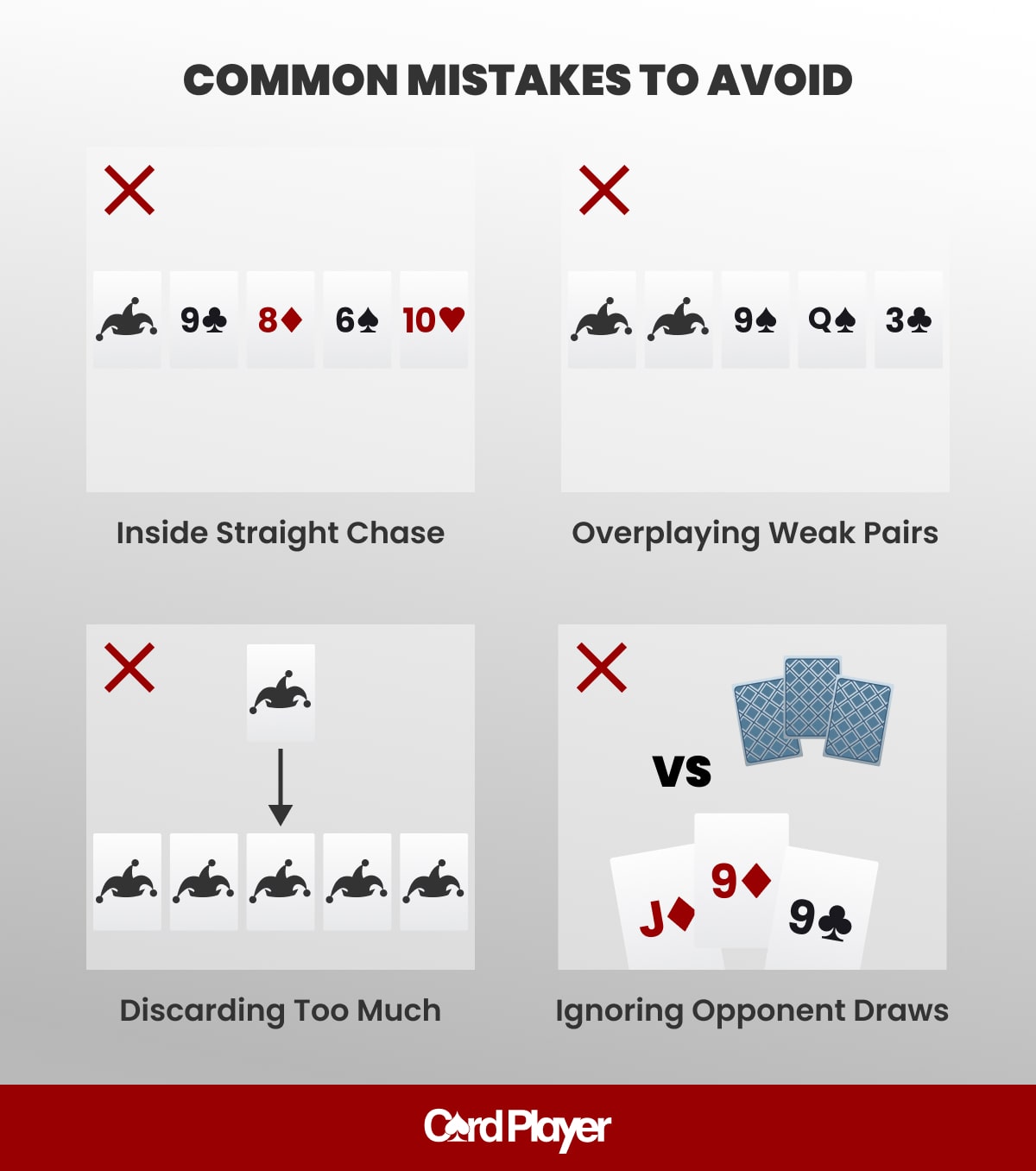
- ⛔ Drawing to inside straights: They will only pay off about 1 in 12 times. Even if we make our hand, our opponent could make a better hand, like a higher straight, flush, or full house. In short, inside straights are just not worth it.
- ⛔ Overplaying weak pairs: Especially in early or mid-position.
- ⛔ Drawing more than necessary: Overdrawing can tip your opponent to your hand.
- ⛔ Ignoring opponent behavior: As a game played by beginners, many beginners concentrate on playing their 5 Card Draw poker hands instead of playing against their opponents.
- ⛔ Failing to fold: Walk away from weak hands; it’s not about winning each hand. It’s about having winning sessions.
If you focus on preventing these mistakes, you’ll already be on your way to a solid 5 Card Draw strategy.
Playing Five Card Draw With Two Players
Let’s take a quick look at how to play 5 Card Draw with just two players. 5 Card Draw is a fun and interesting heads-up format. Facing only one opponent requires us to adjust our strategy quite a bit.
Widen your range
As in any poker variant, heads-up play affects hand strength dramatically, and most players don’t adjust enough. We can’t afford to fold nearly as many hands, because the odds of our opponent’s hand being stronger are much lower than with multiple opponents. A high-card hand (no pairs or better) could easily be the winning hand heads up.
Pay attention to discards and tells
The fact that players fail to adjust to heads-up correctly is a great opportunity for a more psychological, read-based game.
As usual, how many cards your opponent draws – and how they bet after the draw – is your main source of information. Fewer cards drawn usually signal strength – but in heads-up, we can afford more deception. Some players will use it, others will continue to expect a straightforward, card-strength-based game, with high pairs and better at showdown.
You can use those tendencies against them.
Bluff and counter‑bluff
In heads-up poker, we can’t hide behind tight play – we are simply forced to defend with a wider range, as well as bluff and even re-bluff more frequently. A 5 Card Draw battle has plenty of room for that – it can be as engaging and intense as any heads-up poker.
Five Card Draw Vs Other Poker Games
While Five Card Draw was the first game many of us learned, it clearly doesn’t hold the popularity of tournament and cash-game favorites like Hold’em and Omaha. It is a rare game to find in casinos, even as part of mixed games in public card rooms.
But this doesn’t negate the impact 5 Card Draw had on poker’s history and its ongoing place in casual home games. It also remains the basis of all video poker, a popular casino classic.
Five Card Draw Vs Five Card Stud
Many people mix up the two by name, but Five Card Draw and Five Card Stud are two very different games. Five Card Stud is thought to be the oldest variant of poker; it was very popular in the 19th and early 20th century. Modern stud variants do exist and are staples of mixed games, such as 7-Card Stud, Stud Hi-Lo (often played as Stud 8 or Better), and Razz (a lowball variant of stud).
The main difference between stud and draw poker is that stud has a mix of private so-called downcards and visible upcards, while draw poker only has private cards. Stud has more streets and betting rounds – after the initial deal, each subsequent card is dealt separately, with another betting round. Five Card Stud had one downcard and four upcards, while modern (seven-card) stud variants feature three downcards and four upcards.
Strategy: Five Card Draw is based on drawing strategy and reads, while Stud is more about understanding how odds change based on all revealed upcards (the board).
5 Card Draw Vs Texas Hold’em
Texas Hold’em is by far the world’s most popular poker variant, and for good reason. It offers a great balance of mystery, information, and high pressure both as a tournament and cash game variant. In Hold’em, players get dealt only two private cards and have to make a hand using those two cards and five community cards.
5 Card Draw was the first poker game many of us learned, and understanding how to play 5 Card Draw for beginners remains a great way to learn about poker.
It plays the quickest and is both simple and complex enough to be fun for players of all levels. While 5 Card Draw will likely never catch up with Texas Hold’em as a competitive variant, it more than contributes its share as a home game variant.
Author’s Tip:
Many of us long-time players believe diversity of games is one of poker’s biggest strengths, and whether it’s draw poker, hold ’em, stud, or any other variation, every new game sharpens different card skills and helps keep poker exciting and engaging.
Variations of Five Card Draw Poker
Some variations of draw poker have a much more prominent place in tournament poker and mixed cash games, especially lowball variants.
Lowball Variants
In all lowball poker variants, the lowest hand wins. Kansas City Lowball, more frequently called Deuce-to-Seven (2-7), uses deuce-to-seven rules (2-3-4-5-7 is the best hand), where the ace counts as high and straights and flushes count against the winning hand. California Lowball uses ace-to-five rules (A-2-3-4-5 is the best) – flushes and straights are allowed. There are other variations of lowball draw games, such as Badugi, Badeucey (mix of Badugi and 2-7) Badacey (mix of Badugi and California Lowball). Draw games are a big part of poker, and 5 Card Draw was the first popular version.
Some other variations of poker 5 Card Draw:
- Jacks or Better: Requires at least a pair of jacks to open betting. If no player opens with a pair of Jacks or better, the hand is redealt. This variant exists in regular Five Card Draw, but is also the basic and most popular format of video poker.
- Joker Poker: In Joker Poker, one joker acts as a wild card. House rules may define how it can be used.
- Deuces Wild: All twos are wild; higher hand values are needed to win due to all the wild cards.
Most online platforms automatically enforce Five Card Draw rules, reducing errors and making the game easier for beginners to follow.
Playing Five Card Draw Poker Online
You can find Five Card Draw online at select poker sites. While less common than Texas Hold’em, many platforms offer it in cash games or in mixed-game rotations.
Benefits of online play: Online games move much faster than live games and eliminate physical tells. You have the opportunity to practice strategies in low-stakes or free-play options. Free or very low-stakes games, let us practice our strategy without risking a significant amount of our hard-earned bankroll.
Complete Example Hand (from Deal to Showdown)
Let’s now do one full walkthrough of a poker Five Card Draw hand.
The Deal
Joe, Magda, and Dusty are playing a $2 Fixed-Limit 5 Card Draw with antes. Dusty is on the dealer button. Joe is on Dusty’s direct left and will be the first to act.
Joe: Th Ts 9s 8s 6h.
Magda: As 5h 5c Kd Qs
Dusty: Jd 5d 6d Td 6c
First Betting Round
Joe bets with his pair of tens, and both opponents call.
Draw Decision
Joe has a pair of tens, an inside straight draw, and a three-card straight flush draw with Ts 9s 8s. Knowing a good strategy, Joe decides to keep the pair of tens and discard, and draw 3 cards.
Magda discards three high cards and keeps the pair of fives.
Dusty has a pair and a flush draw. He breaks up his pair to go for the flush, discarding the 6c.
Final Hands
Joe: Th Ts Ad 9h 3d
Magda: 5h 5c 7d Js Qh
Dusty: Jd 5d 6d Td Ks
Joe checks. Magda bets as a bluff. Both opponents fold.
Results & Explanation
Each player draws correctly based on their pre-draw hand. They all failed to improve with the draw. Using her read on her opponents’ betting and drawing, Magda decided to bluff with a weak pair of fives.
Since Dusty just called in the first betting round and then drew one card, she thought he was most likely on a straight or flush draw, which misses most of the time.
Magda thought Joe likely failed to improve since he did not bet after the final betting round. A pair of fives was not likely to win, so she used her reads to try to win with a bet, which worked out.
Of course, if Joe was a more stubborn player who thought Magda was a frequent bluffer, he might still call with his pair of tens.
Conclusion
Whether you’re just learning how to play Five Card Draw poker or are a hardened poker veteran, this variant is fun and challenging for every skill set. This poker variant has remained a popular choice over the decades because it offers a perfect blend of simplicity and strategy.
Since all cards are private, we have very little information other than what we can glean from another player, and, of course, the drawing round. A solid 5 Card Draw strategy needs good hand selection and relies on keen observation of opponents. Your ability to lay down a master bluff while playing this game will depend on those reads.
The best way to improve? Practice. Play online for free or cheap, or set up a home game with friends. With some time and practice, you’ll get to master how to play Five Card Draw – exactly when to hold ’em, draw three, or stand pat.
FAQs
What is 5 Card Draw?
5 Card Draw is a simple variant of poker where players receive 5 cards each, and have one opportunity to discard and draw new cards to make the best possible hand. While house variations exist, standard Five Card Draw rules include one draw, two betting rounds, and no community cards.
How do you play 5 Card Draw?
Basic 5 Card Draw rules are easy; everyone gets five cards that only they can see, then betting starts. After that, players get the chance to discard some of their cards and get dealt new ones. After the second betting round follows, the best hand at showdown wins.
How many cards can you discard in 5 Card Draw?
The number of cards that can be discarded depends on house rules. Some allow all five cards to be discarded, while a limit of 3 cards is also common. Some games allow swapping up to four cards, but only if the fifth card is an ace.
How many 5 card poker hands are there?
There are 2,598,960 unique five-card hand combinations out of a 52-card deck, but many are equivalent in value (e.g., a pair of queens) and require the same strategy.
How does 5 card poker work?
5 card poker is simple. Antes are used to generate action, and it has two betting rounds. Players are allowed to discard some of their cards to try to make a better hand with new ones.
What is the best hand in 5 Card Draw?
The best 5 Card Draw hand is the Royal Flush.
Can you bluff in Five Card Draw?
Yes, knowing when to bluff is a big part of playing well. The best time is usually when it looks like other players have weak cards.