







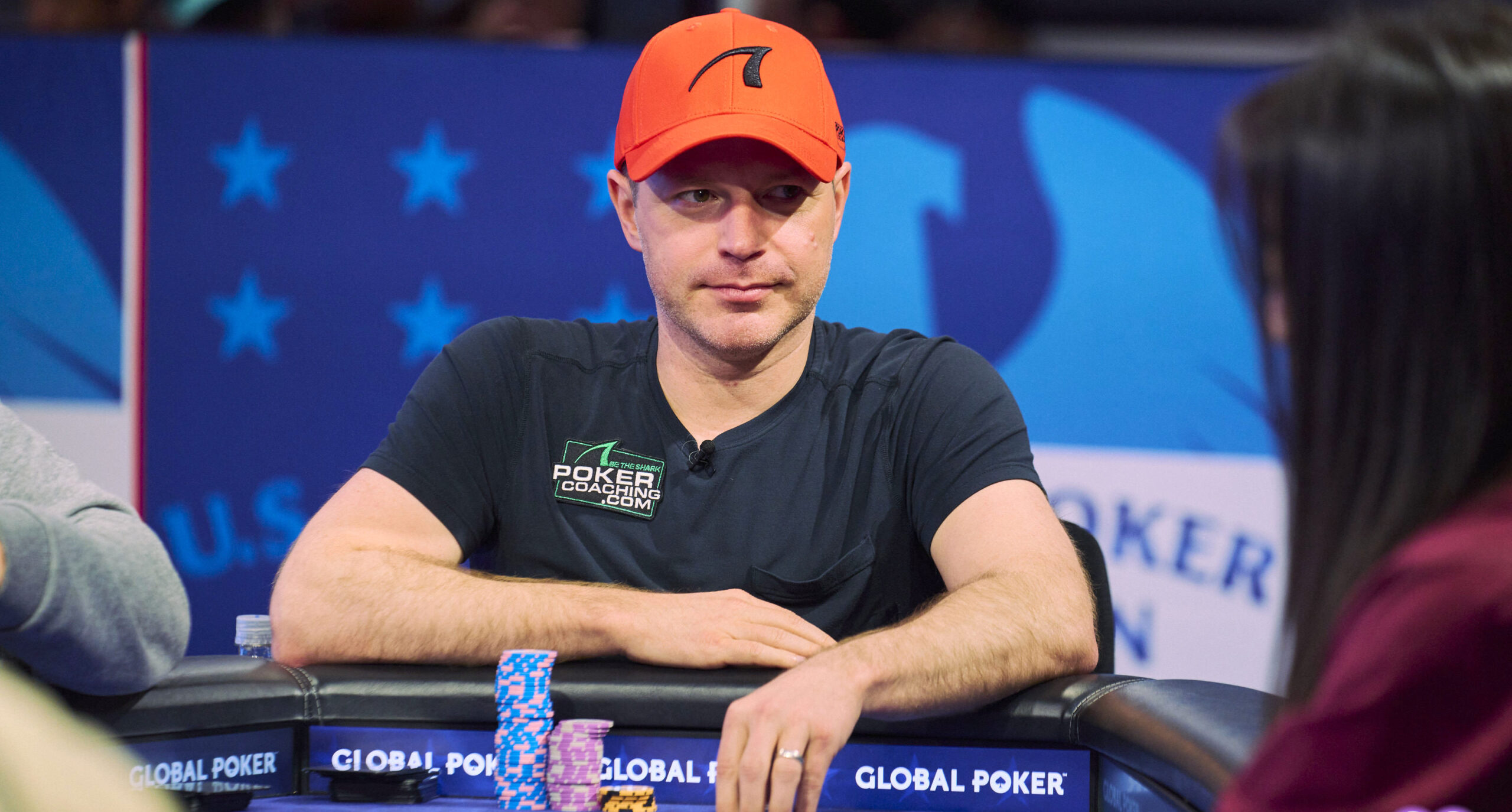
 If you want to increase your poker skills and learn to crush the games, check out Jonathan Little’s elite training site at PokerCoaching.com/CardPlayer.
I recently played a fun hand in a $5,000 buy-in tournament in the PokerGO studio that illustrates a concept you must master if you want to succeed at tournament poker.
With blinds at 1,000-1,500 with a 1,500 big blind ante, everyone folded to me in the hijack seat and I raised to 3,000 out of my 60,000 effective stack with 9♠9♦. The action folded around to a good, aggressive player in the big blind who three-bet to 10,500.
At this point, I could either go all-in or call. Folding would be much too tight. The only time folding would be reasonable is if I was sure my opponent’s range was overly strong, perhaps 10-10+ and A-K.
Calling is the GTO play, allowing me to see the flop before I invest too much more money.
If I expect my opponent to fold to an all-in too often either because they are tight when calling all-ins, or I think their three-betting range is overly wide, going all-in becomes the best option. While an all-in will result in me going broke whenever my opponent has an overpair or wins a flip, it will also ensure I do not make a post-flop mistake of folding the best hand, while also forcing many hands with 50% equity (like A-J and K-10) to fold.
This time I decided to call. The flop came 10♦8♣3♣ and my opponent bet 7,500 into the 23,500 pot.
Again, 9-9 is simply too strong to fold. In general, when the preflop three-bettor makes a small flop continuation bet, you can be somewhat sure you are against your opponent’s entire range, which includes many strong preflop hands that you crush, such as A-K, as well as all the potential bluffs, like 7-6 suited. You may also be against a hand like 8-7 or A-3 that is betting for value and protection.
Knowing this, calling was the best play. The main problem with going all-in is that my opponent will fold most of his worse hands that I crush and will call with all his strong hands that crush me. Clearly that is not a great spot to be in.
I called. The turn was the 3♠ and my opponent bet 21,000 into the 38,500 pot.
What a dicey spot! When the opponent keeps betting, you can be quite certain that he either has top pair or a better made hand, a draw, or a total bluff. When you have a marginal made hand against a polarized range, it makes sense to either call or fold because if you raise, you will only get called when you are crushed.
Situations like this are interesting because some players will bet the turn with only their strong hands, others will bet the turn with all their bluffs but will not continue bluffing on the river, while some will bluff on the turn and river. It is difficult to know what to do! However, if you are aware of your opponent’s tendencies, you can get well out of line to exploit them.
I called. The river was the 10♥, and my opponent checked.
Given my opponent either has an overpair that will not fold to a bet or a junky hand, it does not make sense to bet because the hands that beat me will always call and the hands that I beat will always fold. While I should certainly not expect to win every time when showing down 9-9, checking behind is by far the best play, especially since if I lost, I would still retain a manageable 21,000 stack that I might be able to nurse back to health.
I checked and won against my opponent’s 7-5 offsuit.
That was not what I was expecting to see! By not pushing all-in preflop or by raising post-flop, I allowed my opponent to continue bluffing with a hand that was drawing dead. Sometimes poker is easy!
If you want more resources to help you improve your game, I put together a course called Master the Fundamentals. This course covers the basics, preflop, post-flop, multiway, turn and river strategy, and much more. This course is completely free inside Card Player Poker School!
When you join the Card Player Poker School (it’s free to join), you’ll also get:
- Free Downloadable Preflop Charts
- GTO Preflop Charts
- Video Classes
- Interactive Hand Quizzes
- Free Course: Master The Fundamentals
- Free Course: The 25 Biggest Leaks And How To Fix Them
- Free Training Every Week
 Jonathan Little is a WSOP bracelet winner, two-time WPT winner, and the 2024 PokerGO Cup champion with nearly $9 million million in live tournament earnings, best-selling author of 15 educational poker books, and 2019 GPI Poker Personality of the Year. If you want to increase your poker skills and learn to crush the games, check out his training site at PokerCoaching.com/cardplayer.