







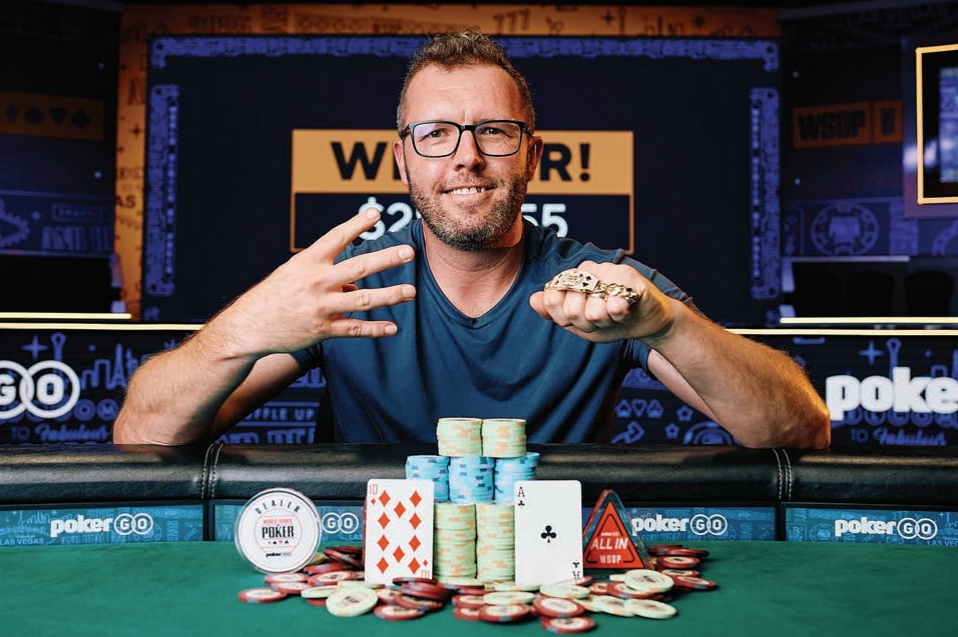
 Ian Johns grew up in Seattle, Washington in a bowling-obsessed family. Both parents worked in and/or owned a bowling alley from the time he was born until their retirement in 2023. Both alleys had a cardroom, and his parents spent countless hours in them, playing mostly just for fun, but also as a way to promote their business. They were essentially their own props.
Ian’s poker journey began in 2003 during the tail end of his senior year of high school with friends in his parents’ garage, cards spread out on the family pool table. He was quickly obsessed and read every book and forum he could find. By the next summer, he was already racking up cash online.
Just a few years later, Johns showed the poker world that he was one of the top limit hold’em players around, taking down the World Series of Poker $3,000 limit event. In 2016, he won two more bracelets, finishing first in the both the $1,500 H.O.R.S.E. event and the $10,000 limit hold’em championship.
Over the years Ian played tons of live cash games in Seattle, Las Vegas, Los Angeles, and now Austin, Texas where he currently resides. Most recently, Johns won the WSOP $10,000 limit championship for a second time, bringing his bracelet count to four and giving him more than $2 million in career tournament cashes.
Card Player caught up with Johns to break down a couple key hands from his latest victory.
Event: WSOP Limit Hold’em Championship
Buy-In: $10,000
Entrants: 118
Prize Pool: $1,097,400
First-Place Prize: $282,455
Craig Tapscott: Can you set this final table up for us? It was stacked with some great players like Daniel Negreanu, Anthony Zinno, and Viktor Blom. What was your plan coming in?
Ian Johns: Coming into the final table, my plan didn’t change at all. When I sit down to play any poker tournament I focus on playing solid, playing aggressively, and not making mistakes. I focus on hand reading, and try not to make impulsive decisions. These are the self-talks I give myself whether it’s day one at 3 pm or day 3 in the middle of the final table.
I’m always looking to essentially wait people out, and that was my approach at the final table. Don’t do anything stupid, bide your time, stay afloat, and wait for things to start going your way.
Does that always work? Of course not, but I think trying to press the issue too much can lead to so many negative outcomes that I try to stay away from that approach.
Luckily for me, I had loads and loads more experience than each of my opponents once we got to four-handed play.
Craig Tapscott: What are some of the keys to excel at short-handed play in limit hold’em?
Ian Johns: You have to stay balanced. You have to find ways to make your betting actions consistent and sensible across a wide array of holdings you may have, because you’re forced to play hands that are much wider than your typical ring game hand ranges. A call can’t always be weak, and a raise can’t always be strong. Mixing things up will keep your opponents from honing in on your exact tendencies.
You also have to keep your emotions in check. Short-handed limit hold’em is an incredibly swingy game. If you get off kilter after a bad beat or a couple losing hands, it’ll snowball the wrong direction for you quickly.
Stay patient. Just because you’re playing short-handed doesn’t mean you have to play every single hand. Figure out what ranges you’re comfortable playing and don’t deviate too wildly. Obviously, you have to loosen up quite a bit, but do it with a plan.
 Hand No. 1
 Hand No. 1
Stacks: Ian Johns – 2,260,000 Anthony Zinno – 1,800,000
Limits: 50,000-100,000
Players remaining: 3
Johns raised to 100,000 from the button holding A♥6♥. Zinno raised to 150,000 from the small blind, and Johns called.
Ian Johns: There was not much to glean from the preflop action. I’ve got a standard button open, and I know his three-bet can be lots of stuff from 4-4 thru A-A or some suited Broadways, or an ace that dominates me. There was also an outside chance of something friskier like a K-8 suited or 9-8 suited, for instance.
Flop: K♥9♥3♦
Zinno bets 50,000. Johns raises to 100,000.
Ian Johns: I raised right away. My hand will have strong equity against all of his holdings, and by raising straight away it gives me the best chance to either win a big pot if I hit or move him off a hand like A-J or 5-5 potentially later in the hand.
Zinno three-bets to 150,000. Johns calls.
Ian Johns: I had an easy call with the nut flush draw in this spot. There was no need to bloat this pot anymore by taking further aggression.
Turn: 7♦
Zinno bet 100,000, and Johns called.
Ian Johns: Once again, I had a clear call.
River: 4♣
Zinno bet 100,000.
Craig Tapscott: What can you do in this spot? Do you think the ace high could be good?
Ian Johns: Well, at this point raising is out of the question. Zinno’s range consists of mostly value hands like K-Q, 9-9, etc. that won’t fold to a raise.
But as I began to think more about it on the river, there are just too many combos of Q-J, Q-10, and J-10, primarily with hearts, that I can beat. I was getting 10 to 1, so…
Johns called. Zinno showed J♠10♠, and Johns won the pot of 1,050,000.
Ian Johns: I opted to make the call. If I called and lost, I would have been in a very similar position in the tournament to where I’d be if I had folded. But if I called and won, then things would swing dramatically in my favor from a stack size point of view.
I was fortunate he had one of the bluffs instead of one of the value hands he could have had.
Craig Tapscott: Can you share some limit strategies when it comes to the river? Where do players have the most leaks?
Ian Johns: I think the prevailing wisdom is that in most limit games you’re getting such a good price in terms of pot odds on the river that calling and showing your hand down is the correct approach if you have showdown value. Honestly, that’s perfectly good advice.
But in limit games, you’re looking to try to win one or maybe two bets per hour to have a successful win rate in the games you’re playing in. So, in that sense, every single bet matters. Blindly calling on the end in spots where you feel like you have no hope of winning the pot is a leak for some players.
Craig Tapscott: How do the best in the game approach river play?
Ian Johns: There’s no hard and fast rule or even situational heuristics that are super helpful. So much of it comes from experience. You should always be putting yourself in your opponent’s shoes. Why is he playing the hand this way? Are there bluffs he could have? Could he be value betting a worse hand?
Be diligent in your thought process and be honest with yourself. Actively seek out spots where even though you’re getting 8 to 1 you think you might be only 5-10% to win by calling, and practice making some folds you might not otherwise.
I should clarify by saying don’t take this too far. You’re still getting a good price in many of these situations, and the default should be to showdown your hands with reasonable showdown value. But the difference between good and great often lies in the very blurry margins, and river play in limit poker is a great example.
It’s tough and you’ll never master it, but continuing to give it deep and quality thought each time instead of blindly calling that last bet will improve your understanding of poker.
 Hand No. 2
 Hand No. 2
Stacks: Ian Johns – 5,800,000 Viktor Blom – 1,200,000
Limits: 60,000-120,000
Players remaining: 2
Blom limped the button. Johns raised from the big blind to 120,000 holding A♥8♥, and Blom called.
Flop: A♦9♠3♣
Johns bet 60,000, and Blom called.
Craig Tapscott: What range of hands are you putting Blom on after he called your continuation bet?
Ian Johns: At this point I was giving Viktor a nine, a three, a straight draw like 4-5, or something like K-2 or Q-5 that understands I don’t have to have an ace and may have some showdown value.
Turn: [invalid notations]
Johns bet 120,000, and Blom called.
Ian Johns: Now I was thinking he either has a king, a nine, or perhaps a three, or he’s picked up a flush draw of some sort.
With that in mind, as the dealer was pulling in the chips, I distinctly remember thinking, ‘Ok, no nine and no club on the river please.’
River: 9♣
Ian Johns: The 9♣ fell. The literal worst card in the deck. I opted to check this time as I think the only hand that’s even possibly calling that I can beat is K-x.
Viktor bet 120,000.
Craig Tapscott: Give us a peek into how you were thinking through this spot.
Ian Johns: Going back to the turn, when he called, I’m firmly of the belief he had either a king, a nine, a three, or a hand with two clubs in it.
On the river, I didn’t think he would be betting a king for value, and I didn’t expect him to turn a three into a bluff.
So now we’re stuck with a nine, a flush, or what was in my estimation a super unlikely A-x hand. I lose to two of those and chop with the least likely of those.
So that leaves folding as the preferred option for me, even though it’s incredibly rare you’d flop top pair of aces or kings etc. and end up folding the river in heads up limit hold’em, but here we are.
Johns folded, and Blom won the pot of 720,000.
Ian Johns: I folded. It turned out on the stream that Viktor did in fact have 9-4. So, I was really happy with that one.
Craig Tapscott: When it came down to heads-up versus Blom, what kind of plan did you have after being able to watch him extensively during the final day or two?
Ian Johns: We were about 4:3 in terms of chips. At that point, I didn’t have a plan other than to play tough as nails and not give away an inch. Once I started to make some hands and pull into a lead, my mindset changed some from simply trying to play my very best to trying to grind Viktor out by not playing big pots with him unless it was on my terms.
I only three-bet out of the big blind once, with A-A. I opted to simply call down with top pair one hand after he check-raised me on the flop. I folded some really marginal stuff preflop that could be played in heads-up limit hold’em.
My entire thought process was that I didn’t want to give him any chance to gain momentum and start playing with reckless abandon that may be hard for me to combat. So, by keeping pots smaller, it would make any potential comeback he made a long and difficult grind for him.