







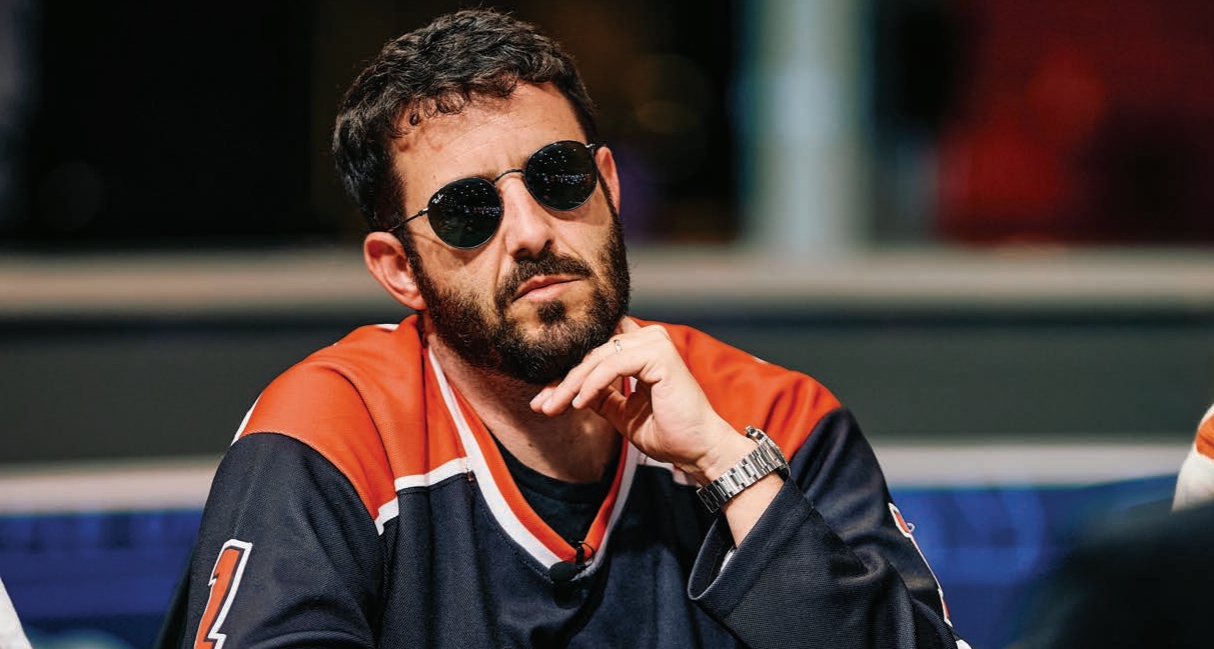
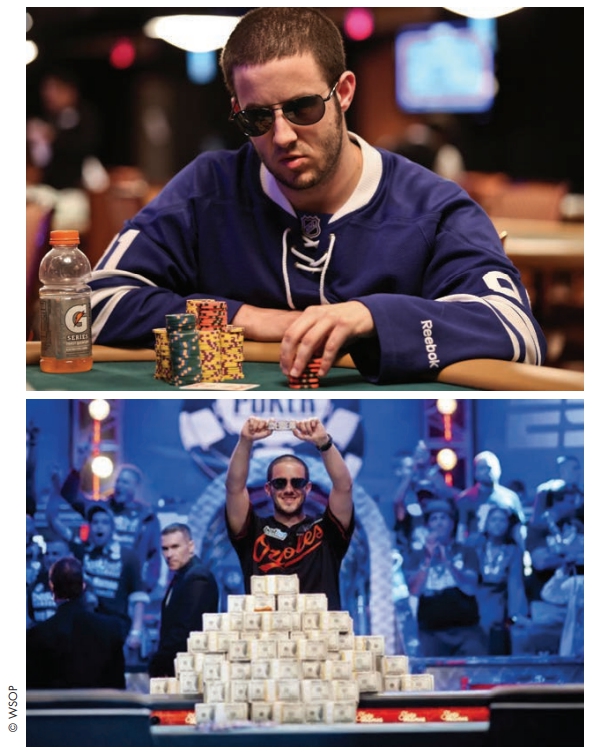
The 2012 World Series of Poker was massive for Greg Merson. The poker pro originally from Laurel, Maryland, took down the $10,000 limit hold’em six-handed event for more than $1.1 million and just 11 days later won the $10,000 main event for $8.5 million. It was an impressive run that included two more final table appearances all capped off with the WSOP Player of the Year title. The huge summer came just a few months after finding sobriety after battling drug addiction – only adding to his life-changing achievement.
Merson certainly hasn’t been a one-hit wonder. After getting his start in the game at the University of Maryland, Merson dropped out after two years to hit the tables full time, becoming one of the highest volume players online. Two years after his main event win, he added another huge score, finishing runner-up at the PokerStars Caribbean Adventure $25,000 high roller for $948,996.
Over the years Merson has come close to adding a third bracelet at the series, making several final tables. He also came close to a World Poker Tour title, finishing fourth in his hometown WPT Maryland Live! main event. The 37-year-old made another big run in the main event this year as the last former champion standing, ultimately finishing 52nd for $200,000. This was his sixth cash in the main event overall,
As one of the latest guests on the Table 1 Podcast, Merson detailed his path to sobriety, winning the main event, and running a sports betting syndicate. Keep reading for some of the highlights. You can also watch or listen to the entire episode on YouTube, Spotify, Apple, or any podcast app.
Justin Young: Tell me about dropping out of college, your parents couldn’t have been pleased.
Greg Merson: I also was having drug problems. They were like, ‘What the hell is going on?’ Because in my childhood, from an academic standpoint was just straight A’s all the way from middle school through high school. I wasn’t a 1,600 SAT guy, I just worked really hard and overachieved, and definitely have an OCD personality for anything that I’m into. I want to succeed.
My brother was a star athlete and I was a decent athlete. I think what I did as the younger brother was try to crush school because he was getting all the accolades in sports. I was okay, but he played baseball in college. So my way of trying to shine was through school.
Justin Young: You only went to Maryland. It’s okay. (laughing)
Greg Merson: I didn’t even have the SAT (score) to get in, but my parents went there.
Justin Young: When you eventually went back to college was the goal to become a poker player eventually? Or was the goal to appease your parents [and find a normal career]?
Greg Merson: It was strictly to become a poker player. It was just to rebuild the bankroll. I was also still struggling with the drug stuff. I didn’t actually get fully sober until August of 2007, and then I dropped out again in November. I was very much fresh to being sober. I relapsed in 2011, but the first three and a half years of my career I was sober. I met a lot of good, younger, full-time players in the area that didn’t really drink and didn’t do any drugs. I made this whole new group of friends.
 It’s a really weird thing when you’re hanging out with people all the time that are using and then when you can’t hang out with them anymore, it’s ‘Oh, you’re too good for me? You can’t hang out with me?’ That type of deal. So, I definitely was lucky to find a new group of friends that had a good influence and were good poker players.
Tony Gregg was one of the first guys I found. John Moore, a longtime cash game player, Christian Harder – all of us moved in together in 2008 and that was my first year of sobriety. All of us were at different stakes at the time, and we all were improving. We were all starting our careers together.
Art Parmann: A lot of grind houses like that have shot out a bunch of top talent. That’s just one of the things I could never have done because I got married at 20 and started my career with a wife and family.
Greg Merson: That was another big adjustment for me. My wife and I moved to Hoboken (New Jersey) in 2014. That was the first time I lived without another poker player and was also right when solvers came out, so there was a really big adjustment period for me not living with someone to constantly talk poker with and keep up with the meta game or different strategies. I’d say from the middle of 2014 until 2016 was a lot of having to adjust and learn on my own without the network of people I was used to always talking poker with.
The discussion later transitioned to Merson relapsing and eventually hitting rock bottom. He also offered a look at his life at the tables during those early days.
Art Parmann: I want to bring us down a little bit. I saw that you had your first million-dollar year and then relapsed into losing some of that money.
Greg Merson: I didn’t have a million-dollar year, but I had made over a million playing cash games online. My whole bankroll came from online cash games. Then, after taxes, I started 2011 with a $650K or $700K bankroll. And I was playing bigger and bigger and bigger.
When I relapsed, I was just dusting online. Then they shut online poker down, which was probably a good thing for me because from when I relapsed to when they shut it down, which is like a two-month period, I’d probably lost about $200,000.
Obviously, playing under the influence is probably not a good idea. I do remember the first time I played Bobby’s Room, I was high. I played $200-$500 half and half. I lost $90,000 with maybe like a $400,000 bankroll. I had 75% of the action, so a huge loss. I just kept losing, spending, losing, spending.
 By the time I got sober at the end of the year, I might have had like $180,000 or $200,000 left, but I was going down the route of just being broke and it was just a matter of time. Because at that point my drug habit was definitely $1,000-plus a week and then just losing money on top of it.
Justin Young: What was the triggering thing that got you back into drugs?
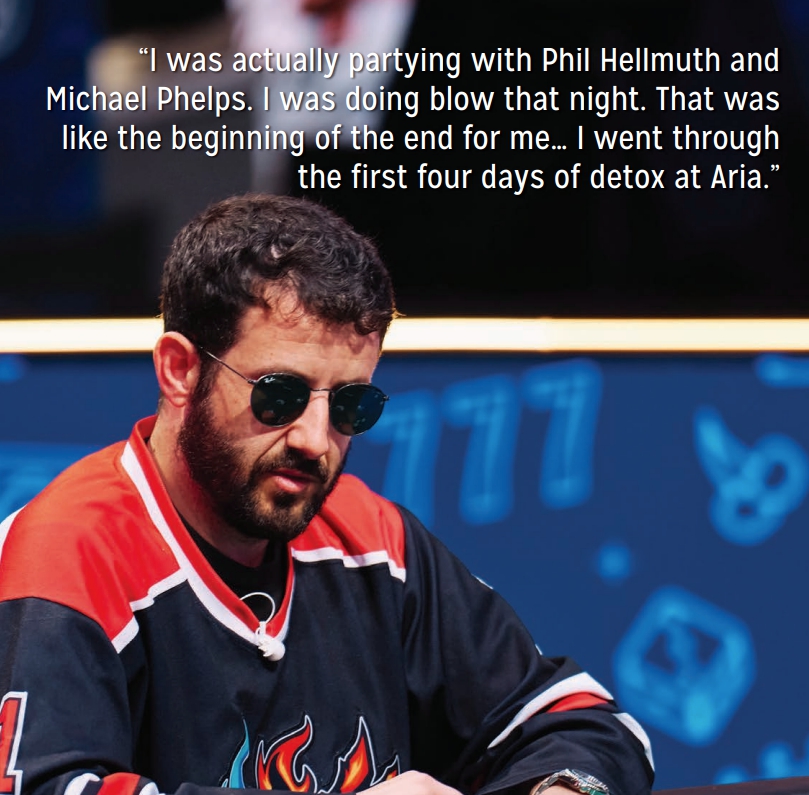
Greg Merson: I was actually partying with Phil Hellmuth and Michael Phelps. I was doing blow that night. That was like the beginning of the end for me. That was the first night that I ended up doing roxies (the street name for the prescription drug Roxicodone, a brand of oxycodone hydrochloride), which is just synthetic heroin.
I’d always stayed away from that stuff because I knew it would ruin my life. But for whatever reason, that night was the first time I tried a really small amount of it. It just was the best feeling of my entire life and I totally understand why people get hooked on this stuff and can never get off of it, because it was just unreal.
Even to this day, I can still remember. That’s the thing about drug addiction is that you will always chase that feeling until the very end. You’ll never get that feeling of that first time you really had your most enjoyable high, and it’s just that constant chase to get it back and increase the dosage. But you’ll never feel the same, which is kind of sad. Then it gets to a point where you’re just doing it so that you’re not sick. It’s pretty nasty.
Justin Young: Did you go all the way down that road where you were doing drugs to not feel sick?
Greg Merson: I never got sick because I had the money to pay for it, so I could get pills. I could just get whatever I needed. I never got to the point where I didn’t have money.
Taking [the story] to 2012, I actually got sober in Vegas at the Aria hotel. I was staying with Christian and Tony. Christian came in the room and caught me using. He was like, ‘What the fuck are you doing? You’re ruining your life.’
Something just really clicked when he said that. He really just called me out on my shit, and I flushed all the pills. I went through the first four days of detox at Aria. I never left the room other than to get cigarettes. I was shitting myself. I was throwing up. I had the chills, fever, all of it – just awful. Then I flew home on the fifth day and didn’t start feeling normal for probably seven or eight days.
This was really only from using pills for six months. I can’t even imagine the withdrawal for people using for years. It was the worst depression on top of the worst physical stuff because getting off blow is all mental. It’s not physical. But heroin is both physical and mental combined. I wouldn’t wish that on anyone. It’s the sickest I’ve ever been in my life
Justin Young: Were your friends there helping you through the whole way?
Greg Merson: Not really, because they were there playing poker. I just told them, ‘I’ll be fine. I’m going to sleep a lot, and order room service.’ I’d go to the Aria shop for cigarettes and Gatorade and I literally didn’t leave for four days. That was the end of 2011 and part of the reason you saw me get emotional for both the bracelets is because it was just such a quick reset on how much I had fucked up my life the year before.
I didn’t really feel like I deserved it because I final tabled the main event when I was seven months sober. I probably didn’t even start playing really good poker until the end of February. Because after getting sober, my mind had to rewire itself on how to play and process all the spots again.
The whole up-and-down experience was just pretty surreal, but it couldn’t have happened at a better time. I always tell people, `Imagine if I won the main event and then relapsed.’ How much worse it could have been, how much worse I could have messed it up? Because a lot of people mess that up.
Merson then offered some insight on running a secret 45-person sports betting syndicate and also renewing a childhood love of sports cards.
Greg Merson: I got into sports betting very hardcore. This is when I realized I really loved business. I was betting sports for a bunch of different groups. We had probably close to around 10 different originators or groups of guys we were betting for. I built out a team where I had 45 different people betting sports for us, all over the country. I was managing that, which was a ton of work.
At the same time, I was really getting back into the sports cards world. It was part of my childhood and then I spent 20-something years never opening a pack of cards. I got back into that around the same time, and then I found breaking (opening boxes) online. I was like, ‘Man, I really would love to start a business like this.’ It kept consuming me where I was playing poker and doing the sports betting stuff, and really enjoying that I could do both. I was loving sports betting, but it was like, ‘Do I really want to start something else? Because if I start something else, I probably have to quit one of these other things.’
 Ultimately, I had to quit both of them because I was running this business 80 hours a week, just non-stop, there’s so much work. I love it, but I’d played poker for four hours. (He continued running the sports card business, but left the betting syndicate behind.)
Art Parmann: What sports was your group betting?
Greg Merson: We were betting everything. I even had a guy for golf. I had a few groups for WNBA, a few groups for baseball. I would work with some originators directly, which is the way to get the information quickest. Otherwise, we were working with other syndicates to bet for them because it’s all just top down. If this originator wants to get down $250,000 a game, maybe he’s only able to fill $100,000 or $150,000 of it himself, then he goes to operations like us to fill the rest where it’s like, ‘Okay, I can give you $20,000 on this.’ The way we make money is by keeping some for ourselves because they’re winning sports bettors.
That’s kind of how that would work. If I could fill $50,000 on an NHL game, $25,000 would go to the originator, and then we would keep the rest for our action. Then that would be split up. There are tons of different splits, but we were playing like $5,000-$10,000 a bet for most sports. Obviously, for women’s tennis or something, it would be $500 to $1,000 or something, but the win rates are higher.
I was fascinated by that and trying to climb the ranks. But ultimately, because I wasn’t originating and just betting for other people, it wasn’t as satisfying. In poker, you’re making the decisions and it’s up to you. Whereas here I was just executing orders like a trader. Plus, just the anxiety of it. When your phone rings, you sometimes have a matter of seconds and you’re trying to get down as much as possible before the line is gone. So you can never turn off from 8 a.m. until midnight – it’s just all day long.
About The Table 1 Podcast
Hosted by high-stakes poker pros Art Parmann and Justin Young, the Table 1 Podcast is on a mission to make poker fun again. Tune in to see world-class pros talk poker, gambling, and all manner of life experiences on and off the felt. Visit the website for the podcast, newsletter, or even to get in the game. ♠
- Photos – PokerGO, WPT, Card Player