







 Even the best players in the world make mistakes. Join Sam Greenwood as he breaks down and analyzes hands played from the high roller circuit on his Punt Of The Day Substack.
In the spring, Jeff Gross was kind enough to invite me to do commentary for the live stream of the GGMillion$ online event. It was a fun final table, and before the stream began, a subscriber asked me to pick a hand from the final table and make it my Punt of the Day.
I thought it was a fun idea and said yes, before considering that some people might dislike me turning my microscope on others’ play. In today’s introduction, I’m going to preempt this criticism. If people want to take competitive poker seriously, players need to be less sensitive about fans and media members criticizing their play.
In sports, the arts, and politics, people’s mistakes are publicly discussed all the time. Some criticism comes from experts, but most comes from overconfident dilettantes who don’t know what they’re talking about. I know, because in other arenas I’ve been that overconfident dilettante.
If you have the stomach to make a giant bluff for millions of dollars, you should also have the stomach to deal with someone saying “that bluff was a disaster.”
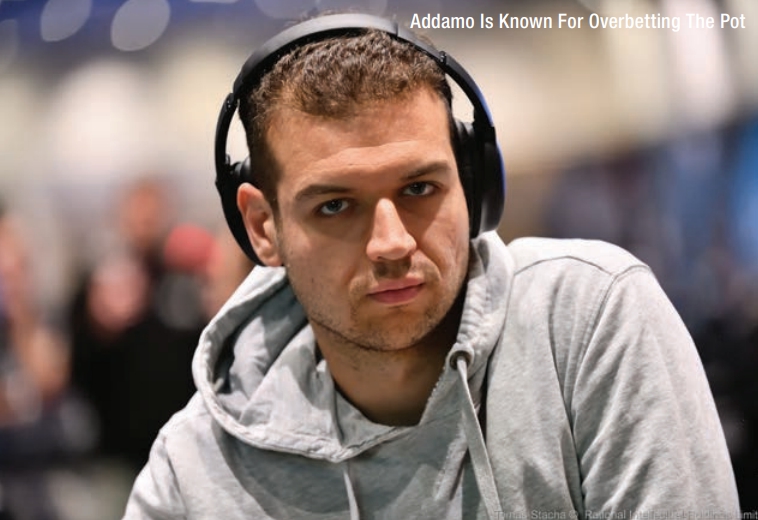
The player who “punted” in today’s blog is Michael Addamo, an excellent poker player and a sweetheart in real life. He ended up winning $1,279,288 in this tournament, plus he has played a lot of crazy poker hands in his life. So, I’d be surprised if he cared that I chose this hand. But for those who might care, I believe he can deal with some mild public criticism.
The thrust of this project is that every day I expose my mistakes for all to see, but occasionally, I’ll look at the mistakes of others.
Event: 2023 Triton London $125,000 Main Event
The Hand
The blinds are 400,000-800,000 with a 100,000 ante, and Michael Addamo is heads up with Alex Kravchenko. Addamo was down a little more than 2:1, sitting with 37,000,000 compared to Kravchenko’s 80,000,000.
Addamo raises to 1,680,000 on the button with A♠10♣, and Kravchenko calls from the big blind.
Flop: A♦J♦8♦
Kravchenko checks, and Addamo bets 1,175,000. Kravchenko calls.
Turn: 5♣
Kravchenko checks, and Addamo bets 5,900,000. Once again, Kravchenko calls.
River: K♠
Kravchenko checks for a third time, and Addamo moves all in for 27,940,000. Kravchenko calls with A♣4♣ and Addamo doubles up.
What Was He Thinking?
Obviously, I do not have the ability to read Mike’s mind or to know what he was thinking. If I did, I’d have lost fewer pots to him over the years and have a lot more money.
But I think his thought process in this hand is relatively simple. Mike knows monotone boards play pretty cagey and passively heads-up, and I think he’d occasionally check the flop. But once he bet the flop, I think he suspected that the big blind would three-bet A-J, A-A, J-J, and 8-8 preflop and often check-raise the flop with a flush.
After Kravchenko check-calls the flop, Mike thinks that unless his opponent improved to two pair or a set on the turn, A-10 is the best hand, and so he keeps betting.
On the turn, Mike can push a lot of equity versus hands that have a pair and a flush draw and deny equity from bare flush and straight draws.
On the river, Mike still thinks he has the best hand, as Kravchenko might fast-play a lot of two pair hands on the turn. He recognizes that after betting full pot on the turn, he shouldn’t have many thin value bets on the river. His river betting range should be polar, and picking a size smaller than all-in doesn’t make sense.
He had also run out of timebank and had 20 seconds to make a decision. Almost all of Mike’s bluffing range should be no pair, and Kravchenko can even hero call with a hand like K♦ 2x or Q♦ Jx. Mike has a very aggressive image and Kravchenko has not been afraid to play back at him, so Mike decided to shove.
What The Solver Says
Normally this section is called “What I Got Wrong.” This time, we are adding “What the Solver Says” and “What Sam is Thinking” segments.
In the PIO sim I ran, I only gave Mike one flop bet size. The solver uses multiple sizes and a polar big bet size is used, but I don’t think many humans play a big size on the flop here and I wanted to look at something closer to the range Mike is playing.
Something that surprised me is that at equilibrium, the big blind rarely raises the flop; regardless of what sizes the big blind is allowed to bet, he raises the flop around 5% of the time.
Once I thought about this, it made sense. The big blind’s value range consists of flushes and a little bit of A-8, and needs to continue on the flop around 70% of the time and has a flush 4.5% of the time. It’s hard to raise the flop often when you have a value hand that rarely.
A-10 bets the turn around 80% of the time, but the preferred size is 75%. However, betting full pot doesn’t lose EV and is a fine play. The big blind rarely raises on the turn, but their raising range is mostly centered around turned two pair, and A-10 with no diamond mostly folds when raised.
On the river, shoving A-10 loses somewhere between 4-6 big blinds, but it has 73.5% equity on the river facing a check. In other words, when Mike shoves the river with A-10 and is called, he has the best hand 40-45% of the time. The thinnest value bet without a diamond that the solver makes is J-8, which has 78% equity, but even J-8 mixes in checks.
There are a couple problems here for A-10. One, when you shove 165% pot, the big blind only needs to call the river around 37% of the time to hit a frequency to make the button’s river bluffs indifferent. A-10 might have 73.5% equity, but when your opponent folds the bottom 63% of their range, it’s hard for A-10 to have 50% when called.
Some of the highest frequency river calls that A-10 beats include worse top pairs. It’s never great to value shove a hand that blocks your opponent’s most frequent calls.
I thought since the big blind was supposed to frequently slowplay a flush, they might arrive at the river with a flush a lot, but they only arrive to the river with a flush 9% of the time, which is double the amount on the flop, but nothing too crazy.
What Sam Says
The two major questions I have here are:
Does Kravchenko arrive at the river with better than A-10 less often than the solver?
Does Kravcheknko hero call more often than the solver?
My answer to question one is — I am not sure. I think he raises the flop with a flush more often than the solver, but I also think he raises the flop with one pair, one-card flush draws, straight draws, etc., more often than the solver. If I had to bet if Kravchenko has a flush 9% of the time on the river, I’d take the under. However, he might play the turn less aggressively than the solver does with two pair, giving him more two pairs on the river.
Does Kravchenko hero call more often than the solver? My answer to this question is yes. He tanked for a very long time before calling with A-4, which is indifferent, but I suspect he might call the river much more often with one-pair hands with a key blocker like the aforementioned K♦ 2x or Q♦ Jx. Addamo shoving A-10 vs Kravchenko in this hand is losing less EV than the solver says.
However, I still think he should have checked.
Shoving the river is losing around 20% of the pot at equilibrium. That is a lot. I think, even making favorable assumptions for Mike, it would be hard for this shove to be making a significant amount of EV.
I watched the entire heads-up match and Kravchenko was too aggressive preflop, continuation-bet too often and too large, and was generally sloppy. If Mike checked and won, he’d have 57 big blinds. Kravchenko’s weak spots heads-up were common nodes that they’d frequently reach, and he’d leak a lot of EV to Addamo.
I think Addamo had an edge in this match, and even under the rosiest assumptions, this shove was winning small. I think he’d have been better off picking a strategy that prolonged the match and pushed his edge.
Types Of Errors Made
- Too Much Money
- Exploiting Too Much
Grade
I feel weird grading a play that isn’t mine, but I’d feel weirder abandoning this article format so soon.
Playing for a $500,000 prize difference heads up with no time bank is a very hard and stressful thing to do. I think Mike made the right micro exploit, but the wrong macro exploit, and his hand was still a little too weak.
If I played this hand with my image, I’d give myself a D+. With Mike’s aggressive image, however, I’ll give it a C+.
 Sam Greenwood is one of the winningest tournament poker players ever and is third on Canada’s all-time money list, having cashed for $42 million and counting in high roller events all over the world. The former stock trader-turned-champion has played millions of poker hands and is breaking them down street by street on his Punt Of The Day Substack. You can reach out to the Run It Once coach on Twitter/X for private coaching @SamGreenwoodRIO.