







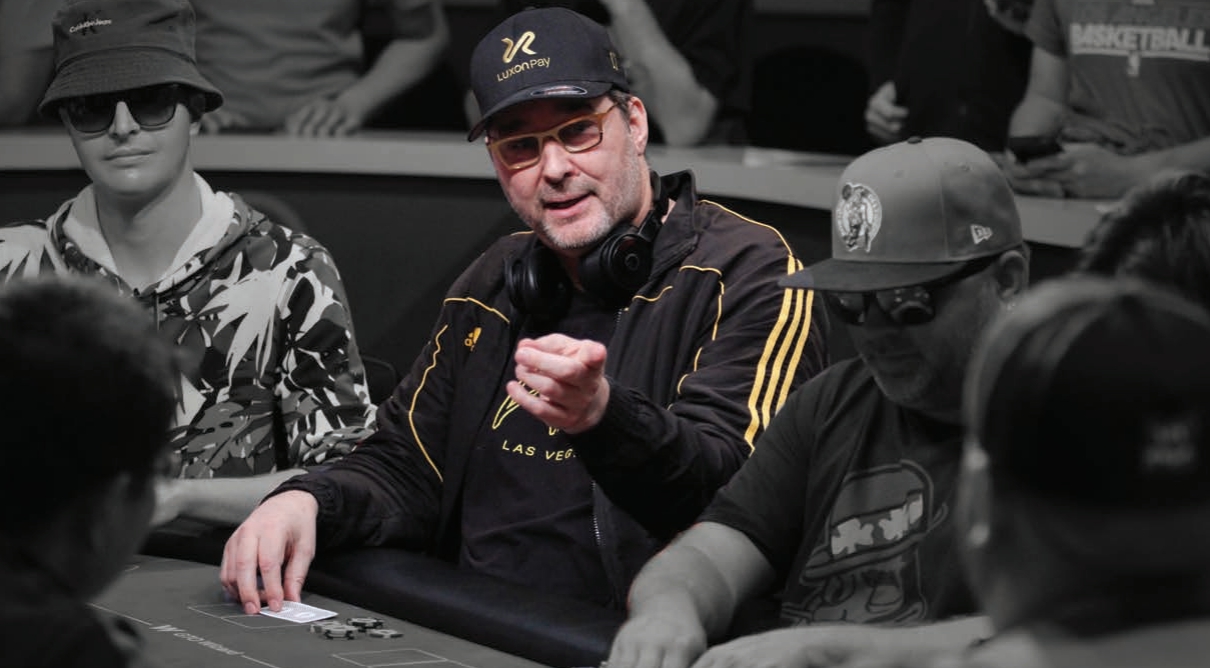
Phil Hellmuth, the all-time leader in World Series of Poker titles with 17, thinks there are simply too many WSOP bracelets awarded each year.
During a break in the action on the set of PokerGO’s No Gamble, No Future, Hellmuth made his perspective clear in an interview with Card Player.
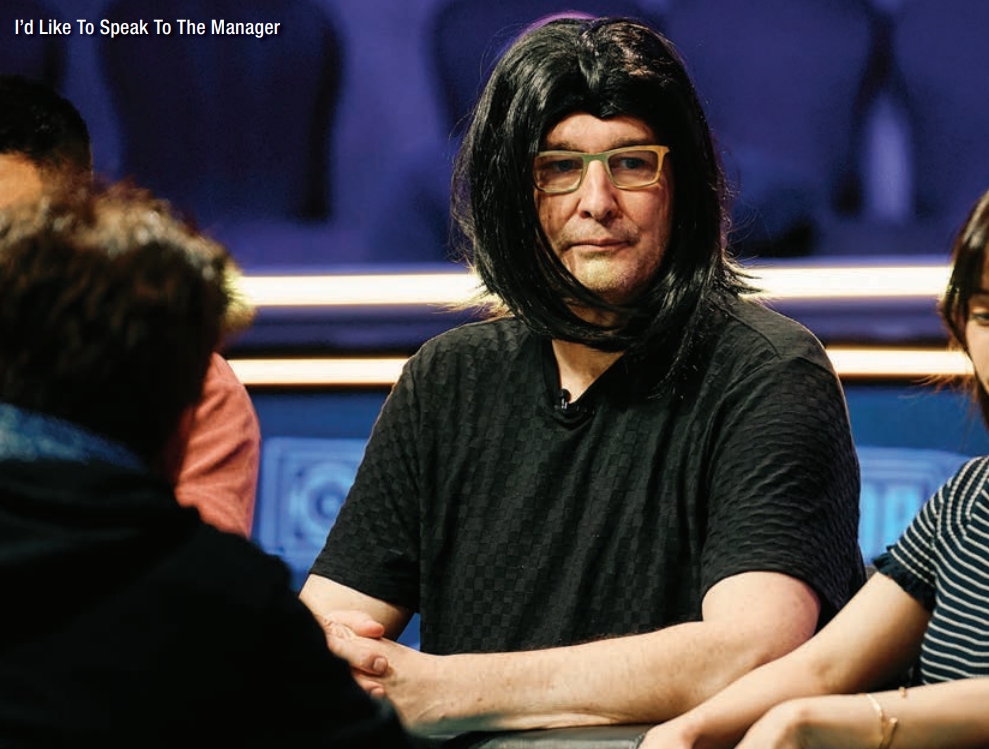
“I went public saying that there should be 100 bracelets,” Hellmuth said. “I know some of the owners of the World Series of Poker [said], ‘Phil, it should be 100 bracelets.’ [Daniel] Negreanu wants to have more. But right now there’s over 300 bracelets overall. I believe they’re becoming meaningless.”
Hellmuth’s 17 career WSOP bracelet wins put him six ahead of Phil Ivey, with 11. Doyle Brunson, Johnny Chan, and Erik Seidel all have 10 each, followed by Johnny Moss with nine. Beyond them sits a generation of younger standouts who appear capable of making a serious run at Hellmuth’s record. Michael Mizrachi, Shaun Deeb, and Benny Glaser each have eight bracelets, and the potential to win many more.
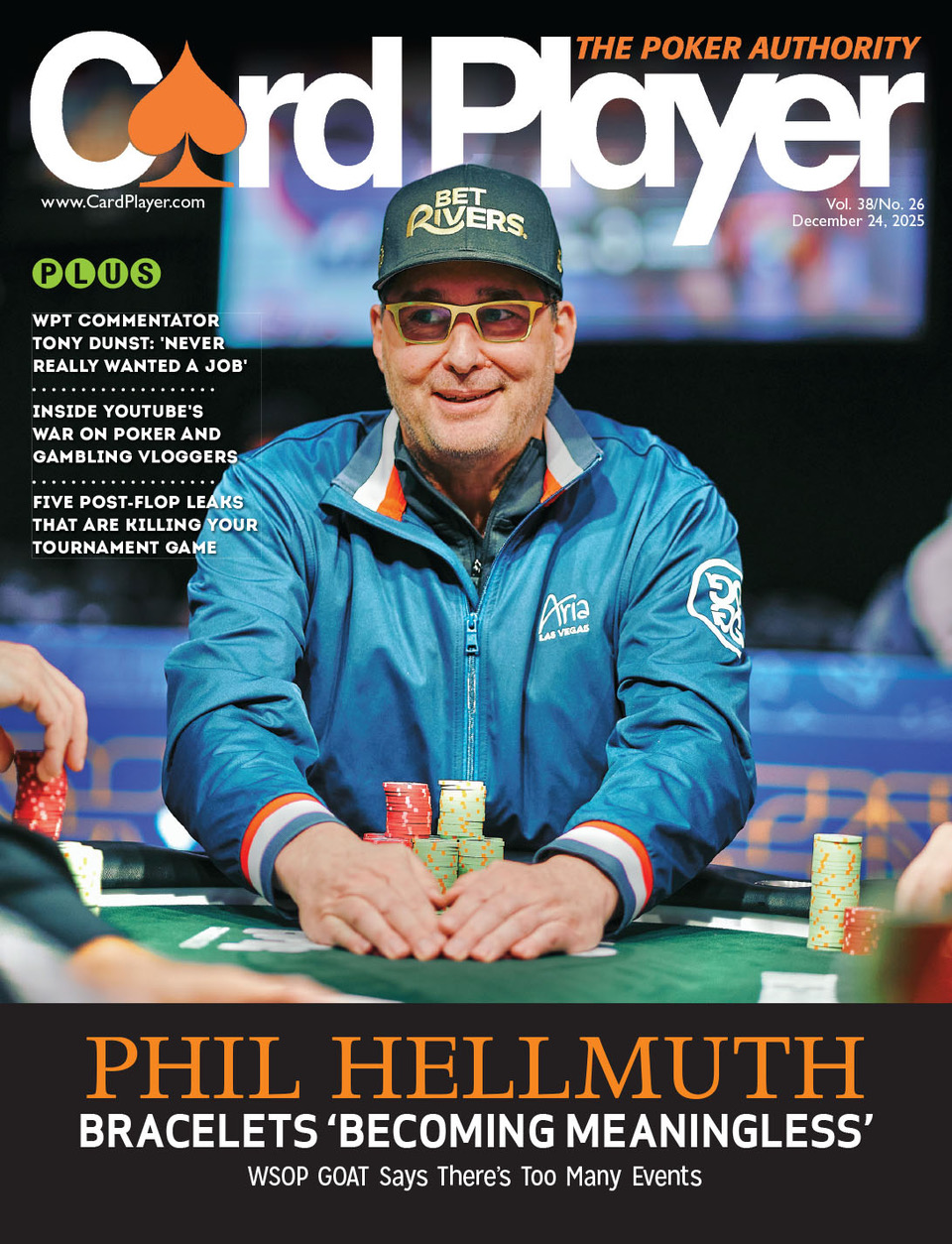
Read This Issue Of Card Player Magazine
While Hellmuth’s comments don’t seem to be directed at anybody in particular, the Poker Hall of Famer’s point is centered around the dilution of one of the game’s greatest prizes. Simply put, there are too many online events.
More Bracelets Each Year
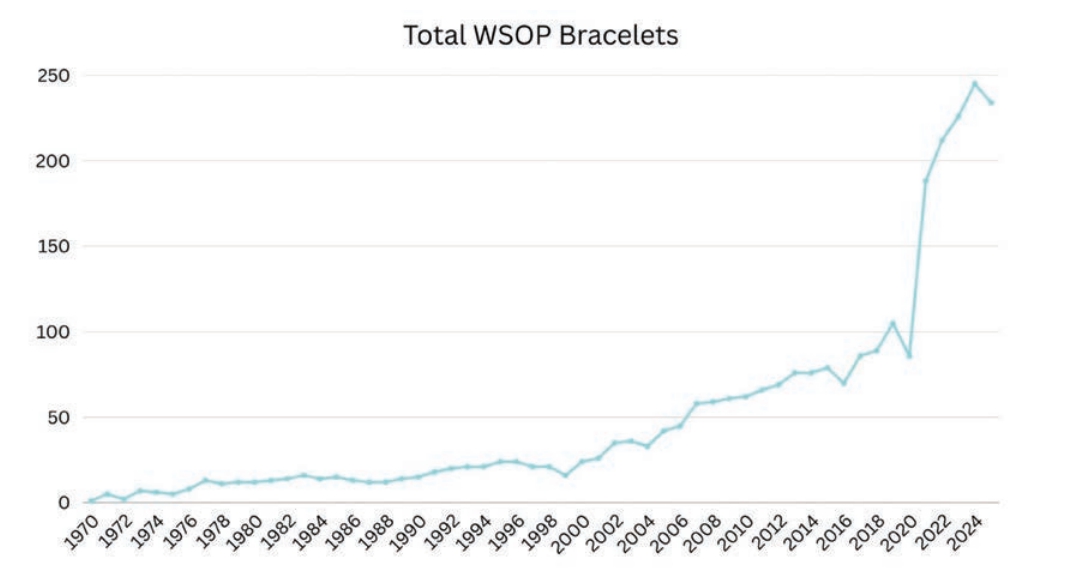
In addition to the 100 live bracelet events in Las Vegas, and live WSOP Europe and WSOP Paradise festivals, there are multiple yearly online events in North America and the rest of the world that all award gold. Hellmuth was only slightly exaggerating when he said there were more than 300 events. In 2025 alone, there are slated to be 234 bracelets handed out.
“I believe the WSOP is going to become worth nothing,” Hellmuth continued. “There are 100 weird names you could give [these events], but this is the World Series of Poker, and it has to have an exclusivity to it. Somebody won a bracelet recently, and we said, ‘Wow, you won a $300 [tournament] online?’ Another guy won over 37 players. And then we’re like, whoa, the bracelets are really being run down and [are] not as important anymore.”
Hellmuth, one of the most prolific and public figures in the game, has played through many different eras of the poker industry. In fact, he has won in every decade since his 1988 debut. His 1989 WSOP main event win came against a field of 178 players. A couple of his early bracelet wins came against fields of 88 and 63. But at the 1993 summer series, for example, there were just 21 bracelets on the line, in total.
‘Make The WSOP Great Again’
During the PokerGO broadcast, Hellmuth reiterated that Daniel Negreanu and GGPoker ownership should listen to his pleas to change the system and reduce the number of bracelets on the line each year. From Hellmuth’s perspective, watering down the value of a bracelet could be devastating to the brand.
“If you have 350 bracelets per year, everyone’s going to have six, and soon,” said Hellmuth. “So, yeah, we have to do something about it. We have to save the World Series of Poker. I’m not a political guy, but I’m going to say, make the World Series of Poker great again. I know that Negreanu wants to cut 200 of the 350 bracelets.”
“I’d like to see 100, Daniel wants 140, 150, but there’s going to be some big changes. All these worthless bracelets… they 100% have to change. You won a bracelet online, that’s a different category.”
Hellmuth asserts he’d simply stop playing events if the trend of more bracelet events each year continues. He already teased sitting out the WSOP main event in 2025, under different circumstances, before ultimately reversing course. But with the status Hellmuth holds in the game, he feels like this is a moment where he has to speak out.
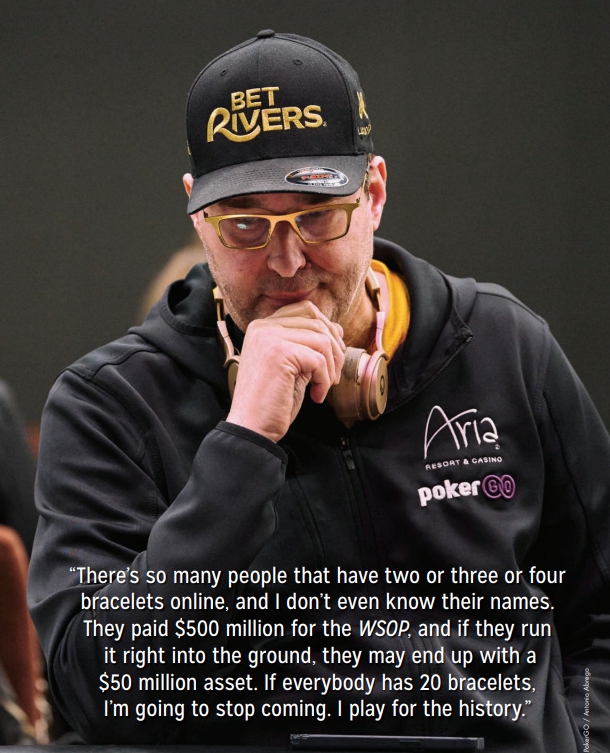
“There’s so many people that have two or three or four bracelets online, and I don’t even know their names,” Hellmuth said. “I didn’t even hear about them winning. The WSOP risks losing… they paid $500 million for the WSOP, and if they run it right into the ground, they may end up with a $50 million asset. If everybody has 20 bracelets, I’m going to stop coming. I play for the history.”
How Many Bracelets Is Too Many?
Is the Golden GOAT right? Are bracelets on the brink of irrelevance?
Maybe. Irrelevancy is a subjective metric, but the objective piece of Hellmuth’s critique can’t be ignored. There are countless more opportunities to win a bracelet now than even just a decade ago.
1976 – The Bracelet Is Born
Seven years into the WSOP’s existence, gold bracelets were officially awarded for the first time. From that point in time forward, the bracelet would become the tool of measurement by which all WSOP performances were judged. (Except for 1982, the one year they awarded gold watches!)
By the end of 1976, Moss had the all-time record for most wins with six. He’d hold onto the top spot in the poker record books all the way until 2005, a decade after his death.
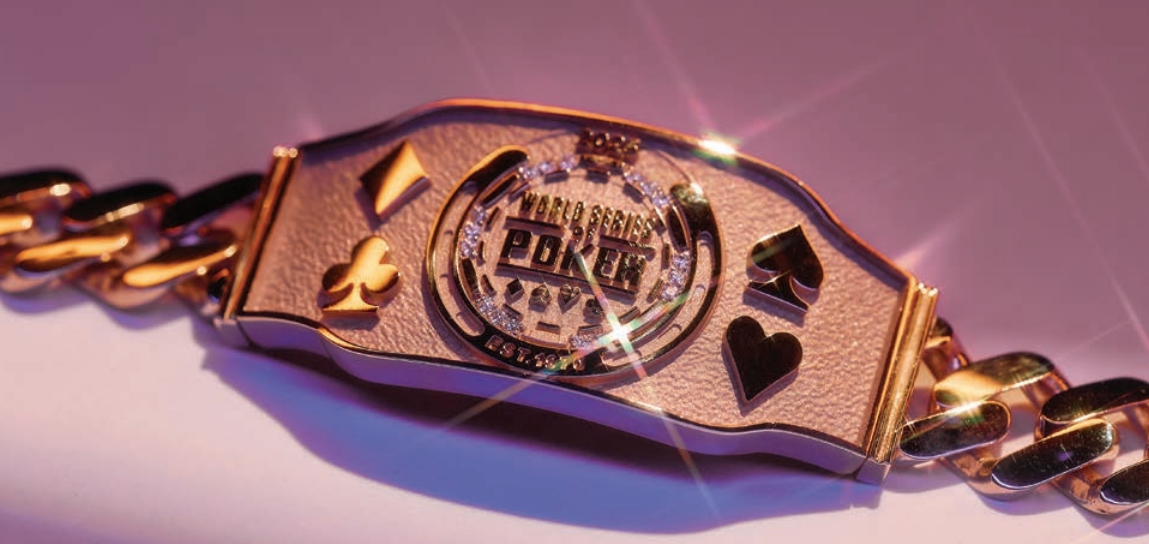 In terms of bracelet events on the schedule at Binion’s Horseshoe, the jump from 1975 to 1976 was 60% more tournaments on tap. The following year, there was a 62.5% jump from 1976 to 1977. In those years, it was a move from five bracelet events, to eight, to 13. It’s a small drop in the bucket compared to modern changes, though, and the number of events plateaued for well over a decade. From 1977 through 1990, there were never more than 16 bracelets on the line in a given year.
When Hellmuth won his first, in the 1989 main event, there were 14 total bracelet events, all in Las Vegas. By 2007, the year Hellmuth claimed the all-time record with his 11th bracelet, there were 55 events on the WSOP schedule.
Bracelet Boom In Vegas
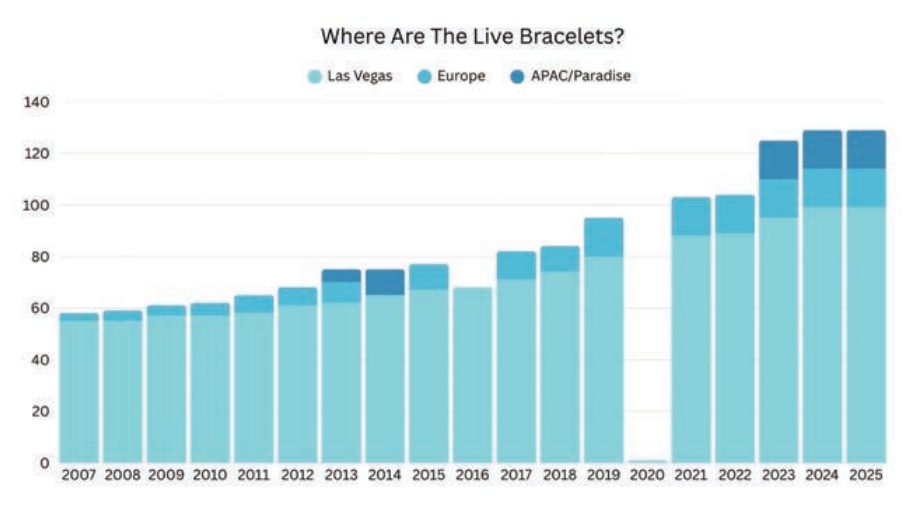
As poker became more popular, the tournament schedule at a brick-and-mortar casinos steadily increased. At both the 2024 and the 2025 series at the Horseshoe Las Vegas and Paris Las Vegas casinos, there were 99 bracelet events.
You can see a huge spike in events in the early 2000’s as online poker became more popular and the Moneymaker effect created an entire new generation of poker players.
Furthermore, event organizers began offering events with lower buy-ins. In 2015, the WSOP ran a $500 event dubbed The Colossus. It was the first time since 1980 that a WSOP open-field event had a buy-in less than $1,000, and it drew a whopping 22,374 entries. The bar dropped even lower in 2023, with the $300 Gladiators of Poker event which attracted 23,088 runners. The 2019 Big 50 remains the record holder, with 28,371 ponying up the $500 buy-in.
The small-stakes events are so popular that there is now a budget-priced tournament every weekend at the WSOP.
Bracelets Go Abroad
In 2007, the same year Hellmuth took the all-time bracelet lead, the then-owner of the WSOP brand, took the series abroad. Caesars held the first WSOP Europe in London, the first time anyone could win gold outside of Sin City.
In the years that followed, bracelets were won in several other live non-Vegas series events. There was the short-lived WSOP Asia-Pacific (APAC), a yearly bracelet awarded at the WSOP Circuit finale under a variety of names, and starting in 2023, WSOP Paradise in the Bahamas.
Non-U.S. bracelet expansion was gradual, but appears to have plateaued. There were only three bracelets up for grabs at the first WSOP Europe in 2017. It climbed to four the following year and peaked at 15 in 2019. Since then, the series has remained consistent with 15 European bracelets.
All of Hellmuth’s bracelets have been won in Las Vegas, except for the 2012 WSOP Europe main event.
WSOP APAC only ran twice, most notably with Negreanu winning the main event in 2013. The first series was comprised of just five events. The following year it had 10.
The plan was for the WSOP APAC and WSOP Europe to rotate annually. WSOP Europe would only be held during odd-numbered years and WSOP APAC on even-numbered years. After a couple years of low turnout, however, the WSOP ended the Asia-Pacific series and replaced it with a broader international WSOP Circuit schedule.
In 2023, the series announced WSOP Paradise, a 15-bracelet tournament series in the Bahamas that is played in December.
The WSOP now awards 30 bracelets annually at live tournaments outside U.S. borders. They make up about 23% of total live bracelets every year.
Moneymaker Effect Creates Larger Fields
The WSOP main event enjoyed steady growth in the late 1990s and early 2000s. The tournament drew more than 300 players for the first time in 1997, broke the 500 mark in 2000, and then got to the magical number of 839 in 2003 when the accountant from Tennessee won it all.
Between the exponential growth of online poker, and the advent of televised poker coverage, the popularity of poker hit a fever pitch. The WSOP main event field more than tripled from 2003 to 2004, and by 2006, there were more than 10 times as many players in the main event as there were in 2003.
The number of events on tap expanded during that era as well. There were 16 bracelet events in 1999 at Binion’s. By 2007, a few years after being acquired by Harrah’s, which would become Caesars Entertainment, that number jumped to 58, a whopping 362% increase.
Live poker boomed in popularity, and so did the number of live events. But the single largest accelerant to the yearly count of bracelets awarded happened online.
Between the WSOP Online platforms across a handful of U.S. states, and on GGPoker internationally, the last five years have seen a dizzying expansion of opportunities to win poker’s most coveted prize.
Bracelets Go Digital
The online poker world in the United States went from the Wild West to a ghost town over the course of just a few years. The passage of the Unlawful Internet Gambling Enforcement Act (UIGEA) in 2006 sent several operators out of the online poker space, and by April 2011, on the day known as “Black Friday,” the biggest remaining operators were driven out.
The first fully licensed and regulated hands of online poker didn’t arrive until two years later. Shortly thereafter, WSOP launched its online poker platform in Nevada.
In 2015, the WSOP held its first-ever online bracelet event. Organizers had the event play down to its final six players online and brought the finalists back to the Rio Casino to play to a winner. The inaugural event drew 905 entries at a $1,0000 price point, and was won by Anthony Spinella for $197,743.
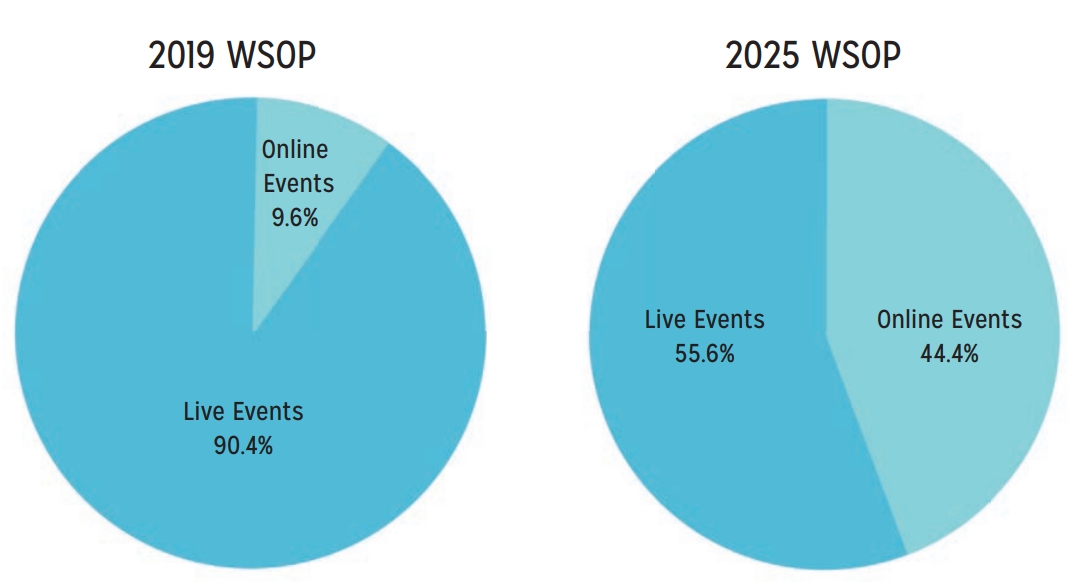
There was one online event again in 2016, three in 2017, four in 2018, and nine in 2019. Even at its pre-COVID high point in 2019, the online portion of the schedule only represented 8.5% of total bracelets up for grabs.
But the pandemic changed everything.
Staying At Home – The Online Poker Revival
 When the world at large shut down in March 2020, the poker world was particularly hard hit. For the first of two consecutive summers, there was no live WSOP in Las Vegas. In its place rose the WSOP Online Championships.
Instead of a proper summer schedule, organizers awarded 85 bracelets online in 2020, with 33 of those in the U.S. For the first time ever, GGPoker hosted 52 online bracelet events for international players.
The following year, the return of the live WSOP in Las Vegas, albeit in November, caused the biggest single year expansion in total bracelets in the 55-year history of the brand. Even with an October live series, the series organizers put another 85 online bracelets on the schedule. By keeping 85 online events on the docket, there were a total of 188 bracelets won in 2021, compared to just 105 in 2019, a 79% increase.
In 2015, the single online event represented just 1.2% of total bracelets. By 2021, online events accounted for 45% of the total number up for grabs, a trend that has continued after GGPoker’s parent company purchased the WSOP for $500 million in 2024.
Not only are there online events internationally on GGPoker, and in Nevada on WSOP.com, but players can now win gold from other states that have joined the Multi-State Internet Gaming Agreement (MSIGA), which includes New Jersey, Pennsylvania, and Michigan. Before MSIGA, there were even series played for Michigan and Pennsylvania online players only, resulting in mediocre field sizes and modest prize pools, despite the gold that was up for grabs. GGPoker also held a series just for their Canadian players in 2024.
The new trend skewing more towards online play than in the past is where the biggest increase in events have come. If the WSOP is going to address any of Hellmuth’s inflation concerns, then the online schedule is likely where they’ll trim.
- Photos by Card Player, PokerGO