







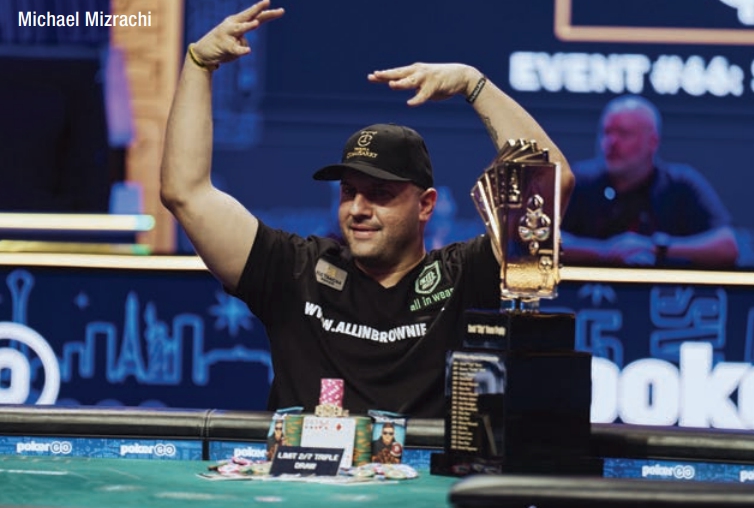
Mizrachi’s Fourth PPC Win
While mixed game aficionados were understandably disappointed that PokerGO’s televised schedule included fewer mixed games than previous years, we were still treated to three full days of coverage from the pinnacle of mixed game tournaments, the $50,000 Poker Player’s Championship. High-stakes player Jared Bleznik joined the announcer’s booth for some of the broadcast and was a welcome addition with his genuine enthusiasm and insightful, but unfiltered commentary.
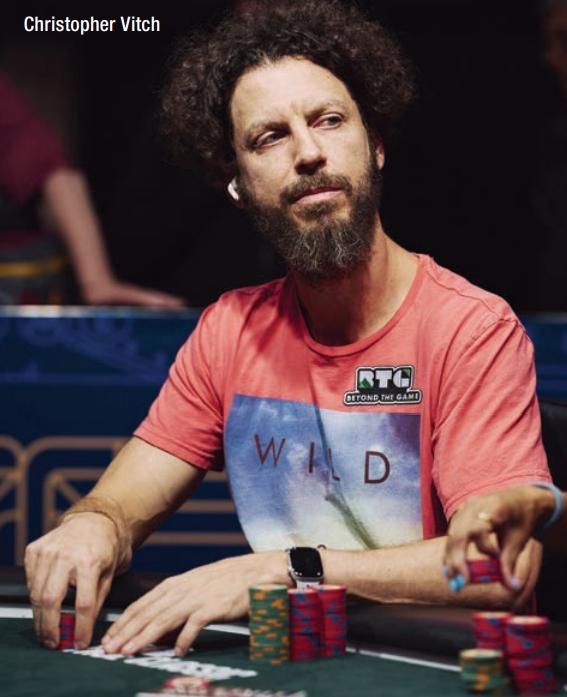
During the Deuce-to-Seven Triple Draw Lowball rounds there were a few instances where players opted to break dealt pat nines, where Jared believed they should have stood pat. The first instance was a button open by Albert Daher. Chris Vitch three-bet from the small blind with 9-5-4-3-2, the big blind folded, and Albert called.
Chris is a long-time top limit mixed games professional with three bracelets, so when he chose to break the smooth nine in this situation it was based off a ton of experience and undoubtedly large amount of work and consideration. As is the case with most poker plays, there are offsetting considerations, and it’s best to list them out and attempt to place value on them.
Over the course of three draws we will improve to the nuts (7-5-4-3-2), the fifth best hand in the game (8-5-4-3-2), or get the nine back around 56% of the time.
In addition, patting a nine low out-of-position can be problematic as our opponent can leverage his position in a few different ways, and there are some reverse implied odds. They can test our possibly weaker pat range that would attack a button open by raising on the turn with a pair of sevens or eights (cards we completely unblock) which creates a problem for us where we could make a mistake.
Or we could get “frozen” on the turn, for example our opponent just calls our bet and pats behind us with a holding such as 8-7-5-4-2 ensuring themselves the pot.
The times our opponent is destined to make a strong holding, breaking also unlocks the possibility of getting bets and raises in with some of the strongest holdings in the game.
A draw to a 2-3-4-5 is also a premium bluff catcher when both players take one on the final draw. Since we completely unblock sevens and eights, we can usually check-call any pair assuming most opponents will at a minimum, bluff when pairing their highest card.
There are a few drawbacks to breaking the nine, of course, the primary being a slightly reduced amount of fold equity on the turn. Had we chosen to pat, our opponent generally deems it necessary to have improved to at least a one-card draw to a decent eight to continue, but when we draw one on the second draw, they might play on with a one-card draw to nine, ten, or perhaps even a premium two-card draw. And when our opponent does continue on the turn with a one-card draw the 2-3-4-5 is usually a small underdog.
We could also make the dreaded six-high straight on the third draw where we should check the river and just resign to the loss. Now if your opponent bets, check-raising is an option targeting high pairs, but that’s a high-variance maneuver.
Breaking the nine especially with a smooth draw out-of-position has been my default play over the years. When two decisions are reasonably close, it seems right to go down the road offering implied odds as opposed to hoping that our hand holds up.
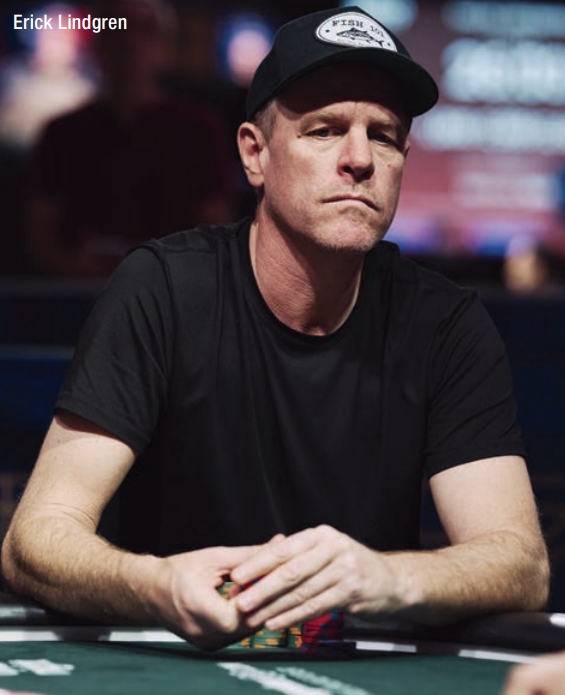
Later in the same round, Esther Taylor opened from early position and Erick Lindgren three-bet from the hijack with the same exact holding of 9-5-4-3-2. He also chose to draw. This situation was closer since Erick has a stronger pat range and position, and can choose to break his hand if Esther pats.
Like the previous situation, it still might be best to break primarily due to it being a favorite to make the same hand or better, as well as the implied odds that accompany making a premium holding.
 However, a hand such as 9-6-5-4-2 could be a pat in position since when broken it can “only” make the fourth (7-6-5-4-2) and eighth (8-6-5-4-2) best hands in the game, meaning we have less implied odds.
Both hands ended on the turn when their opponents didn’t improve in a sufficient enough manner to continue. We don’t always have to make our hand to win the pot, and should always bet the turn when a card ahead.
Mizrachi’s Sevens
Switching gears to a different topic and onto a hand from day 4 with eight players left, none of which were on a short stack. Joao Vieira opened the cutoff with 2-4-8-K-A, and Michael Mizrachi three-bet from the small blind. Bryn Kenney called in the big blind, and Joao called. Everyone took two on the first draw and the Grinder lead the small betting street getting called in both spots.
On the second draw, Grinder drew one, and Bryn requested two. Joao, having picked up a king and a ten on the first draw, opted to take two once again.
On the turn Mizrachi fired again, Bryn mucked, and Joao called with 2-4-8-8-10. While his decision to continue is somewhat unpleasant since he could be drawing dead, it’s appropriate in this bloated pot as Mizrachi had an automatic turn bet being a card ahead of both his opponents and therefore may not have completed his hand.
Both players took one on the final draw, the Grinder lead on the river, and after some deliberation Joao decided to lay down a made ten (10-8-4-5-2). This was a noteworthy fold as he was getting 9:1 on his money and some players will bet jack lows in this spot; thus, in addition to picking off bluffs he also beats thin value hands. It’s not clear if the Grinder would have bet his jack lows, so let’s toss that possibility aside for a moment and just assume his betting range only consisted of better holdings and bluffs.
Mizrachi three-bet a cutoff open from the small blind and drew two cards, so he almost always has a deuce and frequently a seven as well. Given Joao’s specific holding and the cards he’s seen, Grinder’s most likely holding heading into the final draw was 2-3-6-7, and that’s exactly what he held.
If we assume that our opponent will bet all ten lows or better, along with pairs of sevens as bluffs, he will lead the river with the following 17 cards:
Value (14): Fours (3), Fives (3), Eights (2), Nines (4), and Tens (2)
Bluffs (3): Sevens (3)
Since the pot is laying 9:1 and the odds of us having the best hand are around 18% (3/17) we have an easy call. Perhaps it was considered that Bryn’s cold-calling range also contained a seven, and although Bryn held 2-4-5, he’s often correct in that regard. However, even in that circumstance the value to ratio would only reduce to 7:1 still providing more than enough overlay.
If instead Grinder had held 2-3-4-8 there are still two eights to bluff, with 2-3-4-6 he might bluff the straight or a pair of sixes, and with any holding we can’t eliminate the possibility of value betting jack lows. All the jacks were live, so even just assuming he bets them a fraction of the time adds one or two cards to the number of hands we beat.
Sometimes against erratic opponents we can get into difficult spots with what may be theoretically correct bluff catchers, such as a pair of fours, because we will occasionally be shown ace high or a pair of deuces. But when we are sitting there with a ten low it doesn’t seem possible to derive a set of assumptions where this isn’t a call short of saying this individual never bluffs nor makes thin value bets. The number of players that can be put on this list is usually quite small, and Mizrachi is probably never on it.
As Joao was deliberating, the Grinder (who was holding a pair of sevens) said, “Big pot.” Perhaps this influenced him to muck his hand. It was truly the Summer of the Grinder where he could do no wrong and if this little bit of reverse psychology won him this big pot, he earned it.
 Kevin Haney is a former actuary but left the corporate job to focus on his passions for poker and fitness. The certified personal trainer owned a gym in New Jersey, but has since moved to Las Vegas. He started playing the game back in 2003, and particularly enjoys taking new players interested in mixed games under his wing and quickly making them proficient in all variants. Learn more or just say hello with an email to haneyk612@gmail.com.
- Photos by PokerGO