







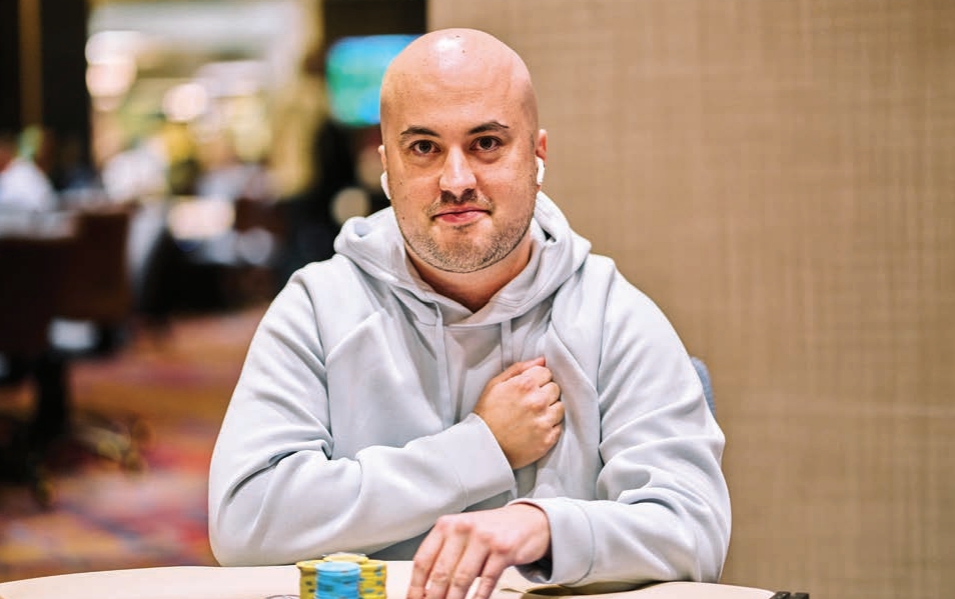
Evan Sandberg attended college at Rutgers University but dropped out after just two months and began playing poker at micro-stakes online. When he turned 21, he started playing at his local casino, Lucky Chances, outside of San Francisco.
He had a $3,000 bankroll at the time and jumped into the $3-$5 games, and then worked his way up to $5-$10. While Sandberg’s confidence was growing, so was his ego, which became his downfall in the games when the negative side of variance hit. He ended up broke and headed home.
Eventually, Sandberg drove to Las Vegas In January 2020, staked with a $350 loan from a friend, Sandberg got in his car and drove to Las Vegas. He’d have to live in the car for a bit, but he was ultimately able to build the roll up to $30,000. He was back in the game.
The following year would bring two breakout scores. He won an event at the 2021 WPT Showdown for $158,000, then took home the trophy at the Wynn Mystery Bounty for $380,000. In 2022, he scored World Series of Poker gold in the online series, topping the $2,000 no-limit event for $94,568. Last year, he added a second bracelet in the online series, cashing in for $124,831 in the $1,000 freezeout.
He found the winner’s circle at the 2024 WSOP Circuit main event in Lake Tahoe, besting a field of 439 for $133,841. This year, he returned and was able to pull off an incredible defense of his title, outlasting 436 players and pocketing another $125,269.
Card Player spoke with Sandberg to break down some key hands from his repeat win in Tahoe.
Craig Tapscott: It’s rare that someone goes back-to-back, especially in a big event with hundreds of players. What did it feel like to defend your title?
Evan Sandberg: As I was driving up there, I was in a mixed headspace because I had just come off a somewhat deep run in the WPT Bay 101 Shooting Star event where I had a big chip stack, played one really bad hand, and ultimately lost a flip a couple of hours later.
I was still feeling disappointed, but I also had confidence. I felt like, besides this one hand, I had been at the top of my game. The first thing I did when I settled into my hotel was go to the sauna, relax my muscles, release negative energy, and meditate.
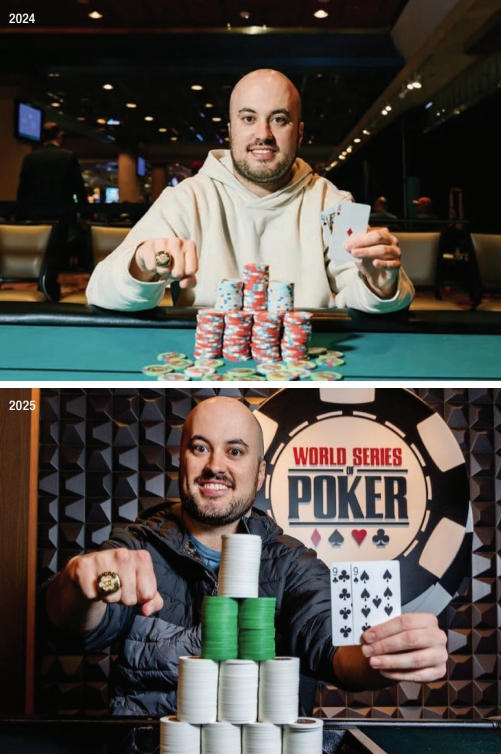
Back To Back At Tahoe
I knew Tahoe was the perfect place for me to be at that point because it’s very easy to feel grateful up there in the mountains. And I can honestly say that defending my title felt better than winning a bracelet. To have the opportunity to go back-to-back in a main event of a series is something that not many people have done.
Event: WSOP Circuit Lake Tahoe
Buy-In: $1,700
Entrants: 436
Prize Pool: $584,322
First-Place Prize: $125,269
Hand No. 1
Stacks: Evan Sandberg – 3,000,000 (60 BB) Villain – 5,000,000 (100 BB)
Blinds: 25,000-50,000 with a 50,000 big blind ante
Players remaining: 7
CT: Why do you think this is an important hand to share?
ES: I think this hand illustrates a few essential points about poker theory, holistic thinking, and understanding what solver outputs actually mean. I’ll explain.
Sandberg raised to 105,000 from the hijack holding 8♥7♥. The Villain called from the big blind.
ES: The Villain in the big blind was the chip leader.
FLOP: A♦Q♦9♠
Villain checked.
ES: On the flop, I feel like I have a pretty easy bet. My hand is so bad that it likely shouldn’t have been opened preflop in the first place, though it’s borderline.
But given I have no showdown value, and it’s a flop that gives me a significant range and nut advantage against the big blind, I think we can comfortably bet the bottom of our range.
Sandberg bet 140,000, and Villain called.
TURN: Q♠
Villain checked.
CT: What now?
ES: On the turn, things change a lot because some of my highest frequency checks on the flop come from second pair hands, so given that I bet, it’s a lot harder for me to have trips than it is for my opponent.
I was kind of expecting my opponent to come with a lead here some of the time. He checked relatively quickly. Thinking this was a bad card to bluff, I…
Sandberg checked behind.
RIVER: 6♠
Villain checked.
ES: My opponent checked quickly. My initial thought was that I needed to bet, because not only am I at the complete bottom of my range, but I also unblock diamonds and unblock straight draws. It just feels like a mandatory bet, and in the theoretical world, I think it is.
CT: But? I know there’s a but coming.
ES: But one thing I’ve realized about playing rivers, both as the aggressor and against aggressive action, is that certain things matter more than computer outputs, at least in my opinion.
CT: What are you asking yourself in this spot?
ES: Well, the most important question I try to ask myself when deciding whether to bluff a river is, do I think my opponent will call more often than he’s supposed to, or fold more often?
The second thing I think about is what’s called ‘future game considerations.’ This is a holistic form of poker thinking that current-day solvers aren’t yet very good at understanding, where you are thinking about how your future tournament is likely to play out after the hand progresses certain ways. It factors in things like the playability of your stack size, your skill advantage/disadvantage over your opponents, position at the table, and so on.
And finally, I think solver outputs come next in line for me. This is on the river, and the earlier streets of a poker hand, I think the level of importance of these things shifts drastically, and correctly executing solver theory becomes extremely important preflop and on the flop. I haven’t exactly heard others say this, but this is how I think about these things.
CT: A check was the best play from that evaluation.
ES: Yes. In this specific hand, I had reason to believe that my opponent was going to call me too often.
I think the point I’m trying to make is that on the river, it’s very important to understand that you are playing an exploitative game where not even the best players in the world are capable of playing like a computer.
Sandberg checked behind. Villain revealed Q♣8♦ and won the pot of 565,000.
Hand No. 2
Stacks: Evan Sandberg – 6,000,000 (50 BB) Francisco Trujillo –11,400,000 (95 BB)
Blinds: 60,000-120,000 with a 120,000 big blind ante
Players remaining: 2
ES: I was feeling very excited during heads-up play, as I was close to defending my title, something I could hardly have imagined just a couple of days earlier.
CT: Did you know much about your opponent?
ES: My opponent, Francisco, appeared to be a very good player. Interestingly, going into the final table, I assumed he was a weak, passive player because he didn’t have many cashes on his player profile. I had only played with him for about 30 minutes on the prior day, and he seemed to be playing very tight.
But I quickly realized at the start of the final table that the way he was playing and the sizings he was using indicated that he had actually had a lot of experience. I assumed he must be an online professional, but I’ve since heard that he plays high-stakes cash games in Los Angeles.
Sanberg limped the button holding 8♦4♥. Trujillo checked his option.
CT: What’s your general plan of attack for heads-up?
ES: My plan for preflop on the button was to mix limping, with 2.5x big blind open raises. When you’re deep stacked and getting 5:1 odds on a call in position, it’s pretty hard to fold!
FLOP: 10♣5♥3♠
Trujillo checked.
ES: I limped this weak holding and got a dry ten-high flop. I decided to use a large two-thirds pot sizing on the flop because I think it’s too easy for the big blind to find continues on this board versus a small sizing.
Sandberg bet 240,000, and Trujillo called.
TURN: Q♥
ES: The turn is the sketchy part of this hand, which, in my opinion, I misplayed. I don’t have access to any heads-up solvers, so I haven’t run this hand. However, when I examine this spot on the turn, I think it makes sense to use two sizing options.
CT: What are your choices and why?
ES: Well, I can overbet, as I eventually did. I think it’s slightly easier for my bluffs to connect with the queen than it is for my opponents’ calls, and I think it’s likely my opponent raises a lot of his strong hands on the flop.
But I don’t think I only want to have an overbet sizing here. Because I don’t think I need to be super polarized with my entire betting range. I think it makes sense to value bet a hand like J-10, and I wouldn’t want to overbet that hand; I would want to bet around two-thirds of the pot.
I think I should be putting 8-4 offsuit into the two-thirds pot sizing pile, or checking it back is okay too. When overbet bluffing the turn, I would rather have a chance of rivering a really strong hand.
CT: Please share an example.
ES: Say I have a gutshot straight draw, such as 7-6 offsuit, for example. Having a nine percent chance at hitting a miracle might not seem that great, but as a theorist and long-term thinker, you can appreciate how big a difference it really is. To have a chance of rivering a straight and going all in and possibly getting called in such a massive pot.
Big pots are made for big hands, and so my bluffs should have a chance of becoming big hands on the river. A solver might disagree slightly and use my hand as an overbet at some frequency. In practice, I don’t think it’s necessary.
Trujillo called.
CT: When you saw his call, did you have a plan formulated for the river?
ES: As he grabbed calling chips, I was feeling very nervous. From my experience, I get nervous not because I’m bluffing, but because I feel what I’m doing might be a mistake.
I told myself I was probably going to give up on the river, as most cards don’t feel natural to bluff on with my hand, and I didn’t want to risk it all.
RIVER: 6♦
ES: But when I saw an offsuit six hit the river, I quickly realized that I needed to go for it. The reason is that a lot of my bluffs are going to be straight draws that are coordinated either around the queen and the ten or the five and the three.
My cards interact well with the low cards; having a four in my hand makes me comfortable representing hands like 7-4 and 4-2 for a rivered straight.
I wouldn’t be nearly as comfortable trying to represent a straight on, say a nine river, where my cards don’t interact with my value range in any way.
Trujillo checked, and Sandberg shoved all-in.
CT: Were there any other considerations before you bombed the river?
ES: I considered my future game. I felt like I had an advantage over my opponent. (I had to believe that, as I was defending my title.) However, I didn’t think it was that significant an advantage to give up on this spot.
I had to take it, and I suddenly felt way more confident than I did on the turn. Because on the turn, I was kind of in no-man’s land, just going crazy with a couple of napkins. But on the river, I knew my hand made sense to bluff with.
Trujillo folded, and Sandberg raked in the pot.
- Photos by WPT, WSOP/Poker.org