







Even the best players in the world make mistakes. Join Sam Greenwood as he breaks down and analyzes hands played from the high roller circuit on his Punt Of The Day Substack.
The final stop of season 2 on the Triton Poker series was in Cyprus, and I found myself in the hunt for Player of the Year. Stephen Chidwick came into the stop with a commanding lead, but myself and some others had an outside chance to catch him.
I was one of the chip leaders with five left in the opening tournament, but I could not close it out and came in fifth place. In the meantime, Jason Koon did close out some tournaments, winning a $20,000 no-limit event and coming second in a $25,000 pot-limit Omaha tournament. So, going into the final table of the main event, there were still three of us in contention.
I entered the final table as a big stack, and Jason and Stephen were two of the short stacks. With a fortunate finish, I could overtake the lead if I won and if Stevie and Jason exited early. Things were looking good when I doubled up early after Viacheslav Bulydgin bluffed into my full house, and then Stevie was knocked out by Jason.
But my POY dreams were ultimately dashed, as Jason proceeded to steamroll through the final table before beating me heads up in just one hand.
The final table is likely best remembered for a spat between Jason and Dan Smith, but there’s another confrontation that loosely reminded me of a legendary poker hand: the clickback war between Phil Ivey and Paul Jackson in the 2005 Monte Carlo Millions.
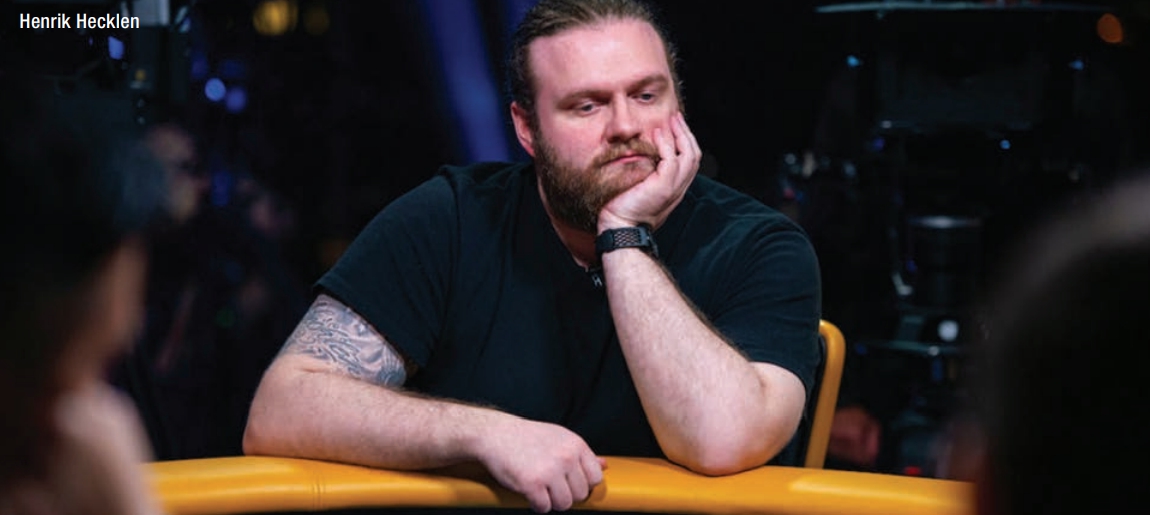
In this hand, I tried to play the role of Phil Ivey to Henrik Hecklen’s Paul Jackson, but unfortunately, Hecklen had the goods. Was this the right move at the wrong time, or the wrong move at the wrong time? Let’s look back at a final table clickback war and you can judge for yourself.
Event: 2023 Triton Cyprus $100,000 Main Event
The Hand
There were eight players remaining, with a stack of 7,200,000 and blinds at 75,000-150,000 with a 150,000 big blind ante. I raised in the hijack to 325,000 holding J♠8♠. Henrik Hecklen, who started the hand with 2,500,000, defended his big blind.
Flop: 10♠10♥2♣ (pot: 875,000)
Hecklen checked, and I bet 200,000. He check-raised to 525,000, and I reraised to 875,000. He raised to 1,200,000, and I folded.
What Was I Thinking?
I knew for chips, 10-10-2 rainbow was a pure continuation-bet from me, and the big blind would play raise or fold with all their continues. The board was so dry, and the out-of-position player has very few hands that would want to check-call. Especially under ICM pressure, where the big blind will fold a lot of 2-x preflop and will be even more aggressive with ace high.
So, while I was not sure if Henrik would play any check-calls on the flop, I knew his continuing range would be very aggressive. Once I got check-raised, I knew I needed to continue a lot and could not fold any hand with backdoor flush and straight draws. I also thought that for cEV (Chip Expected Value), Hecklen is supposed to fight back quite a bit vs my flop three-bets. But I was not sure if he’d have the same fight as a short stack at a final table.
I rolled an aggressive number. and I thought that if Hecklen was indeed playing raise or fold versus my c-bet, he would still need to make some pretty light floats vs. my flop three-bet to prevent my bluffs from winning a lot. I thought at a final table, he might just fold some pure continues with hands like A-9 with a backdoor flush draw, so I went for a reraise.
Once he four-bet, I figured at such a high-stakes final table, it was unlikely he was running a four-bet bluff on the flop. So I pitched it.
What Did I Get Wrong?
I am supposed to pure c-bet on the flop, and Hecklen pure raises all his continues. My hand mixes a tiny amount of flop three-bet, but I got a theoretical concept wrong in the construction of my flop three-betting range.
If Hecklen is not playing any calls on the flop, that means his flop check-raising range is linear. I am not facing a split range of the top and bottom of his continuing range when he raises; I am facing his entire continuing range.
When you are facing a linear range, your response is usually to be more linear with your aggression, which means a lot more of my three-bets are hands like A-K offsuit or K-Q with a backdoor, hands which are ahead of hands like A-9 with a backdoor or Q-J offsuit which the BB will check-raise and call a small three-bet with.
If I don’t think Hecklen is playing this node as loosely as the computer, it probably makes sense to be more polar in my three-bet bluffing range, but I should still have some stronger unpaired hands in my three-betting range. If I can three bet J-8 suited and fold out Q-J offsuit, it becomes a much more appealing class of hand to three-bet. (Yes, the board is 10-10-2 rainbow and I am talking about Q-J offsuit as if not putting seven big blinds in the pot on the flop is a crazy deviation. Paired-board computer poker can get bonkers.)
The other thing I got wrong is, once Hecklen clicks it back, I continue 76% of my range, including J-8 with a backdoor pure. My primary three-bet/folds are A-7 offsuit and worse, Q-9 offsuit, K-7/K-6, and Q-6, Q-5, Q-4 with a backdoor. I am not sure if Hecklen is bluffing often enough that I’d want to continue 76% vs. his flop four-bet, and it’s likely that folding most of my marginal continues is the way to go.
However, it’s unclear if J-8 suited is a marginal continue. I am likely missing the flop aggression with my most common three-bet/folds. (I really doubt I’m three-betting Q-6 suited on the flop here.)
However, all things considered, J-8 suited is quite a high-EV continue for me. It’s not as good a float as the hands that can have eight outs to turn an open ender, like 9-8 suited with a backdoor flush draw. But it’s much better than random high-card hands like K-Q offsuit.
Given Hecklen did have K♥10♣, I’m fine with my fold and with concluding he’s not playing as wild as the computer. However, that I didn’t even think about floating or playing back reflects a problem in my thought process.
Grade
My flop three-bet range construction was off. I should have picked hands that had a little more high-card equity to fight back against getting refloated, and I should have given a lot more thought to peeling against his four-bet.
They are two very minor mistakes, but if I’m going to be results-oriented and reward myself for folding to a four-bet from trips, I can also be results-oriented and give myself a little demerit for bluffing into trips in the first place.
Let’s call it a B-.
 Sam Greenwood is one of the winningest tournament poker players ever and is third on Canada’s all-time money list, having cashed for $42 million and counting in high roller events all over the world. The former stock trader-turned-champion has played millions of poker hands and is breaking them down street by street on his Punt Of The Day Substack. You can reach out to the Run It Once coach on Twitter/X for private coaching @SamGreenwoodRIO.
- Photo by Triton Poker