



If you were to face off against an equally skilled player, whoever had the stronger mental game would gain a long-term edge. In this guide to poker psychology, we outline the scientific principles that affect decision-making, the emotional issues that can result in tilt, and the mindset that will lead you to becoming a more consistent player.
Poker Psychology: Key Points
- Poker psychology encompasses a broad range of valuable concepts, including decision-making, emotional control, and player profiling.
- Poker is a complex game with a high cognitive load, requiring you to accurately process information and make decisions quickly and consistently.
- Emotional control is key. Without it, tilt can derail your A-game
- Poker psychology techniques are available to reduce and manage tilt, while building long-term mental resilience can help you to avoid it in the first place.
What Is Poker Psychology?
Poker psychology is used to consider how thoughts, emotions, and perception impact decision-making at the tables.
It covers three broad areas:
- Your own mental game: Your mindset, your ability to manage emotions, avoid tilt, stay focused, and think clearly when under pressure.
- Your opponent’s mental game: How opponents sitting at your table manage their emotions, how they react under pressure, and whether they have any mental weaknesses.
- Table dynamics: How your table image and the psychological dynamics present during the game impact players’ decisions and the overall flow of the game.
Why Poker Psychology Matters: The Mental Edge
Understanding the maths behind poker is important for developing your strategy.
Without the proper mindset and ability to adapt to each situation, though, you won’t be able to execute poker theory to the best of your ability. When you know how to use psychology in poker, you’ll be able to perform at your peak more often. Meanwhile, players who lack in that area will be prone to making mistakes.
So, although poker strategy is the foundation, it’s your understanding and application of poker psychology that will allow you to execute that strategy to the best of your ability.
Poker Psychology Explained: Decision-Making Process
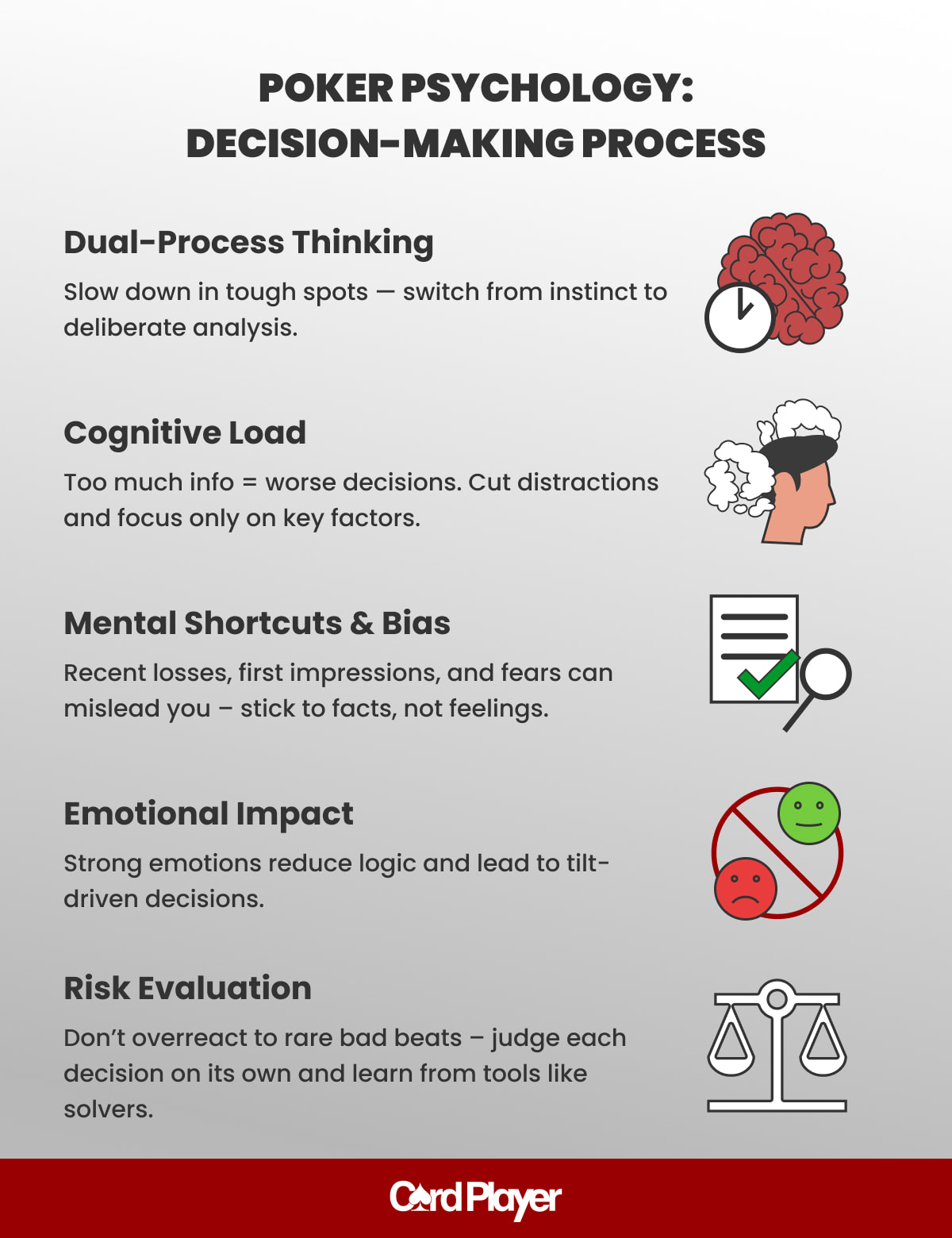
Poker is a highly psychologically demanding strategy game that involves high-level decision-making, risk, and emotional involvement. Given that all of these psychological processes are at work, it’s going to take a great deal of effort to overcome them so that you can make sound, logical decisions for the duration of your session.
Here’s the science behind decision-making in poker, backed by actual psychology.
Dual-Process Thinking
Humans rely on two systems of thought, and poker requires both.
System 1 is fast and intuitive, based on subconscious pattern recognition. System 2 involves slow, deliberate, analytical thought. Quick thinking is useful for routine situations, but complex decisions demand a slower, deliberate approach.
When it comes to a complex, uncommon, or potentially costly spot, you need to slow down and engage System 2.
Cognitive Load & Working Memory
As cognitive load increases, working memory becomes strained, which leads to poorer decision-making and an overautomation of processes.
As poker overloads you with incomplete information, mathematical calculations, betting sequences, and, to top it all off, serious time constraints, the game supplies a heavy cognitive load that you’ll need to be able to deal with. To manage cognitive load, reduce unnecessary distractions, and focus only on relevant information during a hand.
Mastering poker strategy also helps, as a well-structured thought process reduces this load.
Mental Shortcuts & Cognitive Bias
Because the brain uses shortcuts to process information, emotion, and bias often distorts logic at the table.
In the psychology of poker, the following well-established biases could have an impact on your gameplay:
- Availability bias: Recent experiences (like bad beats or coolers) distort your perception of risk and reward.
- Anchoring: Early impressions (such as firsthand strength or another player’s aggression) influence future decisions.
- Confirmation bias: You only notice evidence that supports your existing beliefs (e.g., “I always lose with aces”).
- Loss aversion: The pain of losing outweighs the joy of winning, creating overly tight play
To reduce bias, rely on a structured strategy and review hands objectively after each session.
Emotional Influence on Decision Quality
Emotions reduce logical accuracy and often lead to reactive play. This is known as tilt in poker, which we’ll cover in more detail soon.
Risk and Reward Evaluation
Poker psychology involves a lot of risk. In any hand that you play, there’s a risk you’ll lose chips. In real money poker games, those chips have a cash value.
Where risk is involved, inexperienced players tend to misjudge probabilities and variance, such as fearing rare events like coolers and taking short-term results as an indication of long-term win rate.
Treating each decision in poker as unique and individual will help you to overcome some of this, while using poker tools like solvers and equity calculators can give you a truly objective view of how you played a hand.
Tilt Management and Emotional Control Techniques
Tilt describes a state of emotional frustration often caused by losses and bad beats, which can lead to poor, impulsive decisions.
It can also arise from distractions, vendettas, and ego, or even from over-elation. In any case, going on tilt leads to subpar decision-making. One of the most important poker psychology techniques you can master is controlling your emotions.
Try the following poker psychology tips and see what works for you:
- Notice the early signs of tilt, such as tension in the body, rushed decisions, or urges to gamble impulsively.
- Use quick resets, such as breathing control or short breaks.
- Set stop-loss limits or take longer breaks during downswings.
Building Mental Resilience for Long-Term Success
To stay off tilt in the first place, build long-term resilience with proactive habits.
In order to do this, try the following poker psychology strategies and tips:
- Focus on decision quality over short-term outcomes.
- Gain experience so bad beats sting less.
- Apply bankroll management to protect yourself from variance.
- Review sessions to turn mistakes into learning opportunities.
- Maintain balance outside of poker through rest, nutrition, and exercise.
Table Image & Exploiting Perception
Poker is a game of incomplete information, so players fill in gaps with assumptions about you. Your image – tight, loose, or aggressive – affects how opponents react:
- Tight image: Steal more often and bluff selectively.
- Loose image: Tighten up and play value-heavy ranges.
- Aggressive image: Pressure timid opponent, but be ready for others to fight back.
Adjust your play based on how observant your opponents are.
Reading & Profiling Opponents
Everything we’ve talked about so far also applies to other players at your table.
They are subject to cognitive bias, risk aversion, tilt, and all other manner of poker psychology. As you gain a read on your opponents, don’t just think about their skill level, but also their psychological state.
Are they out to win, looking for a min-cash, or playing for fun? Do they take their time over decisions or act impulsively? How do they act under pressure, and are they scared to put chips in the middle?
Be sure to profile other players in a dynamic way and avoid static assumptions.
For example, how does an opponent react when they lose a big pot compared to winning one? Are they prone to tilt? How do they act at different stages of the tournament, such as when the bubble approaches?
Understanding poker psychology and how it impacts others will set you up to make moves that you simply wouldn’t be able to make if you treated everyone like robots. Noticing and exploiting a psychological or emotional gap can be just as powerful as knowing a set poker strategy.
Ego, Competition & Psychological Warfare
Poker is a competitive game, but letting your ego dictate your play is dangerous. The goal isn’t to ‘win back’ chips or prove dominance, it’s to make the best EV decisions.
In order to manage your ego at the table, you can use the following poker psychology techniques:
- Focus on decisions: Make rational decisions based on expected value and don’t fall into the trap of making moves to prove anything to yourself or others.
- Avoid ego battles: Don’t get fixated on beating a particular opponent or winning back chips from someone who has given you a hard time.
- Embrace folding: Folding is an important part of poker strategy, and you shouldn’t perceive it as weakness.
- Use controlled aggression: Play to win and apply pressure to other players, but do so within a solid framework of poker strategy.
5 Common Psychological Mistakes in Poker (and How to Fix Them)
Here are the most common poker psychology mistakes and how to fix them:
- Going on tilt: Acting out of frustration or letting emotion shroud logic. Use the poker psychology strategy and tips for avoiding tilt mentioned earlier, such as taking regular breaks.
- Focusing on short-term results: Chance and variance play a huge part in short-term poker results. Focusing on outcomes can be unproductive and frustrating. Instead, focus on making optimal decisions during every hand.
- Fear of losing: If you’re scared to lose your stack, you will miss spots and become a target for strong players. Use controlled aggression as part of your poker strategy.
- Ego-driven play: Taking hands personally, seeing folding as a weakness, or developing a vendetta against a player who wins your chips, can lead to huge mistakes. Keep your ego in check and revert to your foundational strategy.
- Ignoring table dynamics: Psychology in poker is not just about your own mental and emotional state, but also about how all other players at the table are thinking and feeling. Stay tuned in to table dynamics by observing the action even when you’re not in a hand.
Understanding Poker Psychology in Different Game Formats
Our guide on how to use psychology in poker applies to all formats of poker, both live and online.
However, each environment brings a different set of pressures and varying intensities. You’ll need to be well-equipped to deal with the game you are playing in order to keep a strong mental game.
Poker Psychology in Live vs Online Play
Here’s a quick rundown of poker psychology for live and online play:
Live poker
- Increased social pressure: Being face-to-face with other players can have a range of effects, from caution and defensiveness to concerns about ego and status.
- Physical cues: In live poker, it’s possible to read the body language and behavioral cues of other players, adding an extra dimension to the psychology of poker.
- Slower pace: The slower pace of live games reduces cognitive load, but it also potentially opens up the door to boredom and impatience.
Online poker
- Faster pace: In online poker, you’ll play more hands per hour, especially if multitabling, which increases cognitive load and can lead to autopiloting and cognitive bias.
- Higher potential for tilt: Although it can happen in any poker game, tilt can come on quicker online due to the potential for a quick succession of bad beats.
- Distractions: Playing online allows for greater external distractions, such as browsing, watching videos in the background, or becoming distracted by home life.
Poker Psychology in Cash Games vs Tournaments
And now, a look at how to use poker psychology in cash games versus poker tournaments:
Cash games
- Consistent decision-making based on chip EV (expected value) is key.
- Stack sizes remain quite constant, fewer high-pressure decisions per hand, but stress can accumulate over the session.
- Easy to leave the tables if you are tired or tilted, as long as you have the discipline to stop.
Tournaments
- Chip swings can be intense and decision stressful due to the risk of losing your stack.
- Long sessions require sustained focus and excellent tilt management.
- Need to be able to adapt to constantly shifting stack sizes and table dynamics.
Bringing It All Together: Your Complete Poker Psychology Framework
It’s been a rollercoaster ride exploring the ups and downs of applying poker psychology.
Now, it’s time to bring together everything we’ve learnt into an actionable checklist. You can use this as a quick reminder of important poker psychology strategies and tips.
To manage your mental game and stay on top of poker psychology, you’ll need to make an effort before, during, and after you play:
- Learn and master poker strategy. Doing so will allow you to rely on “fast thinking” for a greater number of decisions, reducing cognitive load.
- Mentally prepare for each session by clearing your to-do list, eliminating distractions, and warming up with some poker training or small stakes games.
- Maintain presence and confidence when playing. Stay focused on the action and absorb all of the relevant information to make informed decisions.
- Work on emotional control and tilt management to avoid decisions becoming shrouded by emotion.
- Stay aware of table dynamics and the psychological state of other players at all times so that you can find opportunities to win chips from tilting or scared money opponents.
- Analyze hand histories after your session and use poker tools to remain objective about situations and results. This will enable you to recognize instances where emotion or cognitive bias influenced your decisions.
- Learn to handle variance and downswings by using proper bankroll management and adopting a long-term approach for mental resilience.
Developing a strong mental game takes time and deliberate practice, just as learning poker strategy does. By consistently applying these principles and staying aware of both your own and your opponents’ psychological states, you’ll build the edge needed for lasting success at the tables.