






Spin Poker games are exciting and fast. They are designed for recreational players or those with limited time, who can only play poker for a few minutes at a time. However, despite the lottery elements and fast structure, it’s still possible to learn how to play Spin Poker more seriously.
This Spin Poker guide will help you to build your strategy from the ground up, from understanding how Spin Poker rules impact play, to building your preflop and postflop betting lines.
How to Play Spin Poker: Key Points
- Spin Poker is played three-handed with shallow stacks and hyper turbo blinds.
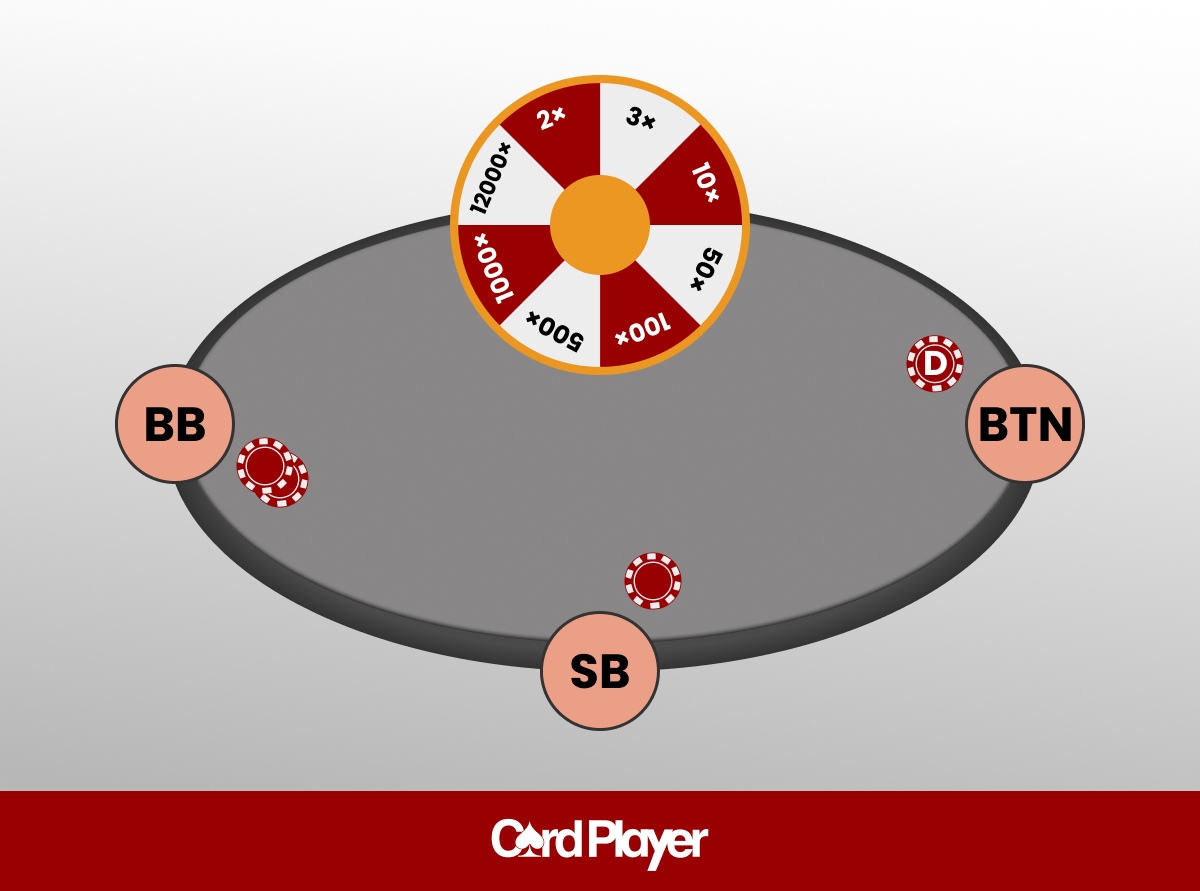
- Prize pools are randomized, ranging from 2x to over 12,000x the buy-in.
- Most Spin Poker games are winner-take-all, but higher multipliers add ICM considerations.
- Effective stacks drop fast, leading to push-fold Spin Poker strategy after just a few blind levels.
- Postflop play is simplified by low SPR, with many decisions resolved on the flop or turn.
- Player pools are recreation-heavy, offering profitable opportunities to exploit weaker opponents.
What Is Spin Poker?
Spin Poker is a fast-paced Sit & Go-style online poker game that can typically be played in under five minutes. The format is short-handed with shallow starting stacks and hyper turbo blinds. Additionally, prize money is randomized, and the winner often takes the majority of it (depending on the multiplier).
Basic Spin Poker Strategy Guide
Let’s break all that down so you can start to form a Spin Poker strategy:
- Short-handed – Spin Poker is usually played three-handed, so you’ll always be on the button or in the small or big blind. The blinds will be hitting you nearly constantly, so you’ll need aggressive opening ranges and impactful counter strategies. Your heads-up game will also need to be on point.
- Shallow stacks – With shallow starting stacks of up to 25 big blinds, you can’t afford to lose small pots playing speculative hands or calling down bets. Your actions need to be decisive, and your major decision will be made preflop or on the flop.
- Hyper turbo – The blinds increase every 1-5 minutes in Spin Poker depending on the multiplier, which further cuts effective stacks and forces the action. After just a few blind jumps, you’ll be down to less than 10 big blinds. From then on, you’ll mostly be using a push-fold Spin Poker strategy.
- Randomised prizes – In Spin Poker, the prize is randomly generated and can be anything from 2x to 12,000x the buy-in, or more. Most of the time, you’ll be playing for a 2-3x prize. Spinning a bigger multiplier can have an impact on gameplay and even structure, which we’ll cover in detail later on.
On top of these Spin Poker features, which are inherent in the game, you should also be aware of player pool tendencies. Spin Poker games tend to attract a greater ratio of recreational players to regs, so opponents may have severe leaks to exploit.
Look out for players who min-open every button, c-bet every flop, fold too much to pressure, or limp-fold the button or small blind. Exploiting these little mistakes will help you gain an edge over the field.
Three-Handed Spin Poker Preflop Plans That Hold Up Under Fire
Three-handed poker demands constant attention, as you’ll always be opening a wide range from the button or small blind and defending from the big blind. Here’s a guide to playing three-handed with the short stack conditions of Spin Poker games:
Button Play in Spin Poker
With a starting stack of 15-25 big blinds, you can often generate fold equity with button raises, as players in the blinds will be in an awkward position if they start calling wide. Your ranges should be looser if the big blind overfolds.
Surprisingly, limping also becomes an option in this situation. Limping allows you to play more hands in position against the big blind, denying them the option to re-shove while still giving yourself the opportunity to win the pot on the flop.
As the blinds rise, effective stacks fall to 10 big blinds or less, so you’ll switch to push-fold Spin Poker tactics. Keep in mind, though, that there are usually no antes in Spin Poker, so your shoving ranges should be slightly tighter than they usually would be.
Small Blind Play in Spin Poker
From the small blind, you will pretty much either be folding or reshoving versus a button raise. If the button is raising wide, widen your three-bet shoving range to take down big pots preflop.
Whenever the button folds, you’ll have the option to raise against the big blind. You can certainly raise your strong hands with the intention of getting it all-in and balance this with a few bluffs that you can raise-fold.
However, raising here is not always the best option from the small blind because you don’t want to inflate the pot out of position with a short stack. The GTO solution is to limp most of your range with 15 big blinds, including some strong hands that you can limp-call or limp-shove.
Again, once you fall to 10 big blinds or less, the decision becomes even simpler, and you can switch back to push-fold.
Big Blind Play in Spin Poker
Even with a 15 big blind stack, you’ll still need a minimum defense threshold to prevent yourself from being easily exploited. Otherwise, players can raise your blind every time knowing you will nearly always fold.
However, keep in mind that with such shallow stacks, most pots will be settled on the flop. Build your calling ranges around hands that flop well so that you can either fold or get your chips in the middle.
You can also three-bet shove over the top of a loose button or small blind raise, which is an option you should always weigh with 15 big blind stacks. Doing so will rob your opponents of their equity and help you to gain chips.
Low-SPR Spin Poker Reality: Commit Earlier Than You Think
Stack-to-pot ratio (SPR) is a measure of how big the pot is in relation to the effective stacks. In Spin Poker, SPR is always very low. Whenever there’s a postflop pot, stacks are guaranteed to be relatively shallow.
If you min-raise preflop with a 10-15 big blind stack and get called, the SPR is between 2 and 4. These stack depths support simple betting lines, such as raising all-in over a bet on the flop, or betting the flop and then jamming the turn.
As such, you should plan your betting lines around whether or not to commit on the flop. Here are some Spin Poker tips for playing the flop:
- C-betting the flop in position puts opponents to the test straight away, as they should want to avoid committing without a strong enough hand.
- You should only call c-bets yourself if you have a hand that is strong enough to commit to on the turn.
- Hands like top pair top kicker go up in value when SPR is low, as you can comfortably play for stacks as soon as possible.
- Hands like suited connectors go down in value with a low SPR because you can’t afford to draw, and implied odds are reduced. Instead, consider turning your strong draws into semi-bluffs while folding weaker draws.
Multipliers in Spin Poker: Play the Prize You Spun
In Spin Poker rules, the prize is randomly determined by the spin of a virtual wheel before the cards are dealt. The Spin Poker odds are weighted towards smaller multipliers that pay only first place.
However, every now and then, you’ll spin a rare high multiplier that pays much more, such as a 10x multiplier or 100x multiplier. It’s always great to see, and there’s no doubt that you and the other players will be zoning in and taking the game seriously.
Keep in mind that there are also significant differences in the structure of the higher multiplier spins. To improve player experience, they have a slightly more generous starting stack and slower structure.
For example, instead of 300 chip starting stacks, a higher structure might have 500 stacks. Instead of two-minute blind levels, you might get three or five-minute levels. This gives you room for manoeuvre when it comes to your opening ranges and postflop play, at least for the first few levels of play.
Very high multiplier spins will also have a different payout structure. They will award first, second, and sometimes even third place. First place takes the lion’s share, but everyone takes a slice. This introduces ICM strategy, as you’ll need to consider the potential of laddering up compared to the risks of accumulating chips. ICM is short for Independent Chip Modelling which assesses the value of chips in terms of their dollar equivalent in a payout structure. When the winner takes all, chips can be treated simply as chips, since you need all of them to profit by any amount at all.
In short, when you overcome the Spin Poker odds and hit a higher multiplier, you should play more like a standard Sit & Go.
Postflop in Spin Poker: Simple Lines and Exploits
When playing Spin Poker, you should avoid fancy betting lines that take multiple streets to execute.
When you have the initiative, you can use small continuation bets on the flop with value hands and bluffs, increasing your c-bet frequency bluff against players who overfold and your c-bet value range against players who call too often. If you’re planning on shoving the turn, size your flop bet to set up a pot-size shove.
When you are out of position or facing a bet, you can either check-shove the flop or call to set up the turn. Just be aware that calling the flop will often commit you to the hand, so don’t do it with medium strength hands that can’t call a turn bet.
Spin Poker strategy is all about simple yet effective lines that work for both value hands and bluffs.
Heads-Up Pivot: Close out Poker Spins Without Punting
As soon as the first player busts, the Spin Poker game will be down to heads-up. Stacks will still be shallow, so most of the advice offered so far still applies.
At this point, though, your ranges should widen considerably from the button so that you can take advantage of position. Likewise, you should start defending or playing back with a wider range from the big blind to counter the button.
Adapting to your opponents is key in a heads-up match. If your opponent overfolds, ramp up the pressure by raising every button. If the stacks are awkward, consider a limping strategy, mixing in strong hands so the big blind can’t overjam.
When you are playing out of the big blind, the best-case scenario is that you can punish opponents who raise-fold the button or who limp trash.
As effective stacks drop to 10 big blinds or less, Spin Poker tactics again shift to push-fold. Shove wide from the button, adjusting your ranges based on your opponent’s calling ranges. From the big blind, look for opportunities to call all in when you have the odds and equity.
In the end, a shove and a call is how a lot of Spin Poker games are concluded, so be prepared and study your charts to know your odds.
Mid-Game Adjustments in Spin Poker Without Leveling Wars
In Spin Poker, adjusting to other players is one of the main ways that you can gain a significant edge. Given the fast format, you’ll have to gauge opponents very quickly so that you can immediately start to exploit them.
Look out for preflop tendencies that give away how someone plays, such as limping every hand, raising every button, or overfolding the big blind. You should be able to spot these within a few orbits and make the necessary adjustments.
For example, if someone is raising every button, look for the next available opportunity to semi-bluff all in. If a player is overfolding the big blind, raise an even wider range from the button.
Postflop situations will occur less often, but when they happen, pay close attention. If an opponent c-bets every flop, be prepared to call down lighter or put them to the test by check-shoving a draw. If they always stab the turn after you check the flop, lay the trap with your monster hands.
These mid-game adjustments still maintain the essence of Spin Poker strategy, keeping your betting lines simple. Avoid leveling wars that can spiral into spewing. Pick your spots to counter other players, then drop back to baseline while you see how they react. Remember, you only need to win a few of these spots to pull ahead, ready for the shoving phase.
Bankroll, Variance, and Mindset in Poker Spins
Spin Poker games have extreme levels of variance due to the short-stacked, hyper turbo structure and prize lottery. We recommend an even deeper bankroll than you would have for regular Sit & Gos at the same stakes, at least 200-300 buy-ins.
If you’re looking to track your results, you’ll need to track your chip EV and $EV separately. This will allow you to see how over or under you are when it comes to spins, so that you can distinguish between bad play, variance in the game, and prize lottery variance.
Although the variance is high, you should pick up a small but consistent edge in Spin Poker games due to the recreational player pools at the lower stakes.
To continue improving your Spin Poker strategy, study small blind versus small blind spots, push-fold charts for 10-15 big blind stacks, and heads-up adjustments.