







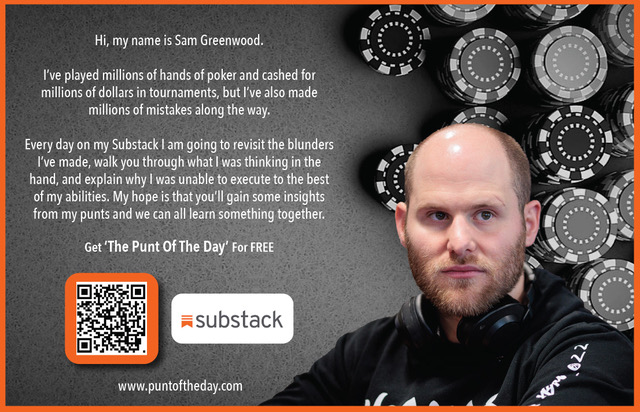
 Even the best players in the world make mistakes. Join Sam Greenwood as he breaks down and analyzes hands played from the high roller circuit on his Punt Of The Day Substack.
If you’ve played enough poker, you know not just what it’s like to tilt, but all the different flavors of tilt. There’s the classic “I just got bad beat” tilt, and “this guy next me won’t shut up” tilt, or “a short stack just doubled again” tilt, etc.
Occasionally an experienced player will recognize they’re feeling of one type of tilt, overcorrect, and find a whole other different type of tilt.
During EPT Monte Carlo in 2022, I busted the main event and then late-registered a $25,000 single day high roller. I almost immediately busted two bullets and hit the cage again to register for a third time.
Back in my seat, Adrian Mateos raised the cutoff and I looked down at K-Q offsuit in the big blind, sitting on 25 big blinds. Registration closed in 10 minutes.
Every fiber of my being was telling me to just call, as I really did not want to three-bet. But I recognized these scared emotions were the product of tilt and asked myself what the best play was. I decided to shove, got called by a pocket pair, lost a flip, and was left with reality of entering the tournament for a fourth time.
Shoving K-Q offsuit may have been a solver-approved play, but it’s chosen less frequently than calling. I was scared, recognized that fear, overcorrected, and put too much money in the pot.
In this edition of POTD, we return to Cyprus for the EPT series to look at a hand from 2023. I had busted the $50,000 super high roller in level 1 in a cooler. I took some time to cool off and as I prepared for bullet no. 2, and told myself I was going to play my best poker.
Then I flopped a set and a scary turn rolled off. As I was in the hand, I convinced myself I was playing how I’d normally play. I wasn’t going to let busting one bullet change my strategy. Or was I?
Every poker player knows the feeling of seeing monsters under the bed when they’re running bad. If you’re feeling that way it’s important to correct it, but calibration is important. Looking back on this hand, I can see that I was not playing my best.
Deep down, I was afraid of three-bulleting the tournament, but that concern made it much more likely I’d have to walk to the registration desk.
Event: 2023 EPT Cyprus $50,000 Super High Roller
The Hand
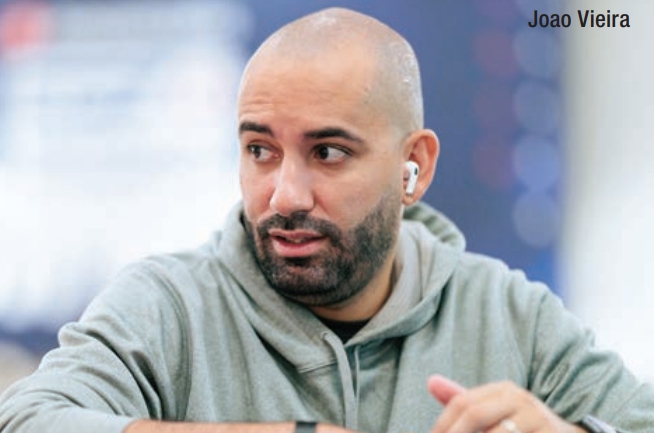
With blinds of 1,000-2,500 with a 2,500 big blind ante, Juan Pardo raised to 6,000 from the hijack. I called with 5♥5♠ in the small blind, and Joao Vieira called from the big blind.
Flop: J♠5♣3♠
Everyone checked around.
Turn: 4♥
I bet 6,000, and Joao raised to 21,000. Pardo folded, and I raised to 51,000. Joao raised to 120,000, and I moved all in for 250,000 total. Joao called with 7♥6♦.
River: 6♣
I failed to fill up on the river, and Joao won the pot with a turned straight.
What Was I Thinking?
I considered leading on the flop, but I thought I only got leads on boards where hands in my range flopped open-enders or two pair. On a flop of J-5-3, that’s not the case. I thought I needed a board like J-5-4.
The turn brought the 5-4-3 combo. I knew this was a good board for the big blind so I couldn’t bet big, but I thought I could split off a blocking-bet range, and sets would have to be included in my blocking range.
Joao raised me and I was worried about straights, but I thought by reraising I was pushing a lot of equity against draws, lower sets, and two pair.
Once Joao four-bet less than all in, I thought most of his bluffs would be high-equity bluffs, and getting them to call or fold would be better than calling and playing half-pot effective stacks on the river.
What I Got Wrong
I do get leads on the flop, and 5-5 is one of my highest frequency leads, but checking is fine. In POTD 21 (check out the Substack!), I wrote about a hand I played in November 2024 regarding turn strategy in a button vs. small blind vs. big blind three-way pot on a 7-6-6-10 board with a flush draw:
“In a heads-up pot, people understand you should play cautiously as the preflop raiser vs. the big blind on a board like 7-6-6. Well, on the turn, we’re out of position vs. a big blind range that is basically the same as their preflop defense range on a board that has 7-6-6 on it. You still must tread cautiously.”
Want to know what hand in my past drilled this mechanic into me? Today’s POTD. 7-6-6-10 flush draw and J-5-4-3 don’t have that much in common, but they’re both boards where the big blind has a lot of really good hands and the small blind and preflop raiser do not. Betting is fine and doesn’t lose EV, but my overall range strategy is heavy on checking.
Facing a raise, I still have a very good hand with a lot of equity. The problem is we are deep. Each subsequent bet put into the pot will be larger, and as more money goes into the pot, my equity will decrease. I have 75% equity facing a turn raise, but only 49% equity facing a turn four-bet. There’s a lot of value to be had putting in eight big blinds with 75% equity; there is no value putting in 100 big blinds with less than 50%.
Another minor note here is, against a 2.4x raise, Joao is mostly supposed to fold A-2 offsuit preflop. If he defends A-2 offsuit, that’s 12 more straight combos he could have, which makes reraising the turn even worse.
When I just call his initial turn raise, I can get away from my hand on scary rivers, or induce bluffs, or just lose less money vs. turned straights. Once I three-bet, I think just calling the four-bet would have been best, but shoving was okay. However, I could have intuited that having the 5♠ makes me less inclined to go all-in. Some of the four-bet bluffs Joao needs to reluctantly call off could be 5-x with a flush draw.
By just calling the turn, I’d allow myself to potentially check-fold some scary rivers. Such as, to pick an example at random, the 6♣!
Types Of Errors Made
- Too Much Money
- Misunderstanding Multi-Way Mechanics
Grade
In this punt, instead of being present and playing the hand to the best of my abilities, I was thinking, “What would someone who hadn’t busted their first bullet already do?” It’s a bad mindset to be in and caused me to play the hand poorly.
That being said, the hand is loosely solver-approved, and getting in a bunch of money with a set when your opponent never has a higher set can never be too bad a play. B-
 Sam Greenwood is one of the winningest tournament poker players ever and is third on Canada’s all-time money list, having cashed for $42 million and counting in high roller events all over the world. The former stock trader-turned-champion has played millions of poker hands and is breaking them down street by street on his Punt Of The Day Substack. You can reach out to the Run It Once coach on Twitter/X for private coaching @SamGreenwoodRIO.