







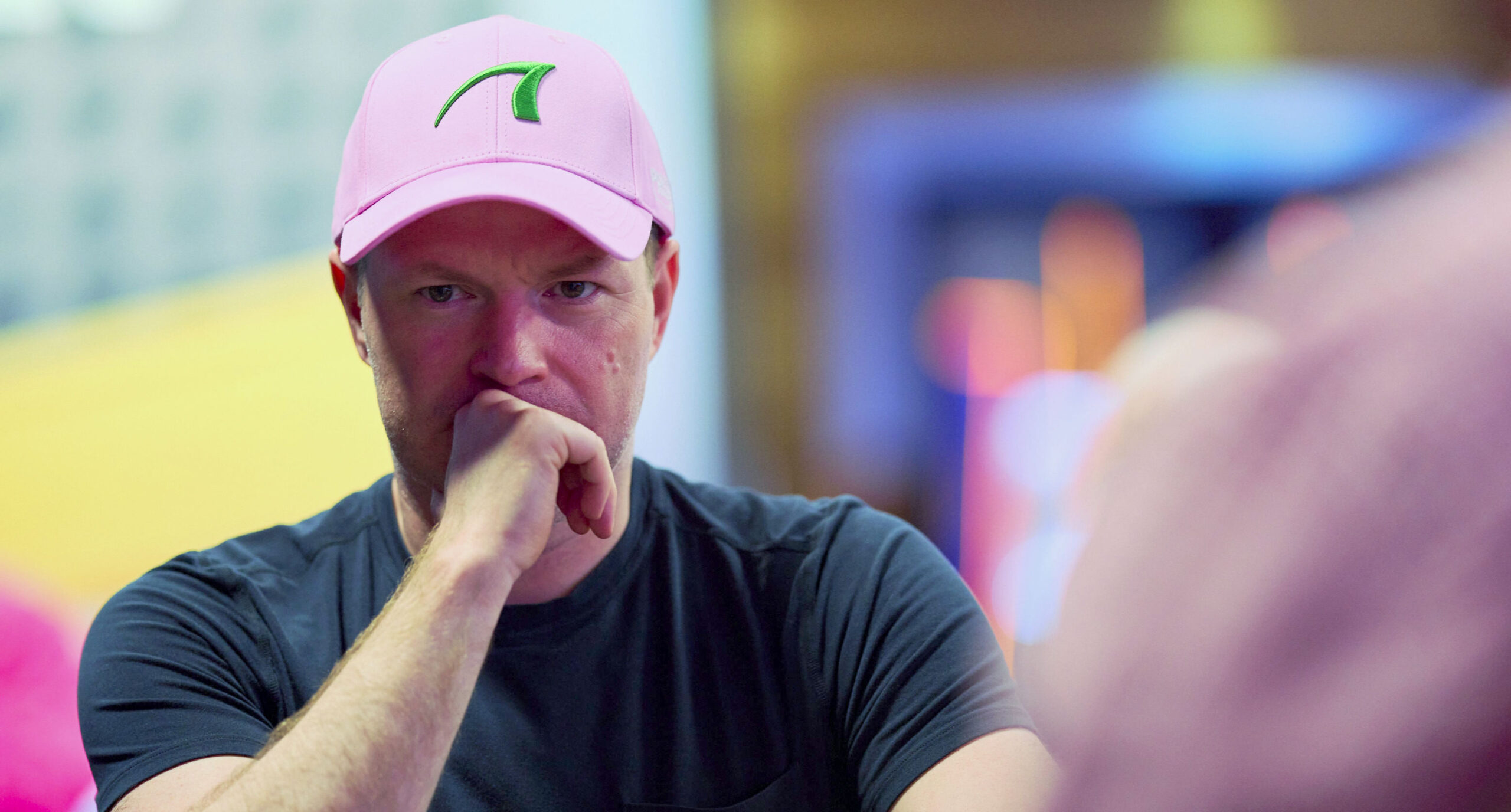
 If you want to increase your poker skills and learn to crush games, check out Jonathan Little’s elite training site at PokerCoaching.com.
When someone raises and then another player three-bets before the action gets to you, you must understand how tight you should play based on your opponents’ ranges.
In the most extreme situation, when a tight player raises from first position and another tight player three-bets from second position, you should fold every hand besides A-A and K-K. This may seem extremely conservative, but take a look at how pocket jacks fares versus even two reasonably tight ranges.
J-J – 33.15%
6-6+, A-10 suited+, K-J suited+, Q-J suited, J-10 suited, 10-9 suited, 8-7 suited, A-J offsuit+, K-Q offsuit+ – 24.56%
10-10+, A-Q suited+, A-K offsuit – 42.29%
The second line is the initial preflop raiser’s range and the third line is the tight three-bettors range. If you four-bet with J-J and get all-in, you will be against only premium hands.
J-J – 36.56%
J-J+, A-K suited, A-K offsuit – 63.44%
Playing for all the money with 36% equity is not how you win at poker. Sure, you will make your opponents fold some amount of the time, but when the money goes in, you will be crushed. Do not fall into the detrimental habit of thinking that you “must” go broke every time you have a traditionally strong hand.
The factor that determines your hand’s value is the ranges you are up against. If you are against only premium hands, you need an incredibly strong hand to enter the pot. In the previous situation, you should simply fold your jacks.
In the real world against normal players, with 80-big blind effective stacks, when faced with an early position raise to three big blinds and a three-bet from another early position player to nine big blinds, you should four-bet to 23 big blinds with A-A, K-K, Q-Q, and A-K, and be willing to get all-in with all of them. You should fold everything else, including J-J and A-Q.
Calling the preflop three-bet is also not a great option because you will have a difficult time playing your hand after the flop.
Imagine you called instead of folded from middle position with A-Q. The flop comes Q-7-5. If your opponent bets and you call, if you face any additional aggression on the turn or river, it is safe to assume you are against at least top pair, top kicker or a better made hand. This should lead you to fold, but if you are folding this hand, you are folding almost every hand in your range, making you easy to run over.
This also applies to when you call with pocket jacks and the flop comes with three undercards. Instead of getting involved in this situation where you have huge reverse implied odds (meaning you will either win a small pot or lose a large pot), you can simply fold.
You may be thinking that if you are only four-betting with the nuts that your opponents can exploit you by folding every time. While that is true, remember you are laying them excellent pot odds to call before the flop by four-betting to 23 big blinds. If your opponents fold hands like 10-10 and J-10 suited, they are folding hands that are getting roughly the right pot odds to call.
If you are wondering why I advocate four-betting A-K and getting all-in with it, it’s because A-K actually does not fare so well against a premium all-in range.
A-K suited – 45.68%
10-10+, A-Q suited+, A-K offsuit – 54.32%
The problem with folding once you put in 23 out of your 75-big blind stack is that you only need to win 34% of the time to break even. Against an extremely strong range of only J-J+ and A-K, your A-K offsuit will win 40% of the time. When you only need to win 34% of the time and you will win 40% of the time, you cannot justify folding unless you are on the bubble of a tournament. The only other time you should consider folding A-K offsuit is when you are against the super-tight range of Q-Q+ and A-K suited.
This same logic of playing tightly against a raise and a three-bettor also applies when the action comes from players in later positions. Even when facing a cutoff raise and a button three-bet, you should play somewhat snuggly from the blinds. In general, when you have to risk a ton of chips before the flop, you should only play your best hands because you do not need to stick around often at all to take advantage of your opponents’ large bets.
This also holds true when playing in cash games where a player normally plays tightly but when he raises before the flop, he makes it 10 big blinds. Just sit back and wait for the nuts. While it is exciting to ram and jam all-in with a wide range, unless you are against two overly loose, aggressive opponents, you should bide your time and wait until your opponents have weaker ranges.
If you want more resources to help you improve your game, I put together a course called Five-Day Preflop Challenge. This course is completely free inside Card Player Poker School!
When you join the Card Player Poker School (it’s free to join), you’ll also get:
- Free Downloadable Preflop Charts
- GTO Preflop Charts
- Video Classes
- Interactive Hand Quizzes
- Free Course: Master The Fundamentals
- Free Course: The 25 Biggest Leaks And How To Fix Them
- Free Training Every Week
 Jonathan Little is a WSOP bracelet winner, two-time WPT winner, and the 2024 PokerGO Cup champion with nearly $9 million million in live tournament earnings, best-selling author of 15 educational poker books, and 2019 GPI Poker Personality of the Year. If you want to increase your poker skills and learn to crush the games, check out his training site at PokerCoaching.com/cardplayer.
- Photo by PokerGO – Antonio Abrego