







 Even the best players in the world make mistakes. Join Sam Greenwood as he breaks down and analyzes hands played from the high roller circuit on his Punt Of The Day Substack.
In May, I returned to Montenegro for the first time since 2019. I was excited to return. It’s a beautiful property right on the ocean, and historically, a quick dip before play starts has been lucky for me.
It was that 2019 visit when I made the final table of three tournaments, including the main event, but like any poker stop, the line between a winning and losing trip is razor thin.
In the first tournament, I had a chip lead on the money bubble at a final table with a couple of micro stacks. I re-shoved Q-9 suited into Steve O’Dwyer’s Q-Q and I had to settle for a min-cash. Steve won the tournament.
In the third tournament, I bubbled when Leon Tsoukernik called my shove in Short Deck with 6-6 (a really bad hand in Short Deck).
I had already busted two bullets in the main event and engaged in my most professional behavior — calculating what place I’d need to finish on the third bullet in order to get in the black on the trip. I looked down at Q-J suited. Danny Tang had raised from middle position, and while I am not the biggest live read guy, I looked at him and thought, “I’ve never seen someone look so at peace in my life.”
I had 30 big blinds in the small blind and reconsidered. “You’re being crazy, Danny has played a ton of live poker, Q-J suited is always a shove here. Don’t be an idiot.”
I shoved and cracked his A-A, and the next day I was nearly the chip leader at the nine-handed final table.
So, I decided to analyze some hands I misplayed at this final table. Consider it a sort of virtual sage-burning to cleanse my poker soul at site where I punted six years ago.
Event: 2019 Triton Montenegro HKD 1,000,000 (~$125,000 USD) Main Event
The Hand
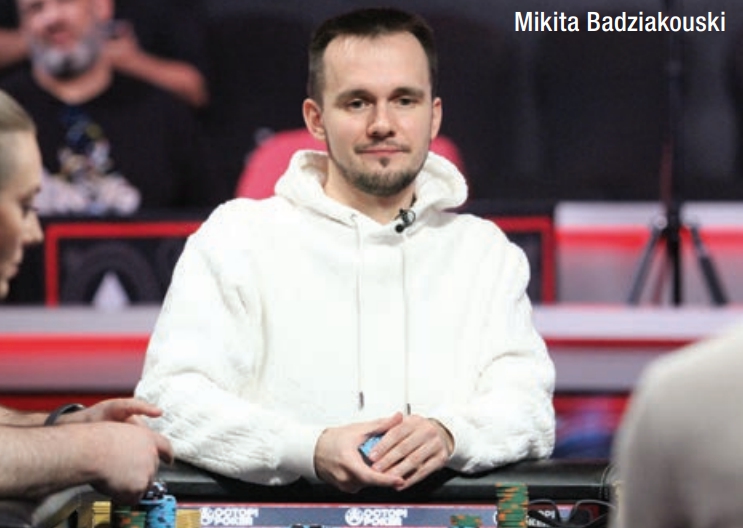
With blinds of 25,000-50,000 with a 50,000 big blind ante and nine players left at the final table, I was sitting on 2,700,000. The average was 2,080,000, and Mikita Badziakouski had me slightly covered with 2,800,000.
It folded to Mikita and raised to 110,000 from under-the-gun, and I called from the button with K♦6♦. The blinds folded.
Flop: J♠4♠3♦ (Pot: 345,000)
Mikita bet 110,000, and I called.
Turn: K♣ (Pot: 565,000)
Mikita bet 300,000, and I called.
River: 2♦ (Pot: 1,165,000)
This time Mikita checked. I bet 1,000,000, and he called with K♠Q♦ to take the pot.
What Was I Thinking?
I thought Mikita would be opening wide as the chip leader, but playing tight and cooperatively post-flop. I also thought that I would be flatting hands as strong as Q-Q, which would allow me to make some more speculative flats on the button.
On the flop, I thought king high, a backdoor flush draw and a backdoor straight draw was enough to continue versus a small bet.
On the turn I had top pair, but wasn’t interested in raising or folding, and never considered another option.
I believed that Mikita would always or almost always bet the river with a better hand than mine, so I believed I had a ton of pot equity and that I could make a large river bet. I bet one million chips and was dreaming of having at least 3 million and maybe 4 milliostn chips in my stack, but I got Mikita-Rolled when he called with K-Q after 30 seconds in the tank.
(Note: Mikita is a deliberate player. A Mikita-Roll is when you value bet, he tanks for long enough that you believe you 100% have the best hand, and then he calls with a better hand. The all-time Mikita-Roll was at the final table of an APPT High Roller in Macau: I shoved six big blinds on the button with 10-8 suited, and he asked for a count from the big blind despite being the chip leader before calling with A-Q.)
What I Got Wrong
A fun thing about this hand. Mikita (UTG), Matthias Eibinger (LJ) and Bryn Kenney (CO) all had similar stack sizes, so when I ran a solve for this hand, I looked to see if I can play K-6 suited against any of their raises.
I can three-bet it versus Bryn’s cutoff open, but it’s a pure fold versus Mikita or Matthias. It appears that the solver needs K-9 suited to flat, but often three-bets K-8 suited.
That being said, the metagame of high rollers at the time involved some very loose preflop play from chip leaders. It’s possible that if 2019 Mikita was opening a lot of small pairs, suited connectors, offsuit aces, and suited kings, then flatting K-6 suited could be a fine play, especially since he’d almost certainly play looser against a three-bet than the solver.
The flop peel was good. I mix continues on the flop with K-10 and K-9 with a backdoor, but K-6 suited has some special powers they don’t. I have so little 6-x in my preflop range that if I backdoor a straight, my hand will be really under-represented, especially on the 5-2 runout where I can get in a lot of money against wheels.
K-6 is a good bluffing hand on turns like ace, queen, jack, or 10 that hit my other floats. The flop call isn’t making much, but is fine.
On the turn, I didn’t consider any other options.
I should have considered other options on the river, however. I was in a spot in the tournament where I don’t want to value bet thin. I don’t have many bluffs, and I risk losing my table position if I’m called by a better hand.
Also, he doesn’t have many credible river check-calls. My preflop range is tight enough that he can’t check-call the river with ace high, so he needs to have a low pair like A-4, A-3, or A-2, a hand like J-x, or a mid pocket pair that bets on the flop and turn. But he rarely has those hands.
The main reason why value betting my hand doesn’t lose that much EV is because, in solver land, my range is supposed to be tight enough that I generate folds from hands like K-Q. So not only was my river strategy a fundamental and exploitative disaster, the Mikita-Roll was totally justified!
He had a neutral-EV bluff catcher and tanked before calling. If he knew my river strategy, he should have snap-called in the way you snap-call with the A♥ in a $2-$5 game when someone goes all-in on a board of 7♥9♥10♥J♥. If they have a straight flush, it’s just bad luck.
This was not “just bad luck” for Mikita, who got a nice gift from me. Check out my Substack to see if it was the only one I gave him at this final table. (It wasn’t.)
Types Of Errors Made
- Too Much Money
- ICM is for rich people, because they cash tournaments
Grade
A lot of the biggest punts in poker come from confidently making an assumption and proceeding without asking, “But what if I’m wrong?”
My preflop, flop, and turn plays in this hand are all on the edge, but fine. My river play is the real costly one.
I started with a ridiculous assumption — what if one of the best poker players in the world never checked the river strong? And then I compounded that by not asking, “If he never has a strong hand, what’s the best way to squeeze out some value against a weak bluff-catcher?” And then I bet a size that was way too large.
This was a poorly played hand and a costly one. My grade is a D.
 Sam Greenwood is one of the winningest tournament poker players ever and is third on Canada’s all-time money list, having cashed for $42 million and counting in high roller events all over the world. The former stock trader-turned-champion has played millions of poker hands and is breaking them down street by street on his Punt Of The Day Substack. You can reach out to the Run It Once coach on Twitter/X for private coaching @SamGreenwoodRIO.