






 It will be a few years before we celebrate the 25th anniversary of the beginning of the poker boom, but there is a 25th anniversary this year that I would like to acknowledge.
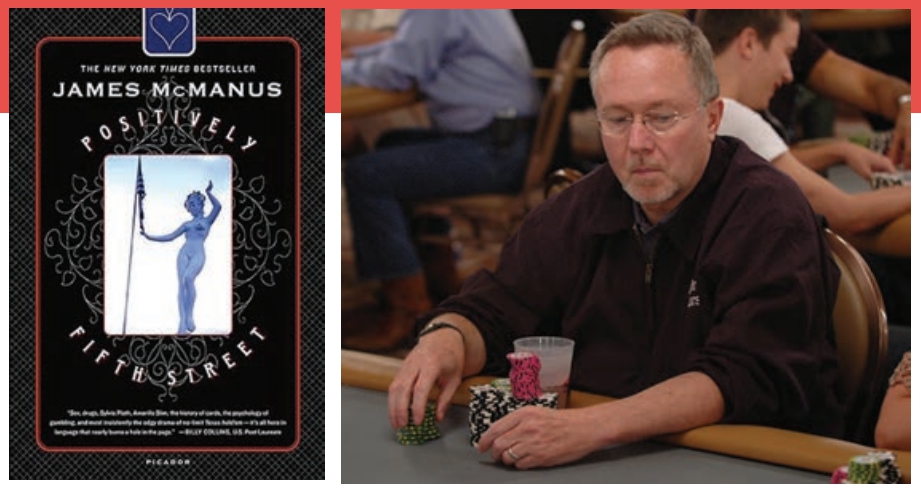
In 2000, a freelance writer from Chicago named Jim McManus was hired by Harper’s Weekly magazine to write an article on the World Series of Poker, focusing on women in poker. An amateur card player but an avid student of the game, McManus arrived in Las Vegas and promptly used the money from his advance to finance $1,000 satellites in hopes of winning a seat to the main event.
Spoiler alert — he was successful in this endeavor and became one of a whopping 651 entrants in that year’s event, which was still held at Binion’s Horseshoe downtown. Amazingly, he fought his way to the final table, highlights of which you can see in the PokerGO archives. Of course, in those days they did not have hole cameras (that invention coincided not coincidentally with the poker boom) so it is not very exciting to watch the action, but it is a kick to see what the tournament was like in the old days, including the smoking at the table. It is also a different style of poker, almost completely dependent on winning with premium cards with few bluffs and rare three-bets.
This would be of minor interest except that McManus captured the story in one of the best poker books ever written, Positively Fifth Street. I read the book when it came out and decided I would re-read it in celebration of the anniversary of that endeavor. Well, not quite – I decided I would listen to it read by the author in the Audible version. I quickly discovered that I had not read the fine print — what I was listening to was an abridged version of the book. That was a big disappointment, so if you want to get the full flavor of the story and digressions into numerous aspects of the game, you have to actually read the book. The good news is that unlike most poker books (no names will be mentioned here), it is written by someone with some literary flair so it is a delightful read.
What makes the book particularly interesting is the inclusion of the trial of Rick Tabish and Sandra Murphy for the murder of Ted Binion, son of Horseshoe founder Benny Binion, was going on at the same time as the WSOP. One might cringe as he becomes seduced (not literally) by Teddy’s sister Becky Binion Behan and her son Benny, but McManus is only human so we can forgive him this lapse as well as for his attendance at gentlemen’s clubs for research.
Those who were not born at the time all this happened might not know that Becky wrested control of the Horseshoe from her brother Jack and proceeded to run it into the ground. But maybe that is not a bad thing, considering that she would ultimately sell the WSOP to Caesars, who steered the series into the modern era.
There are a lot of “Poker and …” books, like poker and law, poker and Zen, poker and game theory, etc., but I don’t think there is another that looks at poker and murder.
The shifting between poker and murder can be jarring but also raises some interesting connections. The well-planned murder requires planning and execution, but there is also a good bit of luck involved. And to avoid suspicion, it requires a consistent story and effective bluffing. Are Tabish and Murphy as good at murder as many of the characters we encounter in the book are at poker? The outcome may surprise you, but you will have to look outside the book to see what happened after.
One of my favorite moments in the book describes a confrontation between McManus and T.J. Cloutier. Co-authoring with Tom McEvoy, Cloutier had written one of the few tournament strategy books available at the time, Championship No-Limit and Pot-Limit Hold’em. (I happen to have an autographed copy in my library.)
One of the memorable lines is, “To win a no-limit tournament, you have to win with A-K and you have to beat A-K.” That is certainly a true statement – but what exactly do you do with it? Anyway, throughout the tournament, McManus had relied on Cloutier’s book to guide his strategy and now here he was face-to-face with his mentor! I was reminded of the scene in the movie Patton when Patton bests Rommel in a tank battle and proclaims, “Rommel, you magnificent bastard, I read your book!”
McManus ended up at another final table in 2004. In a notorious incident, he was put on tilt by the behavior of Ellix Powers, a sometime street person. At one point this led McManus to call down Powers with just queen high.
After scooping the chips, Powers left the table and wandered through the casino and out to the street, proclaiming, “He called me with jack high!” a meme that soon appeared on t-shirts. You can find the video of the incident by searching “He called me with jack high.” It was not McManus’s finest moment, but he later became more sympathetic to Powers.
“The endlessly replayed clash between us is probably the lowlight of my poker career, and the highlight of his,” McManus said. “Ellix Powers was a good man who deserved to make more final tables and many more days in the sun.”
Thank you, Jim, for those kind words and for giving us a poker book that has managed to hold up for the last quarter of a century.
 Scott J. Burnham is Professor Emeritus at Gonzaga University School of Law in Spokane, Washington. He can be reached at profburnham@yahoo.com.