







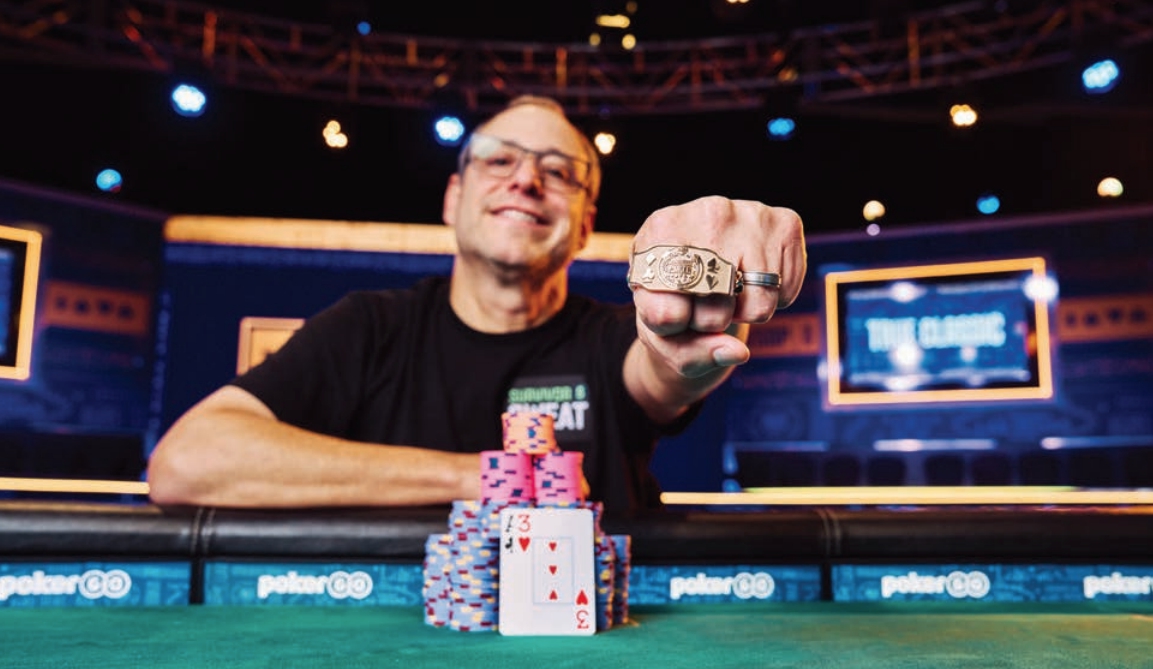
David Baker was surrounded by cheering friends and family as the consummate pro captured his fourth World Series of Poker bracelet this summer in the $5,000 seniors no-limit hold’em event.
It was an unexpectedly expressive win for the usually stoic Baker, but not surprising to the many players and fans who have followed the founder of the popular ODB Fantasy League’s long and storied career.
“I’ve spent my whole life as a grinder,” shard Baker. “I’ve always been kind of making money to pay for my family, my children, my travels, etc. I didn’t expect to get emotional after it was all over. They were definitely happy tears.”
Capturing a fourth piece of gold was special for Baker for numerous reasons, but the financial benefits from his second biggest lifetime score of over $640,000 hit different for the seasoned pro.
“With this win, I’m able to take a breath, put money into my bankroll, and towards my future. I’m getting older, even though I’ve shown no signs of slowing down. But there will come a point when I choose to do so. The WSOP win was a culmination of all those feelings.”
The 53-year-old then followed up his win with a third-place showing in the last $5,000 no-limit event of the summer, banking another $283,554. The WPT L.A. Poker Classic champion now has $8.6 million in career lifetime tournament earnings.
Card Player caught up with Baker a few weeks after the dust had settled from the long summer grind.
Card Player: You moved to Vegas for the first time not too long ago, correct?
David Baker: Yes. I was finally able to get my kids out of the house. (laughs) My wife and I moved to Vegas after our kids went to college, which was four years ago. This is the first time in my career that I actually live where there’s poker. For 20 years, I was nothing but a traveler. I would travel for cash games and tournaments.
CP: This win seems to stand out among your others. Can you share more about why this one meant so much?
 DB: As great as my career has been, I’ve had several chances at big wins slip away. With this event, I was doing my best to get over that hump and not finish short of the win. All my other bracelets combined didn’t equal the financial prize of this one. It was different. It wasn’t all about the bracelet.
Compared to the razz bracelet I won, this one actually had real-world implications. It was something like $200,000 or $250,000 difference between first and second, and $400,000 between third and first, and so it actually was very fulfilling for me and my family to get it done.
CP: The money is usually what is important from most players’ point of view.
DB: I don’t want this to come off as an arrogant statement, but it’s just, well, different as compared to winning $152,000 for my razz bracelet in 2023. The financial gain was significant, as was building on a legacy in the poker world.
CP: Do you see yourself continuing to play as long as someone like Doyle Brunson? Your love for the game has always been apparent.
DB: I’m a poker player. I mean, that’s what I am. It would always piss me off when the young guys would say, ‘If I won the main event, I’d never play again.’ I would think to myself, then you don’t have the love for the game.
I’m cut from the same cloth as Doyle, but I don’t really compare myself to him; not necessarily from my results, but more for the passion for the game.
CP: What category of grinder do you put yourself in, then?
DB: I think of myself more like a Shaun Deeb or a Scott Seiver. We do it for the love of the game, not necessarily because we have to, or because we’re good at it. We do it because we love it.
So, whether I need to or not is irrelevant to me. I’ll keep playing until I stop loving it. But right now, there’s no end in sight. I absolutely love it.
If the WSOP had continued for another four weeks, I would have been there for it. It doesn’t matter. I’ll play every day.
CP: You seem to have a rock-solid table presence. Can you share some of your keys to mental strength when approaching poker?
DB: First off, I will say that I probably am not the most mentally prepared or fit person. (laughs)
I mean, the people that I mentioned that have that immense love of the game, they are also some of the most mentally unstable people. Ask Seiver if he’s mentally stable; he’s not.
CP: Then how do you survive the lows when the game knocks you on your ass?
DB: I will say that it’s important to me to have supportive friends and family. Everybody kind of yearns for this, and you can’t force it. But I have an incredibly wonderful partner in life, and she’s my mental coach as well. My wife keeps me positive and grounded.
From a young person’s standpoint, you can’t necessarily force it into your life, a good wife or a good husband. I just kind of got lucky with that. I will say that it’s important to make sure you don’t settle for a bad one. Because the wrong choice can torpedo a career, somebody who doesn’t understand the lifestyle you’ve chosen to live. There’s no going back on that.
I also have a few close friends, Marco Johnson, Mark Gregorich, and Ray Henson, who are all very mentally strong. We’ve all had our ups and downs in the game, but their support is so very important to me. You know, family-first, then poker, family and poker are kind of hand-in-hand for our lives.
CP: You were winning before solvers and are now winning after. How has your approach to poker strategy changed over the last 10 years?
DB: I’ve watched a couple of training courses, and they’ve helped me. I would say I’m kind of in between the two, GTO and exploitative. I don’t study, but I do talk with some people who do. We go over concepts from time to time, and I’m very good at extrapolating what the strategy is saying and how I can adapt it to my own strategies.
CP: You just won your first no-limit bracelet. (Note: In addition to razz, Baker has also won the 8-game mix and limit hold’em events.) Clearly, the work is paying off, not that you were ever a slouch at hold’em.
DB: I think that’s why I’ve been more successful over the last several years in no-limit than some of the people I’ve grown up playing against. I’m not trying to overhaul my game or the things I’m good at, but I’m also not being ambivalent about the new way of playing.
You could talk to some people at the tables. If you ask them after they played with me for a day, ‘Does he do any studying?’ Some of them would say, ‘Absolutely not,’ and some of them would say, ‘Absolutely. He’s doing all the right things.’
I’ve always considered myself a chameleon, able to adapt to my surroundings. I understand and consider the actions of my opponents. Even within a tournament, I can adapt and be completely different.
I ended up also getting third in the last $5,000 event at the series, and I played multiple different styles. If you talked to one table, they would have thought that I was the tightest player ever, and if you spoke to the next table, I was an absolute maniac.

CP: What is the prime impetus for your switching of gears at the tables?
DB: I’m kind of trying to understand the motivations of the people around me, using that, and doing the opposite of what I perceive their motivations to be. To answer the question, I’ve implemented some minor changes, but I don’t do it all the time. When I’m making a play, I think I get a little more credit for maybe having it, or on the other side, being reckless.
For example, I’m able to overbet in spots where I’m supposed to overbet, but they don’t think that I’m doing it with that range of hands, whether it’s either the nuts or the bluffs.
CP: Why is that?
DB: Because they don’t think I’m playing a particular style, if that makes sense. The long and short of it is, I’m a hybrid of the new school and the old.
CP: Did you approach the senior event with a different strategy than you would usually?
DB: I haven’t played that many. I’m barely a senior. But this is the first one where I had any success.
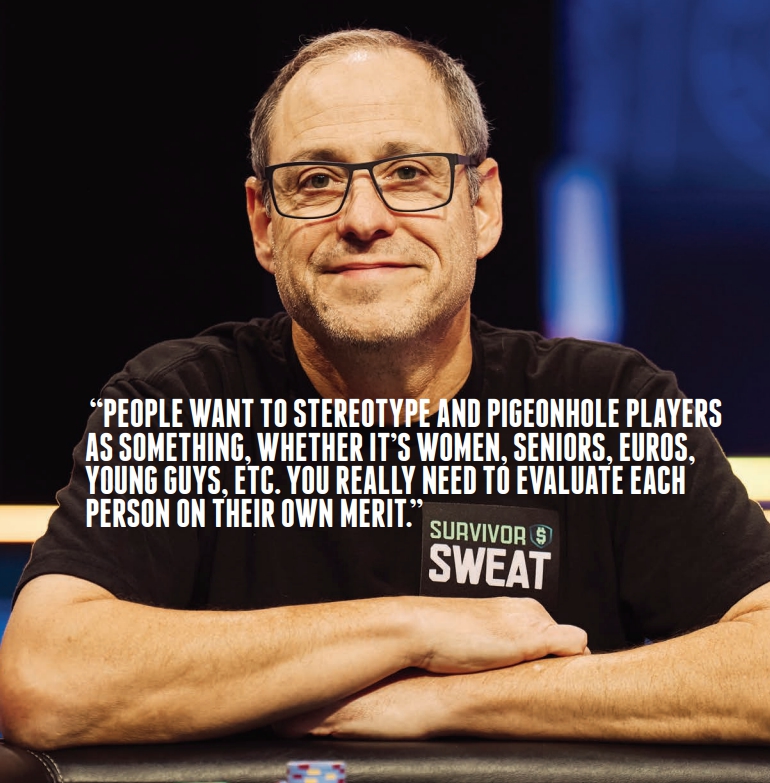
The thing is, people want to stereotype and pigeonhole players as something, whether it’s women, seniors, Euros, young guys, etc. You really need to evaluate each person on their own merit, whether it’s women, seniors, Euros, young guys, etc. You really need to evaluate each person on their own merit.
It’s kind of funny. We live in a society that tries not to place people into stereotypical roles. But at a poker table, people just want to say, ‘Oh, the seniors do this or that.’
CP: How did you look at it?
DB: Everybody’s still a poker player when it comes down to it. I don’t think you can necessarily go in with a certain strategy. You have to play each table, as each person has their own approach to the game.
Yeah, there were some more opportunities for me to apply pressure, but I will say there are a good number of seniors who were pushing back at me. I was the young guy, the ‘Euro player’ to them. (laughs)
Everything in poker, in my estimation, is playing your situation for the time and trying not to bring our own biases into each table.