






 Even the best players in the world make mistakes. Join Sam Greenwood as he breaks down and analyzes hands played from the high roller circuit on his Punt Of The Day Substack.
Monte Carlo was the first European Poker Tour stop I ever went to. I was 19 and wrote my final exam in around 55 minutes, rushed home, got my suitcase and went straight to the airport. (The professor of the exam I had just finished was also at the airport, so I guess we had both checked out on the school year.)
Registration had already closed for the main event by the time I arrived via bus at Monte Carlo Bay, so I could only play side events. I remember getting handed a stack of purple Euros to play a ₡5,000 event and couldn’t believe one bill was worth so much money.
I played a hand terribly vs a Dutch online cash game pro where I got in 100 blinds with 9♠8♦ on 9-7-6 all diamonds and made a full house versus flush. Someone later told me that the cash game player was a massive nit. I ended up bubbling the tournament and would need to wait over five years to cash my first tournament in Europe.
Anyway, that was the first trip. Let’s fast forward to last year and get to the hand, which has no thematic connection to the above story outside of it also taking place in Monte Carlo.
Event: 2024 Triton Monte Carlo WPT Global Slam
The Hand
Registration has just closed in the tournament and I am sitting on my 250,000 starting stack with blinds of 6,000-12,000 with a 12,000 big blind ante.
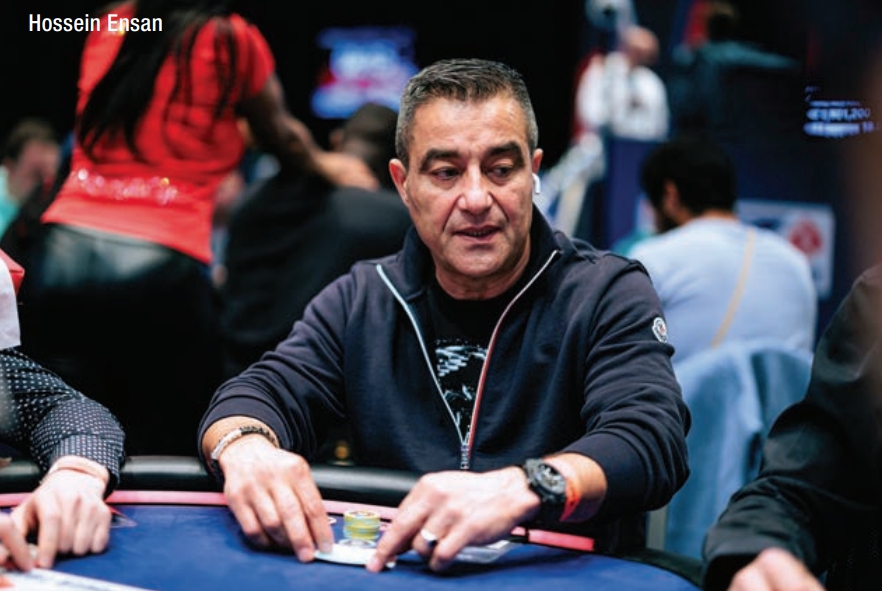
It folds to Xu Liang in the cutoff who raises to 28,000. I call with A♠8♠ on the button, and Hossein Ensan (2019 WSOP main event winner) defends from the big blind.
Flop: K♠10♠10♣
Hossein checks, Liang bets 12,000, and I call. Hossein makes it 50,000, Liang folds, and I call.
Turn: K♥
Hossein bets 58,000, and I call.
River: A♦
Hossein checks, and I check behind. He shows J♣10♦ and I muck.
What Was I Thinking?
Preflop I could have three-bet or called, but I had been battling and playing some crazy pots with Xu, aka Timmy, so I decided I was only going to three-bet if I was ready to also five-bet. I thought A-8 suited was the wrong hand for that.
On the flop, I played passively on paired boards with the big blind still to act behind. If you don’t have trips and the big blind continues, they often have trips, so you don’t want to put in a large raise into two uncapped ranges when you don’t have a blocker.
Once Hossein check-raised the flop, I didn’t want to reraise and risk getting bluffed off such a strong draw, and I also didn’t want to fold a nut flush draw.
I was expecting Hossein to check the offsuit king on the turn because his range looked like it had a lot of tens, and mine looked like it had a lot of kings. Once he bet, I thought his size was small enough that I’d get to continue nut flush draws.
On the river I had three competing thoughts that I mulled over. Maybe Hossein check-raised the flop with a king and is setting me up. Maybe he’s bluffing and I have showdown. Or maybe if he bet the turn with a ten he won’t fold it on the river.
All of those thoughts led me to check.
What Did I Get Wrong?
My preflop and flop logic were sound. My thought process on the turn was correct, as I would call twice on the flop with a king a lot more often than Hossein. I have a lot more top boats than he does and when I don’t have top boat, I often have tens full.
Solvers say to pure check the turn with range in Hossein’s spot, but he bet. This is where I started to get things wrong. Just because a solver chooses not to bet with range does not mean Hossein is “not allowed to.” He can do whatever he wants with his chips.
He has taken me off tree, and now it is my job to respond. 27% pot is a small bet, but calling twice on the flop has tightened up my range a lot. I have a full house a lot and a hand like mine is drawing dead versus his value bets, while blocking his bluffs.
If I wanted to continue some non-full house hands, I should start with straight flush draws, (I might have five combos of straight flush draws) or J-J/Q-Q, which I would probably pure three-bet preflop given the dynamic I’ve had vs Mr. Liang. But they would be better continues than bare nut flush draws.
The solver pure checks range on the turn because my range is stronger. Sometimes if you have a bad hand and someone bets into your strong range, the correct exploit is to start bluffing. Sometimes it just means they have a better hand than you and you should fold. This was one of those times.
On the river, I am not sure if my spidey-sense was right and I was not going to get him to fold enough, or if I was beating myself up for my bad turn call and gave up on the hand. If it was the former I deserve an attaboy, if it was the latter I deserve a demerit.
Types of Errors I Made
- Bad Read
- Focused too much on solver poker
Grade
When poker hands follow the script you expect, it’s easy to play well. The best players know how to improvise when things go off script.
In this hand, I knew I had been taken off tree, but didn’t make the right adjustment. I do not get points for knowing I was off tree, only lost chips for failing to execute.
I’ll give myself a C.
 Sam Greenwood is one of the winningest tournament poker players ever and is third on Canada’s all-time money list, having cashed for $42 million and counting in high roller events all over the world. The former stock trader-turned-champion has played millions of poker hands and is breaking them down street by street on his Punt Of The Day Substack. You can reach out to the Run It Once coach on Twitter/X for private coaching @SamGreenwoodRIO.
- Photo by PokerStars – Danny Maxwell