







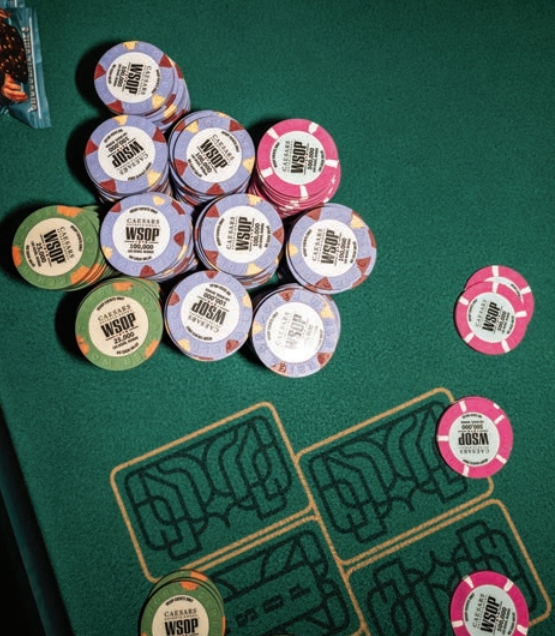
 In the WSOP, when players are heads up, is it against the rules to for one player to purposely lose chips to benefit another player?
This question is unfortunately not hypothetical, but based on what the WSOP has determined happened in the Millionaire Maker event when James Carroll, who had a 9:1 chip lead heads up, proceeded to make what many consider to be questionable plays in order to allow Jesse Yaginuma to win.
The alleged reason? Yaginuma was eligible for a $1 million bonus if he won, and presumably the parties came to an understanding about sharing that money.
In the law, we talk about questions of fact and questions of law. A question of fact is determining what happened and a question of law is determining the rule that is applicable to those facts; in a trial, the former is up to the jury and the latter is up to the judge. The jury is in on this one – the WSOP has determined that chip dumping did occur and has penalized the players involved.
However, this column is concerned only with the question of law – if there was chip dumping, is it against the rules?
On his YouTube channel, Doug Polk, for whom I have enormous respect, maintains that what these players did was not against the rules because it was an agreement only between the two of them and did not affect a third party. I think Doug’s conclusion results from a literal reading of the rule, which, like a lot of WSOP rules, is not as clear as it might be. Rule 40 states in part:
-
The competitive integrity of the WSOP Tournament is paramount. All Participants must adhere to the spirit and letter of these WSOP Official Tournament Rules that forbid play or any action that is illegal, unethical or constitutes cheating or collusion in any form.
-
Collusion is defined as any agreement between or among two (2) or more Participants to engage in illegal or unethical acts against other Participants. Collusion includes, but is not limited to, acts such as: chip dumping; soft play; sharing card information with another Participant; sending or receiving signals from or to another Participant; the use of electronic communication with the intent to facilitate collusion; and any other act that Host Properties deem inappropriate.
-
Chip dumping is defined as any agreement between or among two (2) or more Participants for one or more of the Participants to bet chips with the intent of increasing another Participant’s stack.
Polk is correct in reading “against other Participants” as involving a third party; that is, a player who is not one of the players involved in the collusion. I agree that the definition of collusion does suggest that two players are ganging up on a third. But this is not necessarily true of chip dumping, and “increasing another Participant’s stack” does not necessarily mean a third party is affected.
If Carrol agreed to dump chips to Yaginuma, then Yaginuma is the one whose stack is being increased, so he must fit the description of “another Participant” when the rule refers to “with the intent of increasing another Participant’s stack.” The rules should probably not state that collusion includes chip dumping, but should make them separate offenses.
In any event, a literal reading is trumped by the language at the end of the rule, which broadly prohibits “any other act that Host Properties deem inappropriate.” So even if chip dumping heads up is not collusion, the WSOP could still deem a such an agreement between two parties to be inappropriate and impose a penalty for doing it.
Finally, the WSOP can always invoke the meta-rule of 40.e:
Host Properties will penalize any act that, in the sole and absolute discretion of Host Properties, is inconsistent with these WSOP Official Tournament Rules or the best interests of the WSOP Tournament.
Sometimes less is more. The Tournament Director’s Association Rule covers the same territory in fewer words. TDA Rule 69 provides:
Ethical Play. Poker is an individual game. Soft play will result in penalties, which may include chip forfeiture and/or disqualification. Chip dumping and other forms of collusion will result in disqualification.
Some were upset that the WSOP initially announced that Yaginuma had won the bracelet and then a few days later, ruled otherwise. This is unfortunate, but probably unavoidable when allegations are not made or verified until after the tournament has been completed. The penalties for cheating and collusion are stated in WSOP Rule 40.f:
-
Anyone found to have engaged in or attempted to engage in any act that WSOP officials believe in their sole and absolute discretion compromises or could compromise the competitive integrity of the WSOP will be subject to sanctions imposed by Host Properties. The nature and extent of the sanctions imposed shall be in the sole and absolute discretion of Host Properties and may include, but shall not be limited to, the following:
-
FORFEITURE OF CHIPS
-
FORFEITURE OF PRIZE MONEY
-
EJECTION FROM AN EVENT OR THE ENTIRE WSOP TOURNAMENT
-
LOSS OF PRIVILEGE TO PARTICIPATE IN FUTURE WSOP EVENTS
-
EXCLUSION FROM ENTERING THE PREMISES OF CASINO AND/OR ALL DESIGNATED AFFILIATES OF HOST PROPERTIES.
While the sanctions don’t specifically enumerate a loss of a bracelet that had been awarded, this is covered by the lawyerly language “may include, but shall not be limited to” that precedes the enumerated list of sanctions. Perhaps the rules could be changed to include this remedy and to provide for changing a result after it has been initially announced.
Changing results after the fact is not unusual in sporting events. It happens all the time in horse racing, albeit after a fairly quick review. And in the Olympic Games, medals are reclaimed and awarded to others a long time later after drug tests come in.
Polk also argued that players should be able to make deals to divide the money and establish an order of finish as long as the tournament ends with the deal. If permitted, and the players had done so here, it would certainly look fishy that a player with a 9:1 lead would cede the bracelet to the other player.
Unfortunately, allowing deals would not make for good streaming and TV, and would have a ripple effect on things like the POY standings, the bracelet race, and side wagers, so the WSOP is unlikely to agree to it. It would, however, make many secret deals unnecessary and thereby improve the integrity of the game. Just not in this case. $1 million is a lot of money.
 Scott J. Burnham is Professor Emeritus at Gonzaga University School of Law in Spokane, Washington. He can be reached at profburnham@yahoo.com.