User Name Password  

HOME  
 
MAGAZINES
 
POKER NEWS
 
TOURNAMENTS
 
MULTIMEDIA
 
ONLINE POKER
 
TOOLS & TIPS
 
SUBSCRIBE
CARD PLAYER MAGAZINE
  • CURRENT
  • ARCHIVE
  • AUTHORS
  • SUBSCRIBE
 
CARD PLAYER EUROPE
HEADLINES
 
BLOGS
  • GUS HANSEN
  • ROY WINSTON
  • DANIEL NEGREANU
  • PHIL HELLMUTH
  • DOYLE BRUNSON
  • LEE WATKINSON
 
GAMBLING LEGISLATION
 
HISTORY OF POKER
SCHEDULE & RESULTS
 
PLAYER DATABASE
 
PLAYER OF THE YEAR
 
WSOP
 
WPT
 
NBC HEADS-UP
 
POKER SUPERSTARS
PHOTOS
 
CARDPLAYER TV
 
HAND REPLAYER
 
CP AUDIO
 
POKER MEDIA STORE
 
POKER DOWNLOAD STORE
CARD PLAYER POKER
 
ONLINE TOURNAMENTS
 
ONLINE ROOM REVIEWS
 
ONLINE PLAYER DATABASE
 
ONLINE POKER BEAT
CARD PLAYER PRO
 
POKER ROOM FINDER
 
RULES OF POKER
 
POKER ON TV
 
WEBMAIL
 
FORUM
 
ODDS CALCULATOR
 
POKER ANALYST
 
HAND MATCHUPS
26 ISSUES FOR $19.95
 
GIFT SUBSCRIPTION
 
POKER STORE
 
CARD PLAYER EUROPE
 
SUBSCRIPTION SUPPORT
 
RENEW SUBSCRIPTION
 
 
Sunday May 11, 2008
published: 5 months ago

Online Poker: Interview with Ben 'ShankingYou' Palmer

BY: SHAWN PATRICK GREEN | shawn.green@cardplayer.com

PUBLISHED: Sunday May 11, 2008 02:00 PM

Share this article with a friend


of


close
Talks About His Sunday Million Runner-Up Finish, Bubble Play, and the Poker Meta-Game

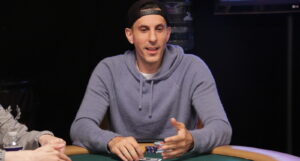
Ben 'ShankingYou' PalmerThe University of Florida has been the breeding ground for many online poker stars, players like Adam “Roothlus” Levy and Aaron “SpanishKey” Been, to name just two of many. Ben “ShankingYou” Palmer is another UF student who has been representing his alma mater well, and he carried that torch all the way to a runner-up finish in the Sunday Million just one week ago, making his biggest online score ever.

Palmer, a 24-year-old college graduate from Boca Raton, Florida, dropped out of law school to become a poker player.

“It didn’t work out for me; I didn’t like it,” Palmer said. “Obviously it was a ton of work, and the content just didn’t interest me, which made me realize that I didn’t want to be a lawyer. Plus, I could make money playing poker.”

That was about a year ago, and since then, he’s just been playing online for his income. His two-way chop at last week’s Sunday Million earned him more than $133,000, which is far more than the average yearly American salary, so it’s relatively safe to say that he’s not regretting his decision, yet.

Card Player caught up with Palmer after his deep finish to talk about outlasting so many players in such a huge field and the adrenaline rush of making a high-profile final table. He also talks about tournament strategy, including short-stack play, bubble play, and always making +EV [positive expected value] decisions.


Shawn Patrick Green: The biggest thing to happen to you recently was finishing as runner-up in the Sunday Million a few nights ago. What kind of adrenaline do you have once you’ve outlasted almost 7,000 other players to make the final table of such a high-profile event?

Ben “ShankingYou” Palmer: It’s definitely the biggest rush that you can get from anything. It’s the reason that we all play poker, to get that feeling when you get the chance to make that big score. Especially in the Sunday Million, which has always been a terrible tournament for me. I’d loathe every Sunday playing in that tournament before last week. So, it was nice to finally go deep, and it was crazy to actually make it to the final table. It surprised me because of how difficult it is to, like you said, outlast 7,000 people. So, it was definitely an amazing adrenaline rush, for sure.

SPG: And do you still get that with pretty much any tournament you play in, those same butterflies, or no?

BP: No. The other biggest tournament that I won online was the Sunday $100 rebuy about a month and a half ago, and that was definitely a big adrenaline rush, but it doesn’t compare to the Sunday Million. That was my first major final table on a Sunday, as well. So, definitely nothing compares to that.

Also, I had flown out to Vegas the day before to finish doing some house-hunting, so it was fun being out here with a couple of my friends right after I won it.

SPG: Considering that you did have a bit of butterflies, adrenaline, nervousness, whatever you want to call it, at this final table, how do you keep that in check to ensure that you continue to play your best?

BP: Well, if I told you the real answer to that, you wouldn’t be able to put it in the magazine.

SPG: [Laughing] Why not? Just go ahead.

BP: No, I’m not going to say what really keeps me calm.

SPG: Ah … [laughs]

BP: But just staying calm and taking deep breaths works. And playing in the same room as a couple of your buddies who are there just to kind of keep you calm — not telling you what to do, obviously — just keeping your head on straight and not letting you get tilted or bothered by any mistake you might make and stuff like that. That definitely helps.

SPG: Can you maybe go over some key moments or strategies in that tournament that led to your runner-up finish?

BP: Yeah, I would say that just staying patient when the blinds get high, even though you may be short. Everyone else is short, as well, when you get to the late stages, and there are going to be a lot of people who, because of the adrenaline, are going to get over-anxious, and they’re going to make mistakes and put their money in in bad spots. If you can wait to put yourself in the right position, you’re going to have a much better opportunity to survive. A lot of people are going to look down at marginal hands in certain situations and just go with it and bust.

Like, for instance, looking for a late-position raise that you can go all in over the top of instead of going all in with A-J when someone under the gun raises, something like that. So, not getting into a bad spot just because you think you have a good hand is what’s important. It’s really about evaluating the situation and making sure that it’s a good spot for you to get it in.

SPG: You chopped evenly heads-up and then played for $30,000. What thoughts went through your head when you were put to the decision whether or not to chop?

BP: It’s just such a large difference between first and second place. Basically, you’re flipping for $100,000.

SPG: Why is that? Was it the structure?

BP: Yeah, I think we both had like 15 or 16 big blinds when we got heads up, so even though I thought I had a skill-edge on my opponent, I wasn’t going to be able to just take away pots and outplay him. I was going to have to get it in with either 60/40s or just flips, and to lose $100,000 on something like that is not something that I was comfortable with. It’s just a safer and better idea to chop it and decrease your variance in that situation, even if you have an edge.

SPG: What would be the cutoff for making that kind of decision?

BP: I think if we were deeper-stacked and I had like 25 or 30 big blinds, where I had enough room that I thought I could outplay my opponent, I wouldn’t have chopped. If it was like $50,000 difference, I probably would have just played it out. So, I guess that would be my cutoff.

SPG: What mistakes are people making in those tournaments?

BP: You know what? To be honest, I don’t know, because I was one of those people making all of those mistakes [laughs] it seems like ever week. Well, actually, my mistakes were just not running good.

But I think people make mistakes in that tournament when it’s late, like I was talking about before. It’s just that — and I noticed it a lot in this tournament, watching players who I know have never been deep and played for this kind of money — when they did get a hand, and it was a marginal hand, they would get way too over-anxious and be willing to risk all of their chips just because they maybe hadn’t seen a hand in a while. People just get very impatient.

I think it’s one thing to put someone else to a decision, but I think too many people late in those tournaments are willing to call off, calling three-bets and four-bets all in, in a marginal spot when it’s better to just lay it down. If you can preserve a stack and everyone is shallow, and you have more than 10 big blinds, you still have enough, at any point in the tournament, to go on a little run and come back and win it.

SPG: What is the hardest part of playing online tournaments?

BP: I think the hardest part about playing online tournaments, for me, is adjusting to the game. It changes every few months; a while back, the game was full of everyone being extremely, extremely aggressive, and now it’s starting to change back to people playing a little bit tighter. It goes through a kind of ebb and flow, and it’s just tough to adjust to how everyone is playing, because a lot of people are changing their styles every few months and stuff like that. You kind of have to keep track and watch how everyone is playing, even if you’re not getting deep, to keep up with the curve.

SPG: You have to pay attention to the meta-game, more or less.

BP: Yeah, exactly. You get to know people very well from playing with them, and knowing what they’re going to do in certain spots — exactly. You have to pay attention to that.

SPG: Is it just as simple as playing whatever the prevailing style is not?

BP: No, I believe that there is a certain style that is the best. It’s a two plus two kind of strategy, just taking +EV spots all of the time in tournament play, I’m sure you’re familiar with that.

You can’t be too tight and you can’t be too loose. You need to be somewhere in the middle. You need to have half of the people think you’re a complete maniac and the other half think you’re tight. If you can achieve half of the people talking about you one way and half talking about you the exact opposite way, then you’re playing the right way, because that means that nobody really knows what you’re doing.

SPG: Something that you said at the beginning of that answer actually relates a debate that I’ve been instigating in a lot of my interviews. In a tournament, should you always be taking any +EV chance that you have, or should you be avoiding coin flips. Like, if you have a 55/45, and you are very confident that it is 55 percent in your favor, should you always take that, even in a tournament? Because a lot of people are saying no, you should wait for a better edge in a tournament, whereas in a cash game it’s a no-brainer, always take it.

BP: I believe that if you’re in a situation like that where you know you’re a favorite, you have to take it. A 55/45 edge is a pretty big edge. If you’re talking closer to a 50/50, there’s a debate, maybe, in some situations, but I’m a pretty firm believer in not passing up many +EV spots. I’ve had some discussions, too, and I think there are probably some spots where, if you have a big enough [skill] advantage, you should [fold as a favorite].

SPG: You busted out on the money bubble at the Borgata a few months ago. How hard is it to bubble, and what does it mean in the grand scheme of things?

BP: It is really tough, especially when you’re playing in one of those $10Ks, where you’re grinding for three or four days and then you bust and you’re disappointed like that. I know that I played the way I should have been playing, putting my money in in certain spots. I just got unlucky blind versus blind and ran into a big hand that knocked me out.

So, I think that in the grand scheme of things, if I continue to play like that, it’ll give me opportunities to get deep in the money. I was disappointed about bubbling, but not about the way I played in the tournament.

SPG: If you’re playing “correctly,” you’re risking bubbling more often because of the way that you’re supposed to play, by playing more aggressively on the bubble.

BP: Right, correct.

SPG: So, if you’re playing correctly, you’re going to be disappointed a lot more often, so you really have to learn how to deal with that.

BP: Right, you can’t worry about the bubble in tournaments like that. You have to continue to play optimally, because if you do worry about the bubble, you’re just going to blind out, and if you do happen to make the money, you’re not going to have a shot at winning the tournament. The prize pools are so top-heavy in all of the live events that a couple of min-cashes are not going to make up for the spots you’re passing up that would give you the opportunity to have a stack and get to the final table and get a top-three finish, which is what you’re always looking for.

SPG: What about when you’re short-stacked on the bubble? Should you still be playing really aggressively?

BP: No, when you’re short-stacked on the bubble, which is basically what I was, you want to be putting your whole stack in when you have a big hand, or you want to be able to shove from the button or the cutoff when it’s been folded to you if you have 10 big blinds or so. You’re basically going to shove any two cards and hope that you pick up the blinds, and if you do get called, you hope that you double up.

But you don’t want to be opening with a short stack and then folding to three bets. You have to be very selective, but you can’t be afraid to put your money in without having a good hand when no one else has entered the pot. Basically, your cards don’t matter; if you’re in late position and it has been folded to you, you have to stick in your last 10 big blinds.

SPG: A decent amount of poker talent has come from the University of Florida. Who do you talk to from there?

BP: There’s actually only one person from there; his name is Ryan “toetagU” [Fair]. I started playing there, but I learned poker mostly from being online and in forums and from a couple of my friends, known online as Akat11 [Adam Katz], Thecronic420 [Jamie Rosen], intervention [Aditya Agarwal], cdbr3799 [Chris Dombrowski], and Brynkenney [Bryn Kenney].

SPG: Well, how did you take up poker in the first place, then, and what did you do to get better?

BP: I took it up when I was a sophomore in college. I guess that was in ’03, around the same time as [Chris] Moneymaker. I started playing on PartyPoker, and I made some $50 deposits, and I was playing cash and would win money and lose money like everyone else. I think six months after that I started playing on Absolute poker, and I played on there for a while and did OK and made some money, and then I got money over to Stars and Full Tilt and kind of ran from there.

The way that I really improved was getting on [the poker forums] within the last year and going on the high-stakes forums and reading what all of the good players were talking about. I do post, but for a while I would just lurk and learn from them, and I picked up a ton from looking at those hand histories and listening to what they had to say.

SPG: Have there been many ah-ha moments for you in poker?

BP: Yeah, actually, I have to give credit to Psyduck [Vivek Rajkumar]. I got some coaching sessions from him, and we went over some hand histories, and he just pointed out some — and they seem so obvious to me now — leaks in my game that he helped me fix up. It really clicked for me after that. I didn’t necessarily go on to win a ton right away, but I could feel myself playing so much better and not making some of the really dumb mistakes that I was making playing tournaments. So, that was really the moment that I went from being a decent player to a pretty good player, and I’ve been improving since then.

SPG: Can you give us an example of a leak that you plugged?

BP: Yeah, sure. One of the big leaks that a lot of people still have now is playing small pairs, like deuces through fives, by raising them in early position with 15-20 big blind stacks. Because basically all you’re doing is just a blind steal; you’re turning your hand into a bluff. And when you do get called, you’re only going to hit a set one in eight times, and you’re just going to spew a lot of chips off like that. It’s really just better, if you’re under the gun with a certain stack to just fold small pairs and not to try to play them from that spot. That was one of my leaks that he helped me plug.

SPG: What is the key difference between good poker players — like many (surely too many) of us think we are — and great poker players?

BP: I think that the great players — and I don’t consider myself one, yet — just have a natural ability to be good at poker; they just have instincts. They learn the game, as well, but a few guys, like lilholdem [Chad Batista] and P0KERPR0 [James Campbell] probably can’t even explain what they’re doing all of the time, but their instincts are always just spot-on. They tend to make the right moves without learning it; the rest of us need to take our time and figure everything out. Those people who are the best are really just that gifted.

 
 Prev | Page 774 of 3658 | Next 
 
 
Messages that harass, abuse or threaten other members; have obscene or otherwise objectionable content; have spam, commercial or advertising content or links may be removed and may result in the loss of your MyCardPlayer ID (including e-mail). Please do not post any private information unless you want it to be available publicly. Never assume that you are completely anonymous and cannot be identified by your posts.


Borgata Poker Open: Champion:
Vivek Rajkumar wins the 2008 WPT Borgata Poker Open.
 
The Scoop: Bill Edler:
Card Player TV's "The Scoop" with special guest Bill Edler.
 
Strategy: Erik Seidel:
Card Player TV sits down with Erik Seidel to discuss playing draws.


about 3 hours ago
WPT: North American Poker Championship Day 3
44 minutes ago
Dennis Phillips Auctioning Spot on WSOP Shirt for Charity
about 1 hour ago
Samuel Oberlin Wins Southern Indiana WSOP Circuit Championship
about 24 hours ago
Tournament Trail: Festa al Lago -- Nick Binger Finishes 1st then 2nd
 VIEW POKER NEWS ARCHIVES
 
 
Oct 15, 08
Alec Torelli
Calling Station
 
Oct 14, 08
Shannon Shorr
Complete Recap from Bellagio 2000
 
Oct 13, 08
Doyle Brunson
DOYLISM OF THE DAY: "Criticizing someone else's garden doesn't keep the weeds out...
 
Oct 12, 08
Roy "The Oracle" Winston
Day 1 and off to NY City
 
Oct 10, 08
Daniel Negreanu's Blog
Why I Play Poker... and other stuff
 
Oct 09, 08
Padraig Parkinson
A Bad Day for the Goliaths
 
Oct 07, 08
Justin "WPTHero" Rollo
A Picture is worth a thousand words, re: PCA Sats so far
 
Oct 07, 08
Lee Watkinson
Am I a passionate man?
 
Oct 07, 08
Andrew "Foucault" Brokos
Strange Play in a Four-Bet Pot
 
Oct 07, 08
Phil Hellmuth
Rock stars on the roof
 
Sep 30, 08
Dani "Ansky" Stern
Shana Tovah
 
Sep 29, 08
Behind the Scenes on the Tournament Trail
On the Road - Back to New Jersey
 
Sep 18, 08
Mike Matusow
Ask the Mouth: Best Hand Readers, Biggest Tilters...
 
 VIEW ALL BLOGS


Home | Advertise with Us | Customer Support | Subscription Support | News & Press | Contact Us | About Us | Terms of Use | Privacy Policy
Site Map | Copyright © 2001-2008 CardPlayer.com, All rights reserved.  Visit our Support Center to send us feedback
Card Player encourages you to gamble responsibly. If you or someone you know has a gambling problem, call 800.522.4700 or go to: www.ncpgambling.org. U.S. Citizens Please Note: The information contained at this site is for news and entertainment purposes only. Any use of this information in violation of any federal, state, or local laws is prohibited. Caveat: It is now a felony to play online poker in the state of Washington.