







If you want to increase your poker skills and learn to crush games, check out Jonathan Little’s elite training site at PokerCoaching.com.
The Hand
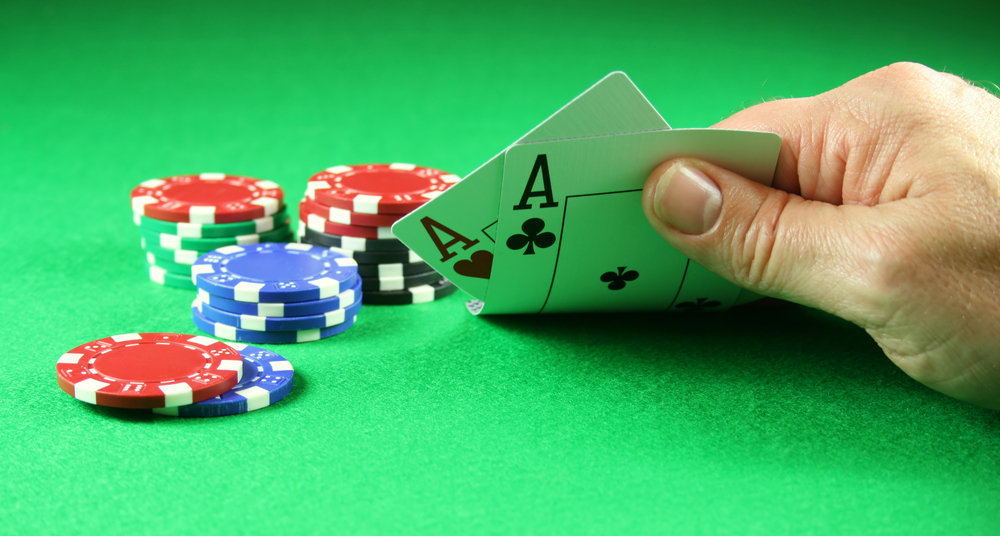
In a $1,500 buy-in poker tournament, I looked down at A♠A♣ from first position. With blinds at 200-400 with a 400 big blind ante, I raised to 1,200 out of my 40,000 stack. A strong player called from middle position out of his 32,000 stack, as did the small blind and big blind. Both players in the blinds were reasonable players who had 40,000 in chips.
The Flop
The flop came down K♥8♥2♦. Both blinds checked and I bet 3,000 into the 5,200 pot. ‘
While a smaller bet is usually ideal in multi-way pots from a GTO (game theory optimal) point of view, I often bet larger when up against players who I do not think are world-class, because most of them will call with roughly the same range regardless of my bet size.
Only the good player from middle position called.
The caller’s range is likely somewhat wide, including any pair (except pocket pairs worse than middle pair) and all flush draws. I can discount K-K, 8-8, and 2-2 because many players will raise those on the flop. K-8, K-2, and 8-2 are unlikely because those hands would not call my initial preflop raise. This led me to believe that I was either against a worse made hand or a flush draw.
The Turn
The turn was the 3♠.
Given this card is highly unlikely to improve my opponent to a better made hand than my aces, and I thought he could easily call a turn bet with most pairs and flush draws, I bet 5,200 into the 11,200 pot. My opponent called.
The River
The river was the 6♥, completing the obvious flush draw.
While it is unlikely that my opponent’s made hands improved on the river, the flush draws improved to beat me. If I thought my opponent was the type of player who would call a small bet with top or middle pair even when an obviously scary card arrives, I should make a small bet of 8,000 into the 21,600 pot. Given I thought my opponent was good (and unlikely to pay off a small bet), I decided to check.
After some thought, my opponent pushed all-in for 22,300 into the 21,600 pot.
That was not what I wanted to happen! At this point, I had to figure out my opponent’s river pushing range and see how my A-A fared, which implied I had to figure out which hands he was checking. Most players would not go all-in with top pair in this situation, opting instead to check and win at the showdown most of the time. Many players would also not turn a hand like 9-9 or 8-7 into a bluff, although some excellent players would (because those hands are now at the bottom of their range).
Notice that there are very few other hands in my opponent’s range that could be used as a bluff, given I rarely expect my opponent to get to the river with an unpaired hand that did not improve to a flush.
The Outcome
Because of this, I decided to fold to my opponent’s all-in. Of course, my opponent may have made a sophisticated bluff with top or middle pair, but I think I am crushed most of the time.
It is important to constantly assess your opponent’s range and see how your hand fares. In this spot, I think folding is the only play that makes sense. Just be sure you structure your river checking range so you can call the all-in in an unexploitable manner. If you fold to an all-in every time you check, you are ripe for being exploited.
Level Up Your Game
If you want more resources to help you improve your game, check out the Card Player Poker School powered by PokerCoaching.com.
Sign up and get access to nearly 70 FREE courses such as the Five-Day Preflop Challenge, Mastering The Fundamentals, Crushing Small Stakes Cash Games, How To Beat Loose Live Games, and 25 Biggest Leaks And How To Fix Them. Students also get free downloadable preflop GTO charts, interactive hand quizzes, and free training every week.
 Jonathan Little is a WSOP bracelet winner, two-time WPT winner, and the 2024 PokerGO Cup champion with $9 million million in live tournament earnings. He is a best-selling author of 15 educational poker books, and the 2019 GPI Poker Personality of the Year. If you want to increase your skills and learn to crush games, check out PokerCoaching.com/cardplayer.