







Raise in Poker: Definition, Rules & Common Mistakes
What Is a Raise in Poker?
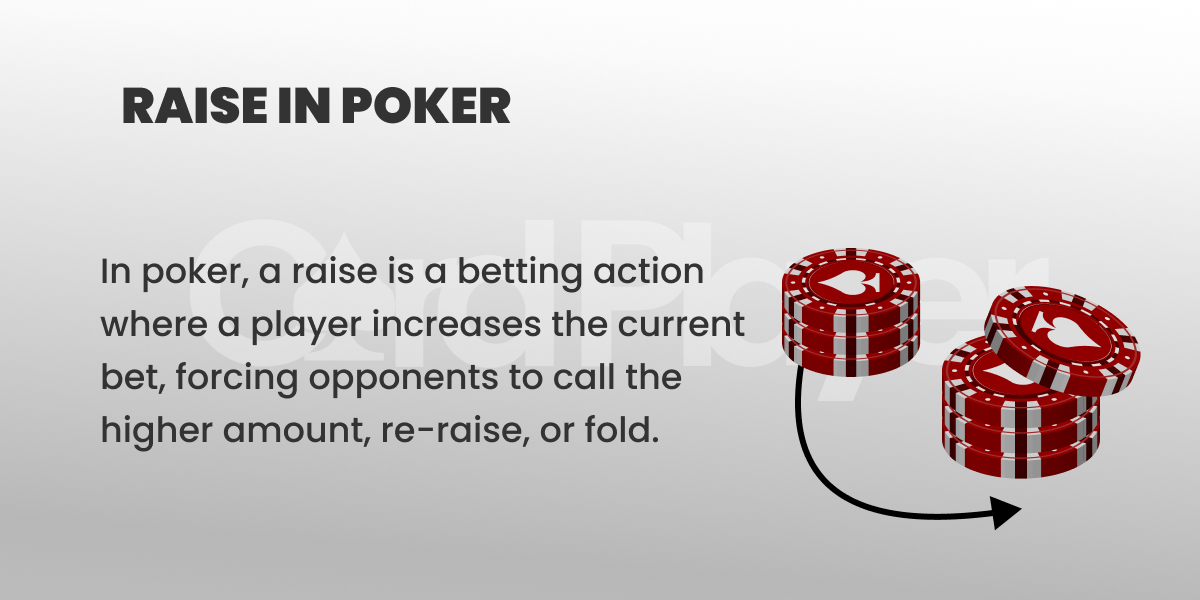
A raise in poker means increasing the current bet during a betting round.
When a player bets or raises, the next player can fold, call that amount, or raise it higher. If you choose to raise, you’re telling the table that you want to put more chips into the pot and force others to match that higher amount if they want to stay in the hand.
A raise in poker is always done during an active betting round. You cannot raise if no one has bet yet. In that case, your action would be a bet, not a raise.
For example, if a player bets 10 chips and you raise to 30 chips, everyone else must now put in 20 chips to remain in the hand.
Raise in Poker: Key Points
- A raise always increases the current bet size.
- A poker raise shows strength or pressure. It signals that you’re willing to commit more chips.
- A raise forces action. Players behind you must now decide whether to fold, call the new amount, or raise again.
Poker Raise vs Call
One of the first strategic decisions new players face is deciding whether to raise or call in poker. The difference matters more than most beginners realize:
- Calling means you match the current bet and keep the pot the same size; it’s a passive action.
- Raising the bet changes the cost for everyone else. This can be considered a proactive or aggressive action.
If a player bets 20 chips and you call, you put in 20 chips. If you raise, you might put in 60 chips instead. That extra amount changes how opponents respond. Weak hands may fold, and stronger hands may reveal themselves by re-raising.
Generally speaking, raising gives you more ways to win a pot. You can win by making others fold, or you can win at showdown. With calling and checking, the only way you can win the hand is at showdown.
Minimum Raise Rules in Poker
As a new player, you’ll have to learn the rules for raising in poker.
The minimum to raise in poker is set by the size of the previous bet or raise. This rule exists to ensure fair and consistent betting. In no-limit and pot-limit games, whether playing at an online poker site or a live game, the minimum raise must be at least the size of the last bet or raise.
For example, if a player bets 10 chips and another player raises to 30 chips, the raise size is 20 chips. The next minimum raise must also be at least 20 chips. So, if you want to raise again, the smallest legal raise would be from 30 to 50 chips. Knowing how to calculate a raise in poker helps avoid mistakes.
Always look at the difference between the last bet and the new total, not just the final number.
Maximum Raise Limits by Game Type
The maximum raise at a poker table depends entirely on the game’s betting structure.
No-Limit Poker
In no-limit poker, you can raise up to all of your remaining chips. This is what players mean when they say no-limit allows all-in bets at any time. For example, a player bets 10 chips, and you have 200 chips left. In no-limit poker, you can raise to any amount, including going all-in for all 200 chips.
Pot-Limit Poker
In pot-limit poker, the maximum raise is limited by the current size of the pot. You can raise any amount up to the pot total after calling the current bet. For example, the pot is 40 chips, and an opponent bets 10. After you call the 10, the largest raise you can make is up to the total pot size, so your maximum raise would be to 60 chips.
Fixed-Limit Poker
In fixed-limit poker, raise sizes are predetermined. You cannot choose the amount. The game sets the exact raise size for each betting round. For example, if the limit is 10 chips, every bet and raise in that round must be exactly 10 chips.
Understanding these limits is crucial for implementing an effective poker raise strategy, particularly when transitioning between game formats.
How to Properly Announce a Raise in Live Poker
In live poker, how to announce a raise in poker matters more than many beginners expect:
- Understand that actions are binding: In live poker, both verbal statements and chip movements count. Once you act, you’re committed to that action.
- State your raise clearly: The safest approach is to say “raise” followed by the total amount, such as “raise to 100.” This helps avoid confusion and prevents accidental calls.
- Be careful with silent chip movements: If you push chips forward without speaking, the house rules will determine your action. In many poker rooms, placing a single oversized chip without announcing a raise is treated as a call.
- Follow proper raise etiquette: Clear communication keeps the game running smoothly and helps avoid disputes with the dealer or other players.
- Personality is fine, clarity comes first: You don’t need to be robotic at the table, but your actions should always be clear before adding emotion or table talk.
Types of Raises in Poker
There are several common raise types that appear across poker games. Each serves a different purpose.
Open Raise
An open raise is the first raise in a betting round. This happens preflop when no one has entered the pot yet. Players usually open-raise to build the pot with strong hands, apply pressure to the blinds, or narrow the field by discouraging weaker hands from calling.
Re-Raise
A re-raise happens when you raise after someone else has already raised. This is often done to show strength, isolate a single opponent, or force out players who might be getting a good price to call. A third raise in the same betting round is commonly referred to as a three-bet, typically representing a stronger or more aggressive range.
Common Mistakes with Raises in Poker
New players often struggle when learning how to raise in poker because they focus solely on their own cards and overlook betting rules and table dynamics:
- Raising small: One common mistake is raising too small. Tiny raises do not apply pressure and often give opponents good odds to call.
- Not following the rules: Another mistake is failing to understand minimum raise rules, which can result in an illegal raise and potentially require corrections by the dealer.
- Poor etiquette: Poor poker raise etiquette, such as string betting or unclear chip movements, also causes problems. String betting happens when a player puts chips into the pot in multiple motions without announcing a raise, which is usually not allowed.
- Raising without a plan: Every raise should have a reason, whether it’s building the pot, protecting a hand, or forcing folds.
Real Examples of Raises in Poker
Example 1: Preflop Raises (No-Limit Hold’em)
- The small blind is 1 chip, and the big blind is 2 chips.
- A player raises to 6 chips before the flop. This is an opening raise.
- Another player raises to 18 chips. This is a re-raise.
- If a third player raises again to 50 chips, this constitutes another legal raise, provided it meets the minimum raise requirements.
Example 2: Raising After the Flop
- A player bets 20 chips on the flop.
- If you call, the bet stays at 20 chips.
- If you raise to 60 chips, you increase the pressure and force opponents to react to a much larger bet.
These real-game examples help you see how raise in poker works in practice and how raising can change the direction of an entire hand.
FAQs
What is a raise in poker?
A raise in poker is increasing the current bet during a betting round, forcing other players to match the higher amount to continue.
How do you calculate the minimum raise in poker?
The minimum raise must be at least the size of the previous bet or raise. You calculate it by looking at the difference between the last two bet amounts.
What do you say when raising in poker?
In live poker, clearly say “raise” and state the total amount, such as “raise to 100,” before moving your chips.
What is a minimum raise in poker?
A minimum raise (or re-raise) is the smallest legal increase over the current bet, based on the size of the previous bet or raise.
How many times can you re-raise in poker?
In no-limit and pot-limit games, there is no fixed limit as long as players have chips. Fixed-limit games usually cap the number of raises per round.
What is the difference between a raise and a bet in poker?
A bet is the first money put into the pot during a betting round. A raise increases an existing bet.
Is a straddle considered a raise?
A straddle is not a raise. It’s a voluntary blind bet made before the cards are dealt, which then allows raising action to start at a higher level.
What is string betting when raising?
String betting happens when a player puts chips into the pot in multiple motions without announcing a raise. It’s usually not allowed under standard poker rules.