










Check in Poker: Definition, Strategy & Common Scenarios
What Is Check in Poker?
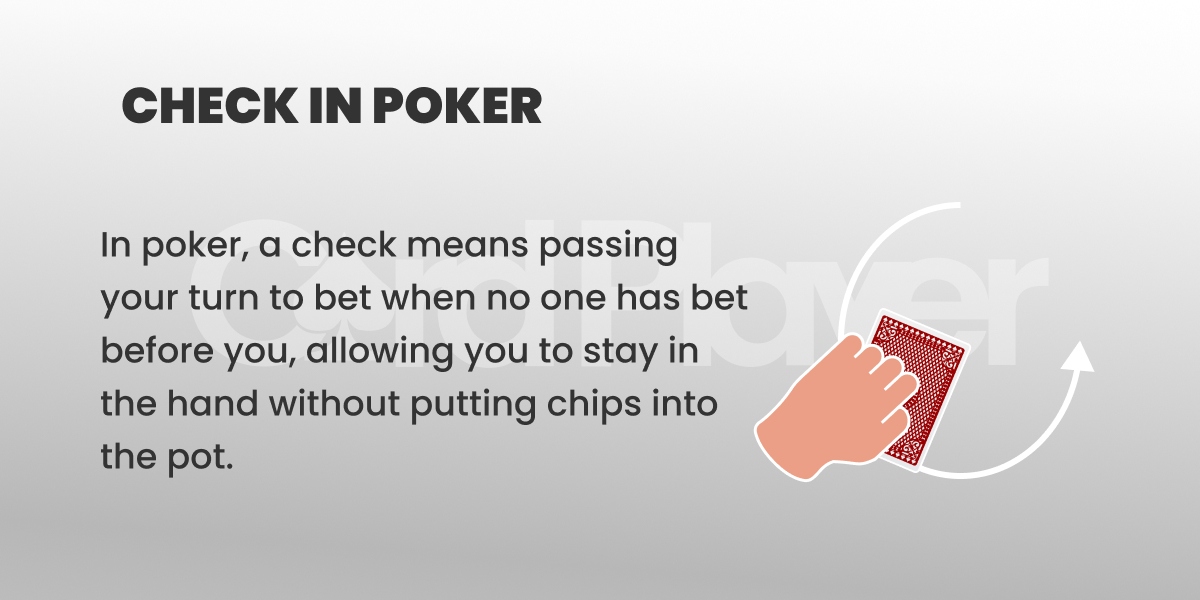
A check in poker is an action that allows players to stay in the hand without betting. When you check during a hand, you pass the action on to the next player without increasing the size of the pot and without forfeiting your hand.
You can only check when no bets have been made during a betting round.
A check in Texas Hold’em can be easily executed. However, the significance of the check move in poker is immense because, with this move, you can control the size of the pot and wait for your opponents to make the next move.
Check in Poker: Key Points
- A check keeps you in the betting round without committing chips, which means you still have the option to call or raise if your opponents decide to bet.
- Checking in poker rules requires that no bet has been made in the current betting round; once a bet is made, checking is no longer possible.
- In poker, players check to slow down the hand, induce bluffs, or balance their strong hands with their weak hands, and protect their range
How Checking Works in Texas Hold’em
To grasp the poker check meaning, you need to understand how betting rounds work in poker. During a hand in Texas Hold’em, players act in a clockwise direction. During the distribution of the flop, turn cards, and river cards, the first player to act will be the first player on the dealer’s left who is still in the hand.
This player can choose to bet, check, or fold.
For example, you are the first to act after the flop. No one has bet at this point. You can choose to check, which means you will not put any money in the pot. The next person can also check. If all players are in the hand check, the turn card will be dealt.
Checking before the flop has its own rules because of the blinds. The first player eligible to check will be the big blind, provided there has been no raise. This also means that you will not be able to check pre-flop unless you are in the big blind and a player that acts before you only calls/limps into the pot.
Difference Between Checking & Betting
Betting and checking are both allowed actions in the betting round, but they achieve different things.
A bet involves putting chips into the pot voluntarily. A bet creates action, makes opponents react to it, and as a result increases the size of the pot.
On the other hand, a check shows readiness to continue the hand without putting more chips into the pot. Checking passes the action on to the next player and is regarded as a passive action in poker.
For beginners, the simplest difference is this: a bet increases the pot, while a check maintains the pot at its current size. You bet when you want to take value or apply pressure. You check when you want the pot to remain the same size or when you want to try and see what other players behind you will do.
Making sense of check vs bet poker choices becomes simpler over time. A player can bet their best pair to protect it, and can also check a hand with potential, such as a flush draw. The better you become at poker, the easier it will be for you to decide which action works best in certain scenarios.
Strategic Reasons to Check
Learning how to check in poker properly can be about far more than avoiding risk because advanced poker players can greatly benefit from this action.
Pot Control
One of the main reasons for checking in poker is to control the size of the pot. A player with a medium-strength hand, holding a second pair, can check to reduce the pot and avoid committing many chips when they have a hand that has potential but can’t stand a raise.
Inducing Bluffs
The second reason for checking involves inducing bluffs. A check from a player with a strong hand indicates vulnerability. Your opponents will be encouraged to bet heavily in the hope that you have a weak hand that will fold. This can be a great strategy against aggressive opponents who like to bet when checked to.
Information
You can also check in hopes of getting more information. By checking, you are basically waiting to see what your opponent will do. Opponents who check back often indicate they don’t have enough of a hand to bet. If they bet, they either have a bluff or a hand that wants to extract value, which means you can exclude a lot of marginal hands from their range. This is, of course, a general rule and will depend on the type of opponent you are facing.
Balance
Checking can help you balance your ranges. In the current no-limit strategy, players combine strong hands, weak hands, and drawing hands within their check ranges, as this confuses their opponents and prevents them from accurately reading their hand. Balancing check moves makes it less likely that you have a weaker hand when you check.
Understanding the Check-Raise
The check-raise is one of the most effective poker plays. It occurs when a player makes a check call and then raises after their opponents bet. This poker technique involves turning an opponent’s aggression against them.
Sometimes, new players will believe that a check-raise always indicates the existence of a strong hand. Though this play can be combined when you have sets, strong top pairs, and strong draws, experienced players also mix bluffs to create a well-rounded approach.
An effective check-raise approach involves playing boards where your possible range looks weaker, but also has enough strong hands to play aggressively.
Common Mistakes When Checking
Many new players misunderstand the concept of the check and end up repeating it unnecessarily. Checking can be overdone and provide opponents with the opportunity to get cards for free.
Automatically checking strong hands can be disadvantageous because this often gives drawing hands a chance to beat you. Betting can save you from the dangers of the board when there are many drawing hands possible against you.
Checking because you are unsure what to do. Uncertainty does not justify a check. A player must consider how their hand performs against an opponent’s likely range. Checking every uncertain spot creates a passive style that loses value.
Too frequent checking with the intent to call will create a pattern allowing an opponent to bluff cheaply against you. Vary check-calls, check-raises, and betting actions.
Balancing Checks & Bets in Your Ranges
Apart from knowing when to check in poker, a strong player builds a checking range with intention. The idea behind balancing checks and bets is to avoid being predictable. When an opponent studies your play, they should never be able to say that your checks always mean weakness or that your bets always show strength.
A balanced check range includes:
- Strong made hands that do not mind inducing action.
- Medium-strength hands that prefer pot control.
- Weak hands, you do not want to fold immediately.
- Drawing hands that can call or check-raise.
Balancing doesn’t mean randomizing for the sake of randomizing. It involves assigning hands to your check-calling range that complements the board and the circumstances, keeping your opponents uncertain about what you might do next.
Checking Strategy in Cash Games vs Tournaments
Your checking strategy should look pretty similar in both cash games and tournaments, whether in live games or online poker. The thing that will have the biggest impact on how you tailor it is stack sizes and stakes. In cash games, you will almost always be over 100 big blinds deep, while in tournaments, your stack will often be under 30 big blinds.
Also, the ability to rebuy makes the check-raise play even more plausible. The check has a role in pot management in non-committing hands. A rebuy allows a strong check-raise poker strategy to move aggressively.
In tournaments, the number of stacks reduces as the blind increases. The effect of the check becomes severe because the wish to get free cards might be at risk of elimination from the tournaments due to the high blinds. The high blinds force you to be careful while deciding whether to bet. The effect of the check becomes minimal because you can save your chips through the check when you decide to call or bet.
In the context of checking in Texas Hold’em tournaments, the move is mostly used when you want to control the size of the pot and avoid committing too much of your stack.
Advanced Concepts for Controlled Checking
As you develop your poker skills, the check becomes an advanced technique rather than a straightforward move.
Controlled checking is the act of performing a check in order to achieve a particular end result, which might be to bluff heavily later on in the game.
The next advanced concept involves the delayed continuation bet.
You can check the flop following a pre-flop raise and bet the turn card. This play occurs when the flop favors neither the pre-flop raiser nor when the turn cards improve their possible hands.
Controlled checking also occurs when there are multiple players in the pot.
Another concept that can be introduced here is the concept of range protection. By checking some strong hands that your opponents expect you to bet, you will be protecting your checking range from being exploited. This is because the opponent will not be able to bet automatically when attacking the check, because the check will contain hands that can continue strongly.
Controlled checking also remains a critical part of advanced no-limit poker tactics, as this approach combines deception and discipline. The technique compels opponents to be honest players and stops them from exploiting passive play.
FAQ
What does a check in poker mean?
A check is the act of declining to bet while staying in the game, permitted only when no bet has been made during the current round of betting.
What does a check-raise in poker mean?
A check-raise is when a player has checked their turn, a bet has been made by another player, and that player who checked then increases the bet.
How do you check in poker?
Say check when no bet has been made yet. Alternatively, you can tap the table when no bet has been made yet.
What’s the difference between check and fold in poker?
Checking preserves the cards in the hand, while folding relinquishes the cards and the right to the pot.
Why do players check in poker?
To keep the pot small, gather information, disguise strength, and create plays, such as check-raises.
Can the first player check in poker?
Yes, if no bet has been made yet in that betting round. Otherwise, they must respond to the existing bet.
What is the rule of check in poker?
You can only check if you’re in a no-bet situation. As soon as a bet is placed in the hand, you must call, raise, or fold.
Why would a player choose to check instead of bet?
Checking can be used to size the pot, bluff, or avoid betting out a marginal hand.