







Big Blind in Poker: Definition, Meaning & How It Works
What Is a Big Blind in Poker?
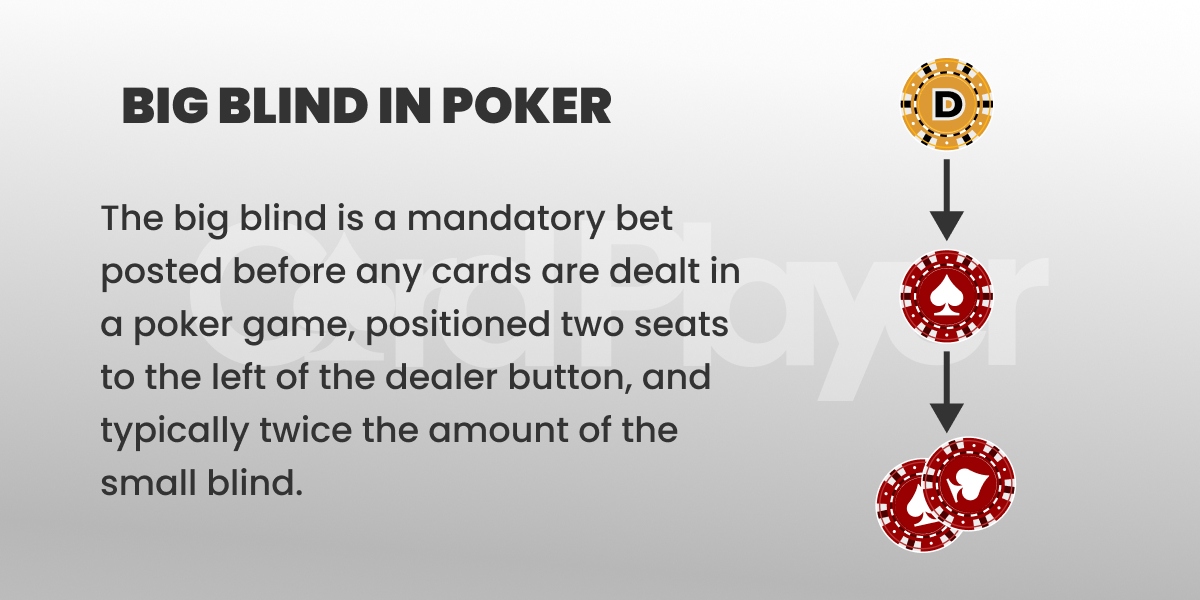
The big blind in poker is the larger of the two forced bets that appear before any cards are dealt.
Most new players wonder what the big blind in poker is because the concept seems unusual at first. Simply put, it’s a way to ensure the hand keeps moving and forces players to be invested in the game.
Big Blind in Poker: Key Points
- The big blind is a mandatory bet that rotates clockwise around the table.
- It’s usually twice the size of the small blind.
- Players measure stacks, pressure, and strategy in terms of big blinds.
Big Blind Position & Action Order
The way the big blind fits into the order of action can feel unintuitive at first, especially for new players. Before the flop, the big blind acts last because every other player must decide whether to fold, call, or raise before the action comes back around.
This gives the big blind full visibility into how the hand has developed preflop and whether the pot has grown through raises or calls. This preflop information advantage is one of the few benefits of being forced to post a blind.
After the flop, however, the situation reverses. The big blind becomes one of the first players to act on every betting round, often checking before anyone else has revealed strength. This creates a split dynamic.
Preflop, the big blind has the benefit of information. Postflop, however, that advantage disappears, and the big blind must play the rest of the hand out of position. This is why defending from the big blind requires a balanced approach. The price to continue is often attractive, but the positional disadvantage makes many marginal hands difficult to manage once the flop is dealt.
Understanding this transition from late action before the flop to early action afterward helps explain why the big blind is both a frequent defender and a difficult seat to play well in Texas Hold’em.
Big Blind Vs Small Blind
While both blinds are forced bets, the differences between them matter. If someone asks about the big blind versus the small blind or wants a simple breakdown of what the big blind and small blind are, it usually helps to see the contrast laid out plainly.
| Feature | Small Blind | Big Blind |
|---|---|---|
| Amount posted | Half stake (usually) | Full base stake |
| Acts pre-flop | Second to last | Last |
| Acts post-flop | Early seat | Early seat |
| Typical play style | Tight because the price is worse | Wider because the pot odds are better |
Unlike the small blind, the big blind already has a full bet in the pot before the flop, so it can afford to call with more hands. The downside is that it still has to act first after the flop. Balancing those two factors is a core challenge in Hold’em, even for experienced players.
Big Blind Vs Ante & Regular Bet
When learning how to analyze big blind play, it’s equally important to know what the big blind ante in poker is.
The ante is an automatic contribution required from every player, either in each hand or in each level of a tournament. As mentioned, the blind is a forced bet tied to position rather than to everyone at the table. Because antes and blinds show up together in tournament formats, beginners sometimes mix them up. The modern big blind ante adds even more confusion for new players. Instead of every person posting a small ante, the big blind posts one combined ante for the entire table.
It speeds up the action and keeps pots meaningful, especially late in tournaments.
Even though the chips end up in the pot, the motivation behind why they’re there is different. The big blind and small blind rotate with the dealer button. Antes stay fixed for everyone, whereas bets are voluntary.
How Big Blind Works in Different Formats
Blind levels vary depending on whether you are playing a cash game, a multi-table tournament, or a Sit & Go. The basics remain constant; however, the circumstances that influence them vary.
Big Blind in Cash Games
In a cash game, the blinds remain constant until you move tables. You can sit with a full stack of money and then leave. You may sit with a full stack of money and then re-enter. You may wait for hands. You’re never forced to make a move.
Players can wait because the blinds always remain constant. For comfortable potsflop play in cash games, 30 BBs is shallow. 100 BBs is standard; 200 BBs allows for deep stack maneuvering.
Because of this, you constantly have to make decisions when in the big blind. As you gain experience, you will develop a certain intuition for reading raise amounts, player tendencies, and how deep of a run you’re willing to make without entirely depleting your stack.
Big Blind in Tournaments
Poker tournaments use blind levels that increase on a schedule.
This single aspect changes everything. In the early stages, players sit with stacks that feel enormous. It’s common to start with 100 or even 200 big blinds. You can play speculative hands, set traps, and wait for clean opportunities.
As blind levels increase, stacks become shallower.
In the middle stages, a majority of stacks lie between 20 and 50 big blinds. This creates situations where you don’t have much room to operate, but raises and 3bets still happen.
Navigating the late game successfully also requires a structured approach. Playing with 10-20 big blinds is tricky because a single pot can alter your entire tournament’s trajectory. You must safeguard your stack and occasionally shove all-in instead of engaging in a multi-street pot.
The tables often have stacks with fewer than 15 big blinds left. At this stack depth, your play requires accuracy. Decisions become binary – fold or push all-in, with fold equity becoming the primary consideration.
Almost everywhere today, major tournaments use a large blind ante. This keeps the action fast and gets rid of that annoying pause where everyone has to ante up before the cards are dealt.
Big Blind Strategy for Beginners
Playing from the big blind requires a degree of art and a degree of math, even when playing at online poker sites.
With both the big blind and small blind, you’re putting money in before the cards are dealt. This gives you a better price than any other player to continue in the hand after the deal. But once the flop appears, the dynamics change, and your focus will need to be on exploiting your pot odds while sidestepping questionable hands.
A quick example.
A small raise of 2-2.5 big blinds with two callers gives you excellent pot odds to defend. Hands that would be marginal folds from other positions can profitably call in this spot.
But if a player opens with five big blinds, this completely alters their cost. A big raise will punish a marginal defender. Sometimes folding is the right play even though you’ve already put in one big blind. The chips you’ve already posted are gone—don’t throw away more trying to chase them back.
The big blind will also be a spot where you can press your opponents. When the small blind just completes (calls rather than raises), you can raise to punish this weak action and potentially win the pot immediately. Some aggressive players will have a well-rounded big blind game with a mix of both calls and raises.
Calculating Pot Odds From the Big Blind
Understanding pot odds in the big blind is essential because so many decisions in this position come down to whether you are getting the right price.
What Are Pot Odds?
Pot odds compare the cost of a call with the total amount you can win.
If the pot is six big blinds and your opponent bets one, you are calling one big blind to win seven, giving you 7:1 pot odds. This means your hand needs to win at least 12.5% of the time for the call to be profitable.
Now, consider this scenario.
You’re the big blind in a poker hand with a suited connector. The opener raises, two players call, and you’re getting attractive pot odds to continue. You only need to invest a small additional amount to compete for a much larger pot, and with a hand that plays well multiway, these situations can justify looser big blind defenses.
Using Pot Odds for Decisions
The big blind faces very different math depending on the size of the raise.
For example, let’s say the opener raises to 2.5 big blinds. You already have 1 big blind posted, so you call 1.5. If only the raiser is in the hand, the pot before your call is 3.5 big blinds (2.5 raise + 1 blind), and after you call it becomes 5 big blinds. You’re risking 1.5 to win a total pot of 5, giving you pot odds of about 3.3 to 1. This means you need roughly 23% equity to break even.
If another player has already called, however, the pot becomes 6.5 big blinds before your call and 8 after. You’re risking 1.5 to win 8, which is 5.33 to 1, meaning you need about 16% equity.
Take another example. The opener raises to 6 big blinds. You must now call 5 more. The pot before your call is 7 big blinds and becomes 12 after you call. Here, you are risking 5 to win 12, which is 2.4 to 1, requiring roughly 29% equity.
Common Mistakes With Big Blind
Beginners often fall into predictable traps in both the small blind and big blind, even though the problems are simple to fix once you see them clearly.
1. Auto Defending Without Considering Pot Odds
Just because you already posted chips doesn’t mean every hand deserves a defense. Each raise size changes the math.
2. Playing Too Many Weak Hands Out of Position
You might feel compelled to play because the call is cheap, but weak hands out of position create problems on future streets.
3. Never Raising From the Big Blind
Calling is comfortable. Raising is necessary. If you never challenge opponents, they will exploit your passivity.
4. Ignoring Opponent Tendencies
Ranges shift depending on who raised. Tight players demand tighter responses. Loose players give you room to widen your calls.
5. Failing to Adjust to Stack Sizes
A deep stack big blind can call more freely. A short stack big blind must treat every decision as a meaningful risk.
If you understand how the big blind in poker works, you unlock a large portion of poker strategy.
Everything, from pot odds to stack pressure to position, becomes clearer when viewed through the lens of the big blind’s role. Keep practicing, pay attention to raising sizes, and the seat will start to feel far less intimidating.
FAQs
What does the big blind do?
It posts a forced bet before the cards are dealt and then acts last before the flop.
Who pays the big blind?
The big blind is paid by the player seated immediately to the left of the small blind. Each player takes turns posting it as the dealer button rotates.
What does it mean to call someone the big blind?
It simply refers to the player who currently occupies that seat for the hand.
How much is the big blind in poker?
It depends on the stakes. It’s normally twice the small blind.
Does the big blind always bet first?
Not pre-flop. After the flop, the blinds act early unless one of them folded.
What is the big blind vs small blind?
They are the two forced bets before each hand. The big blind is larger.
Can you fold if you’re the big blind?
Yes, once someone raises, you may fold rather than continue.
Can you raise less than the big blind?
No, minimum raises must be at least the size of the big blind in most formats.