







Poker Hand: Definition, Poker Hand Rankings & Poker Hand Hierarchy
What Is a Poker Hand?
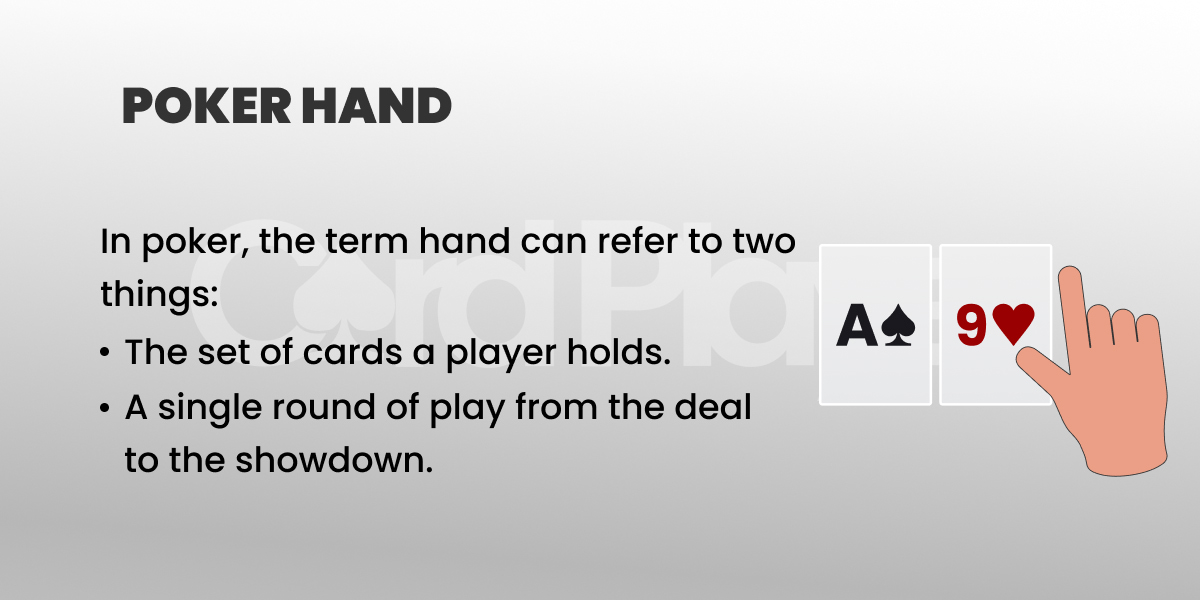
A poker hand is a term that has two distinct meanings. These meanings are related but often confused by new players.
A poker hand refers to the five cards used to determine a winner at the showdown. In most poker variants, this means five cards. The five cards that people use in Texas Hold’em and Omaha are made up of a mix of personal cards (hole cards) and community cards. When people ask what a poker hand is, it will be about these cards.
Alternatively, a ‘poker hand’ can refer to an entire round of play. A person might say, “That was a strange hand,” referring to the entire betting and dealing process. Context usually clarifies the intended meaning.
When asking what constitutes a poker hand, the answer depends on context—either the five-card combination or the entire round of play. For hand ranking purposes, only the five-card combination matters.
Poker Hand: Key Points
- Every poker hand is evaluated using exactly five cards.
- Poker hand rankings follow a fixed hierarchy.
- The value of a poker hand depends on its rank and then on kickers.
The 10 Poker Hand Rankings Explained
Poker hands ranked from strongest to weakest follow a universal structure used in almost every poker variant.
Learning poker hand rankings is essential because every decision builds on this hierarchy. Understanding how different hands match up against each other is essential for strategic decision-making.
1. Royal Flush
A royal flush is A-K-Q-J-10 of the same suit. It is the strongest poker hand and cannot be beaten.
Example: A♠ K♠ Q♠ J♠ 10♠
2. Straight Flush
A straight flush is five consecutive cards of the same suit that are not a royal flush.
Example: 9♥ 8♥ 7♥ 6♥ 5♥
3. Four of a Kind
Four of a kind contains four cards of the same rank plus one kicker.
Example: Q♠ Q♥ Q♦ Q♣ 7♠
4. Full House
A full house combines three of a kind with a pair.
Example: K♠ K♥ K♦ 9♣ 9♦
5. Flush
A flush is any five cards of the same suit that are not in sequence.
Example: A♥ J♥ 9♥ 6♥ 2♥
6. Straight
A straight is five consecutive cards of mixed suits.
Example: 10♠ 9♦ 8♣ 7♥ 6♠
7. Three of a Kind
Three cards of the same rank with two unrelated kickers.
Example: J♠ J♥ J♦ 8♣ 2♠
8. Two Pair
Two different pairs plus one kicker.
Example: A♠ A♥ 7♦ 7♣ 3♠
9. One Pair
One pair plus three kickers.
Example: K♠ K♥ Q♦ 8♣ 2♠
10. High Card
No matching ranks and no straight or flush.
Example: A♠ Q♥ 10♦ 6♣ 3♠
Poker Hand Rankings: What Beats What
Mastering poker hand rankings requires more than memorization—you need to understand how hands compare in common situations.
Confusion often arises when seemingly strong hands rank lower than expected. Among these commonly confused combinations are: straight versus flush, and two pair versus three of a kind.
| Hand A | Hand B | Winning Hand |
|---|---|---|
| Flush | Full House | Full House |
| Straight | Flush | Flush |
| Two Pair | Three of a Kind | Three of a Kind |
| High Card | One Pair | One Pair |
| Straight | Three of a Kind | Straight |
This poker hand hierarchy is absolute in standard poker—no exceptions exist. A flush never beats a full house, and a straight never beats a flush (does not apply to the “non-standard” Short Deck Hold’em variant).
Poker Hand Odds and Probabilities
Poker hands ranked by strength do not appear equally often. Some hands are rare, while others occur constantly. This affects how valuable they are.
| Poker Hand | Probability | Odds |
|---|---|---|
| Royal Flush | 0.000154% | 649,740 to 1 |
| Straight Flush | 0.00139% | 72,192 to 1 |
| Four of a Kind | 0.0240% | 4,164 to 1 |
| Full House | 0.1441% | 693 to 1 |
| Flush | 0.1965% | 508 to 1 |
| Straight | 0.3925% | 254 to 1 |
| Three of a Kind | 2.1128% | 46 to 1 |
| Two Pair | 4.7539% | 20 to 1 |
| One Pair | 42.2569% | 1.37 to 1 |
| High Card | 50.1177% | 0.99 to 1 |
These probabilities come from calculating all possible five-card combinations from a 52-card deck.
To illustrate, there are 2,598,960 possible combinations involving five cards. Just 4 of these hands qualify as royal flushes.
How to Compare Poker Hands (Tie-Breaking Rules)
When two players have identical types and ranks of poker hands, tiebreakers are used to declare a winner. Kickers become essential in these tiebreaker situations, and these rules apply to both land-based and online poker rooms.
- Pairs: The higher pair wins. Equal pairs are decided by the highest kicker and then successively lower ones.
- Two Pair: Compare the highest pair first. If equal, compare the second pair. If these pairs are equal, then the next pair will be compared. Only then will a kicker be considered.
- Flushes/High Cards: With flushes and high-card hands, compare cards from highest to lowest.
- Straights: Straight comparisons are straightforward. A straight with the highest top card wins. A wheel straight A-2-3-4-5 is the lowest straight.
Understanding Poker Hand Strength in Texas Hold’em
Texas Hold’em uses seven available cards, but only five count toward your poker hand. The goal is always to make the strongest possible five-card combination.
Example:
- Your cards: A♠ K♠
- Board: A♦ K♦ K♣ 7♠ 2♥
- Your best hand is A♠ A♦ K♠ K♦ K♣, which is a full house. The extra cards do not matter once the best five are chosen.
Now consider a more confusing situation.
- Board: Q♠ J♠ 10♠ 9♠ K♠
- Your cards: A♥ K♦
Although you have very strong cards, a straight flush is made on the board. All remaining players use the board’s straight flush and split the pot. Hole cards don’t matter here—everyone plays the board. However, if someone holds the A♠, they have a higher straight flush and win outright.
Full house versus straight and flush versus straight comparisons always follow the fixed hierarchy. Full house ranks higher than a flush, a flush ranks higher than a straight. These rules don’t change.
Common Mistakes with Poker Hands
Many beginner mistakes stem from misunderstanding the poker hand hierarchy rather than poor strategy.
- A common misconception is that a flush beats a full house. A flush may appear very attractive, but it ranks below a full house.
- Players sometimes mistakenly believe Q-K-A-2-3 forms a straight. It doesn’t—straights cannot wrap around from King to Ace to Two.
- Players who miss that the board contains the best possible hand often overvalue their hole cards.
- Forgetting about kickers causes confusion when both players have the same pair.
- Overvaluing weak hands, such as the bottom pair, leads to expensive mistakes.
- Understanding the difference between sets and trips is strategically important. Both are three of a kind, but sets (pocket pair + board card) play differently than trips (two board cards + one hole card).
Real Examples of Poker Hands
Example 1: Full House vs. Flush Showdown
- Player A holds K♠ K♦.
- Player B holds A♥ J♥.
- Board: K♥ 9♥ 9♦ 4♥ 2♣
Player A has a full house, Kings full of nines. Player B has a flush. The full house wins because it ranks higher in the poker hand hierarchy.
Example 2: Kicker Decides the Winner
- Player A holds A♠ Q♦.
- Player B holds A♥ J♣.
- Board: A♦ 7♠ 6♣ 4♥ 2♠
Both players have one pair of aces. Player A wins because the Queen kicker beats the Jack kicker.
A poker hand is always judged by the same poker hand rankings, no matter where or how you play. Learn the poker hand hierarchy and understand tie breakers, and mistakes at showdown disappear quickly.
FAQs
What is a poker hand?
A poker hand is the five card combination used to determine the winner, or the full round of play depending on context.
What is the best hand in poker?
The royal flush is the best possible poker hand.
Does a flush beat a full house?
No. A full house always beats a flush in poker hand rankings.
What is considered a hand in poker?
It can mean the five card result or an entire round of betting and dealing.
What is the rarest hand in poker?
The royal flush is the rarest poker hand.
How are poker hands ranked?
Poker hands ranked from highest to lowest follow a fixed poker hand hierarchy used worldwide.
What poker hand is the hardest to get?
A royal flush is the hardest poker hand to make.
How many cards make a poker hand?
A standard poker hand always uses exactly five cards.