







Pocket Rockets in Poker: Definition, How to Play & Mistakes to Avoid
What Are Pocket Rockets in Poker?
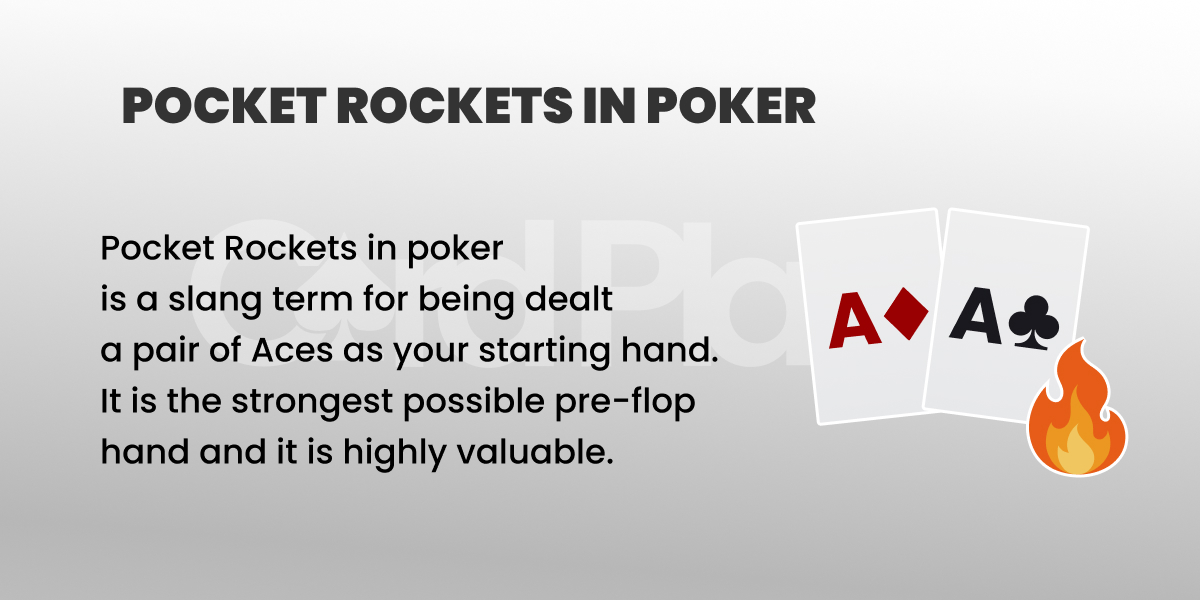
Pocket rockets is a slang term referring to being dealt two aces as your starting hand in Texas Hold’Em. It is the strongest possible starting hand in poker, dominating even the second-best hand, pocket kings, with approximately 82% equity in heads-up play.
Despite this overwhelming advantage, pocket aces still require careful play to extract maximum value and avoid costly mistakes on dangerous board textures.”
Pocket Rockets in Poker: Key Points
- Pocket rockets refers to being dealt pocket aces as your starting hand in Hold’em.
- They have approximately 82% equity against pocket kings (the next strongest hand).
- Pocket Aces can lose significant value in multi-way pots and on dangerous boards.
Why Are They Called “Pocket Rockets”?
The slang term has two components:
- “Pocket” refers to the fact that the cards comprise your two private hole cards.
- “Rockets” refers to the power and dominance of pocket aces, which are the strongest starting hand in poker.
Pocket aces have other common nicknames, including “bullets” and “American Airlines”.
Are Pocket Rockets the Best Starting Hand in Poker?
Whether you’re playing live or on online poker sites, two aces remain the most powerful starting hand you can hold.
However, having the best starting hand does not guarantee you will win the pot, as, if the hand is played to completion, five community cards will be dealt across the flop, turn, and river, with a round of betting after each stage. Players make their best five-card hand containing any combination of hole and community cards.
A starting hand is not a made hand. The strongest starting hand can be one pair, whereas after the flop, players can make stronger hands such as straights, flushes, or full houses.
How to Play Pocket Rockets Pre-Flop
The key to maximizing value with pocket aces pre-flop is to play them aggressively in most situations.
- When acting first: Players should generally raise from all positions except at very short stack depths, where simply moving all-in may be correct. This is in order to build value, while also attempting to limit the number of opponents you will face.
- When there has been action ahead of you pre-flop: It is almost always correct to re-raise pocket aces, again to build value and to thin the field. There may be circumstances where calling a raise is justifiable to trap aggressive or short-stacked players behind, but this risks being out of position in a multi-way pot.
- When you are deep-stacked: It can be correct to call, particularly when in position heads-up and facing aggression pre-flop. This is because it is unlikely that other players will be willing to commit very significant amounts pre-flop unless they also have a truly premium hand.
These alternative lines should be employed judiciously, as raising and re-raising with pocket aces remains the most profitable default strategy.
How to Play Pocket Rockets After the Flop
Pocket aces, like all pocket pairs, often do not improve beyond one pair unless they make three of a kind, also known as a set.
While aces will often still be the best hand, particularly if it makes a set, there are board textures where caution should be exercised when it remains one pair, particularly if out of position:
- Paired boards: Where the board is paired, particularly comprising Broadway cards, aces may be against trips.
- Straight boards: Where the board makes straights, in particular one-card straights, aces may be drawing dead.
- Flush boards: When the board contains three or more cards of the same suit, opponents may already have a made flush.
- Connected boards that favor the opponent’s range: Opponents may be significantly more likely to hold two-pair hands.
Players often become wedded to the preflop strength of pocket rockets and fail to acknowledge that their value may have diminished significantly due to the board texture.
Because of this, it is often claimed that pocket aces either win a small pot or lose a big one.
Why Do Pocket Rockets Sometimes Lose?
Pocket aces can lose for a variety of reasons, including:
- Variance: In all-in pre-flop scenarios, aces may be usurped by worse hands on the runout.
- Multi-way pots increase risk: The equity advantage held by aces decreases with each additional opponent. Multi-way pots can be difficult to navigate, particularly out of position, and this is often where mistakes occur.
- Overplay: Players may put too much money in on paired, straight, or flush boards where one-pair hands are never likely to be good in light of the action.
Variance can often be attributed to bad luck, whereas the final two reasons are generally strategic errors.
Examples of Pocket Rockets in Poker
Below, we set out two example hands of aces in poker:
Aces Winning
Pre-flop:
- Player A raises from early position with A♦A♣ off a 25bb stack.
- Player B moves all-in for 18bb from the big blind holding J♦J♣.
- Player A calls.
Pre-flop situation:
- Pocket aces are a strong statistical favorite.
- Player B has two outs (the remaining jacks) to take the lead.
Board runout:
- Flop: K♣ 8♦ 2♠
- Turn: 3♣
- River: 9♦
Result:
- Player B does not improve.
- Player A wins the pot and busts Player B
Pocket aces usually perform well against lower pocket pairs in pre-flop all-in situations.
Aces Losing
Pre-flop:
- Player A raises to 2bb from early position with A♠A♣ off 30bb.
- Player B calls from the small blind with K♦T♦ off 60bb.
- Player C calls from the big blind with 7♦7♣ off 25bb.
Flop:
- Q♦ J♦ 7♠
- Player A holds an overpair on a highly connected and suited board.
Flop action:
- Action checks to Player A, who bets 2.5bb.
- Player B check-raises to 10bb.
- Player C moves all-in for 22bb.
- Player A re-shoves and Player B calls.
Turn and river:
- Turn: 2♦ (Player B completes a flush)
- River: J♠ (Player C improves to a full house)
Result:
- Player C triples up.
- Player B wins the side pot and busts Player A.
In multi-way pots on dangerous board textures, pocket aces can quickly lose value. Heavy aggression from multiple opponents often indicates that a one-pair hand is no longer best.
Common Beginner Mistakes With Pocket Rockets
Common mistakes that can be made when playing pocket aces include:
- Slow-playing too often: Don’t fall into the trap of slow-playing pocket aces too frequently, as you’ll fail to extract maximum value from this premium hand.
- Refusing to fold when clearly behind: Avoid becoming so attached to the pre-flop strength of your aces that you can’t recognize when you’re likely beaten, whether due to heavy action or dangerous board textures.
- Overvaluing aces on wet boards: Be careful not to overvalue your one-pair hand on wet boards that are paired, make straights or flushes, or heavily favor your opponent’s range based on their position.
- Ignoring the number of opponents: Always recognize when you’re in a multi-way pot, where the equity of your one-pair hand decreases significantly with each additional opponent.
Remember that pocket aces are the best starting hand, not the best hand by the river – adjust your strategy accordingly as the board develops.
FAQs
Are pocket rockets always a winning hand?
No, pocket rockets are not always a winning hand.
How often do pocket rockets win?
It depends on which hands they are against and how many. Aces generally have at least 82% equity against any specific hand combination, but that equity decreases in multi-way pots.
What hands beat pocket rockets in Texas Hold’em?
Any hand stronger than one pair can beat pocket rockets, including three of a kind, straights, flushes, full houses, four of a kind, and straight flushes.
Should you always raise with pocket aces?
Yes, as a general rule, pre-flop. There may be circumstances that justify slow-playing aces pre-flop.
Can you fold pocket rockets?
Pre-flop, you should never fold pocket aces, unless satellite or heavy ICM considerations apply. Post-flop, there are many situations in which a one-pair hand is likely to be losing and should be folded.