







Flop in Poker: Definition, How It Works & Common Mistakes
What Is the Flop?
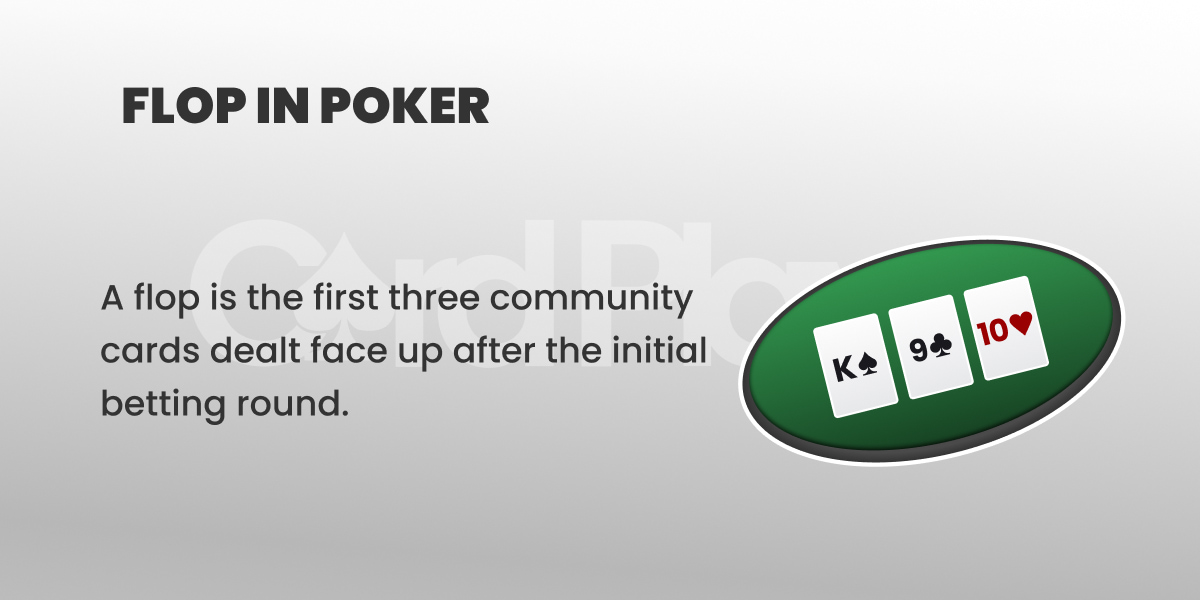
The flop refers to the first three community cards dealt face-up in Texas Hold’em and Omaha poker. This is when players can begin to evaluate whether they’ve made a strong hand or have opportunities to improve.
Flop in Poker: Key Points
- The flop gives enough information to make informed decisions about your hand strength.
- The flop reveals whether you’ve made hands like pairs or sets, or picked up promising draws like flush or straight draws.
- A flop strategy in Texas Hold’em can vary significantly according to the board, position, and range interaction.
How the Flop Works in Texas Hold’em
Learning what the flop in poker is means understanding the order of a Texas Hold’em deal to some degree. After the preflop betting round, the dealer reveals three community cards simultaneously. This is the flop.
After seeing the community cards, you’ll know if your starting hand has gained or lost value relative to possible opponent hands. On the flop, you can now recognize whether you’ve made top pair, an overpair, a set, or picked up draws like flush draws, open-enders, or gutshots.
A significant amount of a hand’s strategy is built on playing the flop.
Understanding Flop Textures & Board Types
The first thing you need to know about reading the flop in a poker game is board texture.
Dry flops have unconnected cards that don’t offer many drawing opportunities or obvious hand combinations. Board texture determines which starting hands likely improved, helping you decide how to bet or respond to bets. For example, K♠-7♥-2♣ (rainbow, meaning three different suits) is a classic dry board. There is neither a straight draw nor a flush draw, and few starting hands connect here.
The opposite of dry boards are coordinated (or ‘wet’) flops, where cards connect to form multiple possible hands and draws.
Consider J♥-T♥-9♣. This flop creates straight draws, flush draws, made straights, and combinations like pairs with draws. New players often underestimate how dramatically board texture affects hand strength. Two different flops can pose completely different levels of danger to your hand, even when you hold the same cards. Dry boards favor the preflop aggressor since most calling hands won’t improve on disconnected flops.
A few broad categories help players think about types of flops in Texas Hold’em:
- Dry or uncoordinated flops with no draws.
- Semi-connected flops with one potential draw.
- Highly coordinated flops with straight and flush possibilities.
- Paired flops where the board repeats a rank, like Q-Q-4.
- Monotone flops where all three cards share the same suit.
How to Play Strong vs Weak Flops
Now that you understand flop textures, let’s discuss how to evaluate your hand relative to the board.
A flop is strong for you when you’ve made top pair with a good kicker, flopped a set, completed a straight or flush, or picked up a strong draw. A weak flop for you is one where your hand missed entirely or the board heavily favors your opponent’s likely holdings.
Here’s an example: You raise pre-flop with A♠-Q♥, and the flop comes Q♦-7♠-3♣ (rainbow—all different suits). This is generally a strong board. You’ve flopped top pair with the best kicker, and the dry board offers few drawing opportunities for opponents. But on a flop like J♠-T♠-9♥, even your A-A becomes vulnerable despite having an overpair, because the board creates many straight and flush possibilities.
Understanding the meaning of the flop in poker will show you that weak flops require caution.
You might completely miss with A-K on a 9-6-4 flop. You have two overcards, but no made hand and no real draws—proceed carefully. Understanding how to play the flop means knowing when to bet for value or as a bluff, and when to check because the board doesn’t favor your hand.
Reading Opponents’ Ranges on the Flop
The flop represents the first opportunity to see if a player’s expected hands potentially correlate with their bets. Hand ranges transition from being wide preflop to being narrower postflop, and being able to read the flop in poker is essential for success.
Online poker offers a great training ground for learning to read ranges—multi-tabling lets you play significantly more hands per hour, giving you faster experience in recognizing how different ranges interact with various flop textures.
Let’s say an experienced player raised preflop, and you defended your blind. The flop comes 9-8-7. This coordinated board connects well with suited connectors, pocket pairs, and Broadway cards—all hands aggressive players typically raise with.
On an A-5-2 board, however, fewer hands connect. Your opponent might have an Ace, but many of their preflop raising hands have completely missed.
When you understand the concepts of flop texture poker, you begin analyzing who is left with strong ranges on given boards.
Position is a factor here, too. Players who act late can represent a range of hands because they get a read on what other players will do before they must act.
Common Flop Mistakes & Misreads
New players tend to make mistakes on the flop because of overvaluing weak hands or undervaluing strong ones. When you always c-bet (continuation bet) the flop after a pre-flop raise, you will encounter mistakes often.
For example, you fail to take into consideration the connectedness of the board. It’s okay to bet top pair on a dodgy flop, but on a two-color board with Js-Ts-9s, top pair can be in trouble.
A common error is a failure to recognize a backdoor draw. For example, with A-Q, a board of T-5-2 will often be seen as a missed board, but you will have overcards and perhaps a backdoor straight draw and a backdoor flush draw, depending on the suits. This is not a reason to bet always, but a reason why you need to be aware of the possibilities your hand may hold.
Forgetting about what your opponent’s potential calling range looks like is a common problem.
When you think only about your potential outcomes, you can only make one-dimensional flop plays. A player can easily understand the concept of playing a flop in a Texas Hold’em game once he/she can think about potential ranges rather than potential hands.
Changing Flop Play Between Cash Games & Tournaments
The flop is important in both cash games and tournaments, although the conditions differ.
With cash games, stacks will be deep, so you can be more patiently selective with your plays. A flop continuation bet can be a means of value accumulation with a strong hand or consistent pressuring with a weaker one. It’s a moment to swallow your calls on the flop and continue looking for value on later streets.
When it comes to tournaments, the stakes involved in the flop change because your stack is smaller than the blinds. Missing a flop may leave you with some tough calls.
A good flop is a chance for you to double up. Even the kind of flops available in Texas Hold’em change because the constant threat of stack protection is always present in your mind.
Flop Dynamics & Positional Advantage
Position is more significant on the flop than it is before the flop. When you act after your opponents, you gain additional information about their preferences for the board. This is especially so for boards where both players can have connected cards.
Example pair with A-J, with a raise on the button:
- Big blind calls
- Flop is J-8-6 with two diamond suits
- Big blind checks first
Now you must decide whether you will bet for a value, check for control, and some other lines based on the opponent’s table behavior you’ve observed so far.
Advanced Concepts for Flop Strategy
After you grasp those fundamentals, you’ll begin to understand other concepts, such as range and nut advantage, and equity split. Range advantage and nut advantage may sound peculiar at first, but they’re simple concepts.
- Range advantage means you look at who has the strongest hands out.
- The nut advantage means you look at who has the best hands most often.
For example, on a board such as A-K-4, the pre-flop raiser will generally have the range advantage because he will have a better number of strong Aces and broadways.
With a board such as 5-4-3, the caller will have a better number of sets and straights. This is why a good player will adjust the frequency of c-bets according to the board.
Another concept is understanding the frequency with which you may want to bet for defensive purposes. It may benefit to bet strong with K-Q on a Q-6-4 flop because the turn card can pose a problem for you. The goal isn’t to bet only because you have a strong hand, but to take away equity and keep others from seeing a free card.
FAQs
What is a flop in poker?
The first three community cards turned up after the pre-flop betting in a poker game compose the flop.
When does the flop occur in Texas Hold’em?
The flop comes right after the first round of bets is over, and the dealer burns a card.
How do you read the flop in poker?
Reading the flop is a function of analyzing board texture in relation to your hand, with a view to understanding the interaction with your opponent’s likely range.
What are the different types of flop textures?
Flop textures include dry, semi-connected, coordinated, paired, and monotone boards.
How do you play draws on the flop?
You calculate the pot odds, implied odds, and then factor in your position to bet aggressively or simply call with the purpose of improving your position.
Is position significant on the flop?
Yes, playing last gives you more information and gives you a choice of options, controlling the pot versus pressuring.
What is a coordinated vs a dry flop?
A coordinated flop is one with straight or flush possibilities, whereas a ‘dry’ flop is one with no relation and very few draw hands.
How can you bet the flop with top pair?
As a player, you often bet for value while considering the board cohesiveness and your opponent’s typical reaction patterns.