
Each hand of Texas Hold’em starts exactly the same way: you’re dealt two face-down cards and must make your first preflop decision. The value of starting Texas Holdem hands shifts dramatically once you factor in position, stack depth, and opponent tendencies. These two cards, the starting hand in Texas Hold’em, are the building blocks for your Texas Hold’em strategy and for every decision you’ll make.
Recognizing which hands to play, when to fold, and adjusting accordingly to the position is what distinguishes successful players from those who rely on luck. Learning how to analyze Texas Hold’em starting hands is the first lesson in becoming a true Hold’em player.
Texas Hold’em Starting Hands: Key Points
- Your choice of poker starting hand is the foundation for every subsequent decision.
- Texas Hold’em poker hands are classified according to strength and playability.
- The best starting hand in Texas Hold’em is pocket aces, while the worst is 7-2 offsuit.
- Relative hand strength varies depending on factors like position, stack size, and opponents’ tendencies.
In This Guide
- Texas Hold’em Starting Hands: Key Points
- What Are Texas Hold’em Starting Hands?
- Texas Hold’em Starting Hands Ranked
- Texas Hold’em Starting Hands Chart
- Poker Starting Hand Selection by Position
- Adjusting to Stack Depth
- Suited vs Offsuit Hands — What’s the Difference?
- Pocket Pairs vs High Cards
- Texas Hold’em Starting Hand Equities
- Adjusting Poker Starting Hands Based on Game Type
- Common Texas Hold’em Starting Hand Mistakes
- Poker Starting Hand Nicknames
- Final Thoughts: Mastering Poker Starting Hand Strategy
- FAQs
What Are Texas Hold’em Starting Hands?
Texas Hold’em starting hands are the two private cards dealt to each player at the beginning of every hand — and learning to judge their strength is the first step toward building a solid preflop strategy. In Texas Hold’em, these cards are also known as hole cards.
These two cards are your initial starting hand.
There are 1,326 possible combinations, which amounts to 169 distinct Texas Hold’em starting hands. Some are very strong, while others are too weak to play even if you have position.
On online poker sites, you’ll encounter all of these hand types regularly, making it essential to know which ones are worth playing before the flop.
Texas Hold’em Starting Hands Ranked
Having Texas Hold’em starting hands ranked by equity and playability gives beginners a clear framework for preflop decision-making. Every Texas Hold’em player needs to learn the poker hand rankings, which run from the very best starting hand — pocket aces (two aces) — all the way down to the worst, which is a 7 and a 2 of different suits. Here’s a breakdown of the top hands, strong and playable hands, speculative hands, and weak hands that you should just fold.
Top 10 Best Starting Hands
The best starting hands in Texas Holdem are premium pairs and strong Broadway combinations that dominate weaker holdings. These premium hands often dominate weaker holdings and the top few can be played for stacks.
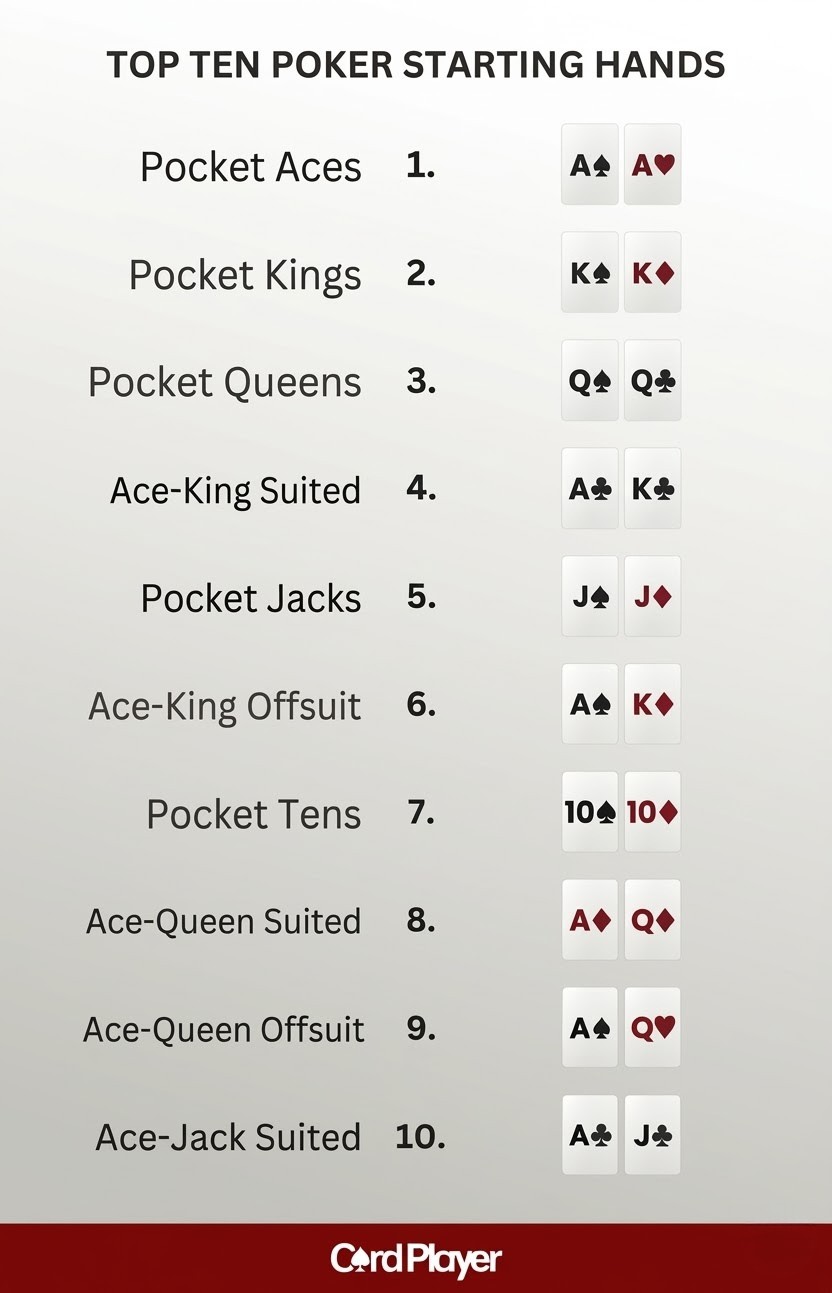
Pocket aces is the best starting hand in poker, followed by kings. Suited broadways have the edge over offsuit combos, while hands like AQs and TT run very close in terms of equity and playability. The best Hold’em starting hands share one thing in common: they either dominate weaker holdings or have strong multiway equity.
Strong & Playable Hands
You don’t have to stick to just premium hands in poker. There are many other starting hands that you can open-raise with depending on factors like position, stack sizes, and opponent tendencies.
Here’s a list of strong hands that play well from middle and late position: KQs, AJo, ATs, KQo, 99, KJs, 88, A9s, 77, KTs
Speculative Hands
Texas Hold’em good starting hands don’t have to be premium — suited connectors and medium pairs can be strong in the right spots. Speculative hands include suited connectors, small pairs, and one-gap suited connectors. The aim is to see a cheap flop and see if you can pick up a monster hand like a set or a playable draw. When they do hit, these hands tend to be well hidden and often get paid off by top pair.
Strong speculative hands include: QJs, JTs, A5s, T9s, QTs, 98s, pairs from 22-66, and so on.
Weak & Unplayable Hands
Some poker starting hands are simply too weak to play. Hand combinations such as T3o, J4o, and 72o rarely connect with the board and should almost always be folded preflop. Fold your offsuit trash and wait for a better hand.
Texas Hold’em Starting Hands Chart
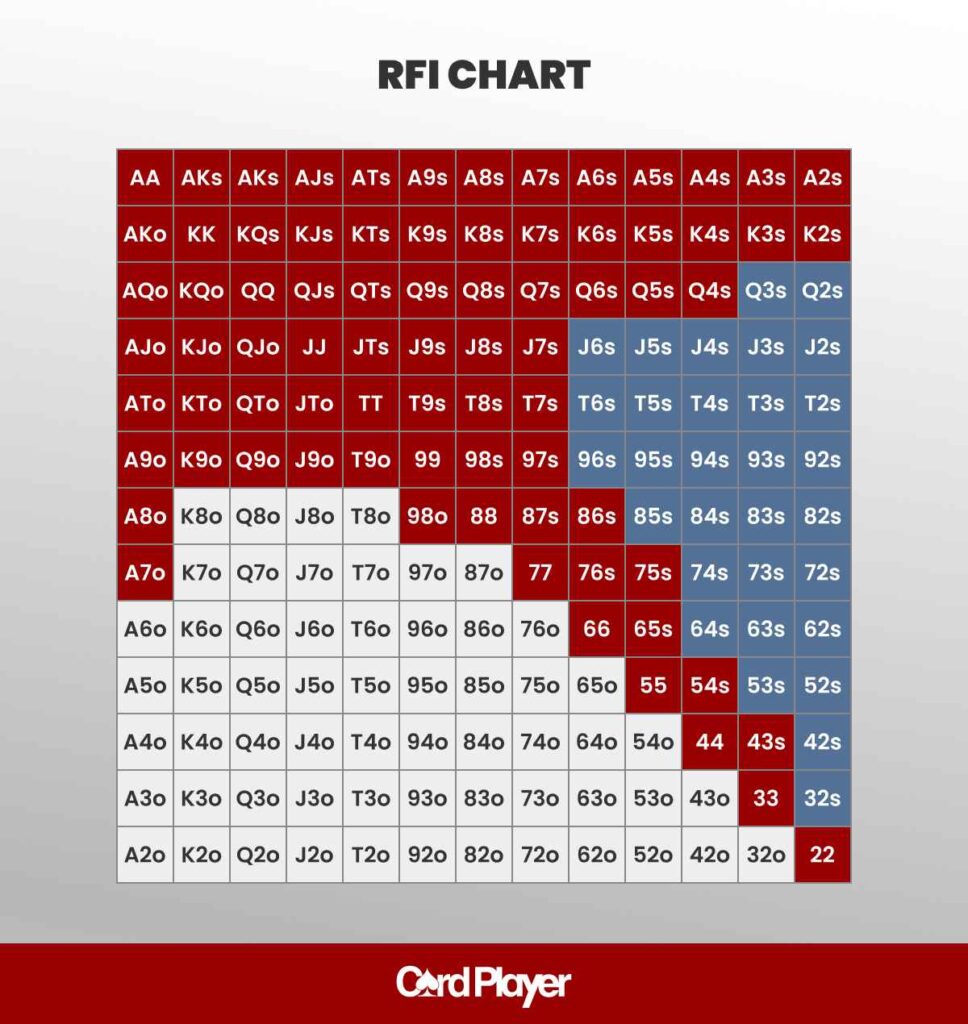
Here’s a poker starting hands chart showing all 169 distinct starting hand combinations.
The chart below is a Raise First In (RFI) chart for the button position, showing which starting hands are profitable to open with when no one else has entered the pot before you. It maps out all 169 possible starting hand combinations, with pocket pairs running diagonally through the center. Offsuit hands sit to the left of that line, while suited hands appear to the right. The strongest hands are found in the top left corner, with hand strength gradually decreasing toward the bottom right.
Poker Starting Hand Selection by Position
When it comes to choosing which hands to play, you should be more selective early in the betting order and gradually open up your range the closer you get to the button — the most favorable seat at the table.
Position refers to where you act in the betting order.
The later your position, the more hands you can profitably play. This is because you’ve seen who entered the pot before you, and you’ll have the advantage of acting last after the flop. Poker starting hand selection should therefore be very tight in early position and wide in late position.
Early Position (10–15% range)
The earlier your position, the tighter you should play. From under-the-gun in a full ring game, you’re only raising between 10-12% of hands, similar to UTG+1 and UTG+2. This group of hands includes high pairs like aces, kings, and queens, strong high-card combinations like ace-king and ace-queen, and a few suited ace hands — where your ace is paired with another card of the same suit — to add some variety to your play.
Middle Position (15–20%)
From middle position, such as the lojack, you’ll typically want to raise between 15-20% of hands. Raise with all early position starting hands, plus medium pairs, broadway hands like KJ, and strong suited connectors.
Late Position (25–55%)
If the action folds around to you in late position, you can raise a very wide range, such as 40-55% of hands from the button. This includes all middle position hands, plus any pair, any suited ace and most offsuit aces, suited connectors, one-gap suited connectors, and many other hands.
Blind Play & Defending vs Raises
From the small blind, you can open-raise quite wide against the big blind with around 30% of hands. Against a raise, you’ll only defend or three-bet a tight range of premium hands and mix in a few bluffs against aggressive late position opponents.
From the big blind, you’ll have the odds to defend wide with around 35-55% of hands against a late position raise. Defend much tighter against strong early position raises that are more likely to have you crushed.
Poker Starting Hand Range Chart By Position (6-Max)
This simplified chart offers a modern guideline for building a strategy for working with starting hands in Texas Hold’em. The ranges are for open-raising in an unopened pot in a 6-max No Limit Texas Hold’em cash game with 100 big blinds. They do not show calling or three-betting ranges.
These ranges are not rigid rules; they adjust depending on table dynamics, stack sizes, and player tendencies. However, they provide a strong foundation for developing solid preflop play in poker cash games or the early stages of tournaments:
| Position | Tight Range (Beginner-Friendly) | Standard Range (Balanced Strategy) | Aggressive Range (Advanced Mix) |
|---|---|---|---|
| UTG / Lojack | RFI 12%: AA-88, AKs, AQs, AJs, KQs, AKo | RFI 17%: AA-66, AKs-ATs, A5s-A4s, KQs-KJs, QJs, JTs, AKo-AQo-KQo | RFI 20%: Axs, 55, KTs, QTs, AJo, KJo, T9s, 98s, 87s |
| Hijack (HJ) | RFI 16%: AA-77, AKs-AJs, KQs-KJs, QJs, JTs, AKo-AQo | RFI 21%: AA-55, AKs-ATs, A5s-A3s, KQs-KTs, QJs-JTs, T9s, 98s-87s, AQo-KQo | RFI 25%: Add A9s, AJo, KJo, QTo, 76s, 65s, 54s |
| Cutoff (CO) | RFI 23%: AA-66, AKs-ATs, A5s-A2s, KQs-KTs, QJs-JTs, T9s-87s, AQo-KQo | RFI 28%: AA-44, AKs-A9s, A5s-A2s, KQs-K9s, QJs-J9s, JTs-T8s, 98s-65s, AQo-AJo-KQo | RFI 33%: Add A8s-A6s, K8s, Q9s, J9s, T9o, 87s-54s |
| Button (BTN) | RFI 40%: AA-55, any suited Ace, KQs-KTs, QJs-JTs, T9s-87s, AQo-AJo-KQo | RFI 48%: Any pair, any suited Ace, K9s+, Q9s+, J9s+, T8s+, A9o+, KTo+, QTo+, JTo | RFI 55%: Nearly any suited hand, all broadways, many one-gappers, most offsuit Ax |
| Small Blind (SB) | RFI 32%: AA-99, AKs-ATs, A5s-A2s, KQs-KTs, QJs-JTs, T9s-87s | RFI 38%: AA-22, AKs-A8s, KQs-K9s, QJs-J9s, T9s-65s, AJo+, KQo | RFI 45%: Add A7s-A2s, K8s-K6s, Q8s+, J8s+, T8s+, 98s-54s |
| Big Blind (BB) | Defend ≈ 35%: 55+, A8s+, KTs+, QTs+, JTs | Defend ≈ 45%: 22+, A2s+, K9s+, Q9s+, J9s+, T8s+, 98s-65s, A9o+, KTo+, QTo+, JTo | Defend ≈ 55%: Mix 54s+, suited Aces, suited Kings, broadways, low connectors |
Adjusting to Stack Depth
Your stack size, or your opponent’s stack sizes, have a huge impact on your starting hand selection. Here’s a quick overview:
- Short stack (10-15bb): Play transitions into push-fold territory. Shoving hands often contain high cards, blockers, or hands that have decent equity against calling ranges.
- Short to medium stack (20-40bb): Value shifts toward high-card strength. Hands like AJ gain value because there’s less room to maneuver postflop and they can win immediately with top pair on the flop.
- Medium stack (40-50bb): Ranges balance between raw strength and playability. There’s still room to play postflop, but speculative hands count for less than with a deep stack.
- Deep stack (100+ big blinds): Playability and implied odds matter more. Suited connectors, small pairs, and suited aces become valuable since they can win large pots when they connect with the board.
Exact stack depths will vary, making each situation different from the last and demanding constant adjustment to ranges. However, if you study common stack depths like 10bb, 20bb, 30bb, 50bb, and so on, you’ll always have a fair idea of your starting hand ranges.
Suited vs Offsuit Hands — What’s the Difference?
Suited hands add around 2-3% equity to a hand. So, for example, if AK offsuit has 50% against your opponent’s hand, AKs will usually have around 52-53%. This doesn’t sound like much of a difference, but it can be enough to shift the odds in your favor.
More than that, though, suited hands add a lot of playability. You’ll flop a flush draw around 11% of the time, allowing you to play with a premium draw that has overcards and nut potential. Big suited combos like that are ideal for semi-bluffing.
Pocket Pairs vs High Cards
Pocket pairs typically have around 50-55% equity against two overcards preflop, even though it is commonly referred to as a coinflip. For example, JJ is a 54% favourite against AK suited and 57% favourite against AK offsuit.
Lower pairs tend to be closer to a coin flip, although 33 is still technically ahead of AK suited preflop as the 52% favourite. The problem is that low pairs are not very playable postflop beyond set mining. You’ll encounter overcards and often be forced to fold, whether your opponent hits or not.
Low pairs can be used for set mining when stacks are deep. The idea is to see a cheap flop to try to hit a set. If you miss, you fold to a bet. The nearly 12% of the time that you flop a set or better, you can play for big value with a disguised hand.
Texas Hold’em Starting Hand Equities
Texas Holdem starting hands percentages show how much equity each hand holds against a random holding preflop. Equity is your statistical chance to win at showdown at a given moment during a hand. Here are some starting hand equities when you are all-in versus a random hand:
- AA → ~85%
- KK → ~82%
- AKs → ~67%
- AQo → ~63%
- JJ → ~77%
- T9s → ~54–56%
- 72o → ~34%
Keep in mind that you are rarely playing against a “random” hand, as your opponent will have a range that they raise or call with.
In multiway pots, hand equity nearly always falls. For example, here’s how your equity looks with pocket aces versus one, three, or five opponents:
- 1 player → ~85%
- 3 players → ~63%
- 5 players → ~49%
Adjusting Poker Starting Hands Based on Game Type
Recognizing these differences helps you adapt your opening hands strategy in Texas Hold’em to the specific format you’re playing.
Cash Games
In cash games, stacks are typically deeper, allowing for a wider range of playable hands and more postflop skill. With stacks typically at 100bb, speculative hands become stronger and stacking off with top pair is risky.
Tournament Play
In tournaments, rising blinds, antes, and payout pressure constantly shift the value of starting hands. Stack-to-blind ratio and fold equity become more critical than pure hand strength. Tournament poker play also introduces ICM pressure, bounty formats, and bubble dynamics, all of which shift the value of starting hands compared to cash games.
6-Max vs 9-Handed Tables
At a full ring table, there are more early position seats. At a 6-handed table, the early positions are removed and action starts with the lojack, so your ranges are generally wider as you’ll be playing in middle and late position more often.
Loose vs Tight Tables
You should always adapt your poker starting hand ranges depending on the other players at the table and the overall dynamic. Against tight players, you can open wider, especially from late position. Against loose players, you should tighten up a little or refine your range so it is more value-heavy.
Common Texas Hold’em Starting Hand Mistakes
Here are some of the most common mistakes players make when it comes to starting hand selection in Texas Hold’em:
Playing Too Often Out of Position
Playing from the blinds or early positions with marginal hands is one of the quickest ways to lose a stack of chips. Preflop, there are still loads of players left to act who could wake up with a strong hand. Postflop, you will be forced to act first on every street postflop.
Overvaluing Offsuit Aces
A hand like A7 offsuit seems promising because of the ace, but it often gets beaten by stronger kickers. This type of hand is a novice’s trap, as it tends to win small pots and lose big ones when dominated. Small suited aces like A3s and A5s are stronger, because they can form flushes and straights.
Overlooking Suited Connectors in Deep Stacks
Some new players fold hands such as 98s because of a lack of confidence. However, in deep stack situations, these kinds of hands are great for mixing up your range, making draws that you can semi-bluff, and occasionally breaking topped-out hands to win big pots.
Memorizing Charts Without Adapting
Poker starting hand charts are awesome tools that can help you to learn the basics of range construction. However, you shouldn’t rely on them as a final solution. It’s important to understand how to adapt your ranges based on other factors like the actual stack sizes and your opponent’s unique tendencies. As your poker strategy becomes more developed, you’ll be able to construct your own ranges.
Ignoring Position
Position is, without a doubt, one of the most important factors when it comes to poker starting hand selection. If you’re raising the same hands from any position, that’s a big error in both directions. You’ll be playing subpar hands in earlier positions and not loosening up enough from late position.
Poker Starting Hand Nicknames
You might hear poker starting hands be referred to by their nickname. Here’s a list of the most common slang names for starting hands:
- Pocket Rockets (A♠ A♦): A pair of aces, the strongest starting hand in Texas Hold’em, so-called because the AA looks like rockets.
- Cowboys (K♠ K♥): Pocket kings, called “cowboys”, a nod to the Wild West.
- Ladies (Q♣ Q♦): Pocket queens, a nickname for the female royal face cards.
- Big Slick (A♠ K♠): Ace-King, especially suited, a strong drawing hand that looks powerful but can be tricky to play.
- Doyle Brunson (10♠ 2♥): Ten-deuce, named after Doyle Brunson, who won the WSOP Main Event twice with this hand, making a full house both times.
- Snowmen (8♠ 8♦): Pocket eights, because the number 8 resembles a snowman.
These nicknames are part of poker culture and you’ll hear them regularly at the table.
Final Thoughts: Mastering Poker Starting Hand Strategy
Texas Hold’em starting hand charts offer a guide as to what starting hands to play from which positions at the table. A novice player can use these charts as a reference guide. However, the charts must never be considered set-in-stone methods of play.
Poker is a constantly adaptive game. A chart will not be aware of a player in the small blind who is way too aggressive or a short stack who is waiting to shove. To master starting hand strategy in poker, you’ll need to be able to construct your own ranges and develop an intuition for how to adapt starting hand selection in real time.
Experience, combined with study, is what transforms charts into actionable understanding.