



As I have often said, poker tournaments need to have only one rule – what I call the “Golden Rule.” We know it from baseball as the Commissioner’s right to act “in the best interests of the game.”
The World Series of Poker states it not quite so succinctly in Rule 45:
Host Properties’ employees will use reasonable efforts to consider the best interests of the WSOP Tournament and fairness as the top priority in the decision-making process, with the understanding that “best interests of the WSOP Tournament and fairness” shall be determined by Host Properties, acting in its sole and absolute discretion. Unusual circumstances can, on occasion, dictate that the technical interpretation of the rules be balanced against the interest of fairness.
Technically, the Tournament Director could just cite that rule to support every decision that is made if they wanted. But we as poker players demand more precision for a variety of reasons.
The Legal Fiction Of “Knowing The Rules”
One reason is to inform players of what they can and cannot do. Before playing in the WSOP, each player attests that they agree to abide by the rules. In theory, they should therefore know what the rules are. But we know that isn’t really true.
How often do you actually read the Terms and Conditions before you click “I AGREE?” Most of us have better things to do with our time, even if it is watching reruns of Buffy the Vampire Slayer. But there is no doubt that even if we have not read or understood those Terms and Conditions – or the WSOP Rules – they are binding.
It is a legal fiction that we are supposed to know the rules. It has always amused me that it is a principle of criminal law that if a law is vague or ambiguous, you can’t be found guilty of violating it because it was not clear to you what behavior was prohibited. The law seems to assume that a would-be criminal reads it in order to know how to behave before they commit the crime!
Regardless of how ridiculous that is, a poker player would be wise to know the important rules before the fact rather than learn them the hard way. (Perhaps another reason for a specific rule is so the TD can cite it to the player who commits the offense, making clear that any penalty is not an arbitrary application of the Golden Rule.)

How One Controversy Becomes A Permanent Rule
Years ago, a player who made it deep into the Main Event attributed his success to his neglect of personal hygiene. When he was finally dragged kicking and screaming from his odiferous seat at the table, he was heard to shout, “Where does it say in the rules that you have to take a shower?”
It didn’t, but the next year such a rule appeared. WSOP Rule 40.d provides:
This rule [referencing the rule requiring “civility and courtesy”] shall include, but is not limited to, any Participant whose personal hygiene has become disruptive to the other Participants seated at their table. The determination as to whether an individual’s personal hygiene is disruptive to other Participants shall be determined by WSOP Personnel which may, in its discretion, implement sanctions upon any such Participant who refuses to remedy the situation in a manner satisfactory to Host Properties.
Chip Dumping, Side Deals, And The Limits Of Existing Rules
The WSOP has a tendency to be reactive rather than proactive – coming up with a rule to cover a situation that has already happened. And so it is with rules that have been modifed for this year’s WSOP.
One rule change addresses a controversy at the 2025 WSOP where two players allegedly conspired in heads-up play in order to benefit from a million dollar prize offered by the third-party poker website.
The WSOP called their behavior “collusion,” but the cited rule, WSOP Rule 40.b, clearly contemplates that collusion takes place when players conspire to disadvantage a third player, not to disadvantage one of the conspirators. Perhaps citing chip-dumping would have been more accurate, but chip dumping is also defined as a form of collusion.
In any event, it was clearly a violation of the Golden Rule, so the WSOP was well within its rights to take action.
The first sentence of WSOP Rule 40.e was always there, but now the rule is more specific. It provides:
Host Properties will penalize any act that, in the sole and absolute discretion of Host Properties, is inconsistent with these WSOP Official Tournament Rules or the best interests of the WSOP Tournament. Such act includes, but is not limited to, the Participant accepting any payment or prize from a third-party person or entity (e.g., pursuant to a promotion, product or service) based on the outcome or results of any WSOP Event, in which case the Participant shall forfeit all of the WSOP prize money; if the prize money has already been paid to Participant, then the Host Properties shall have the right to the return of all the prize money plus interest.
If broadly applied, this rule could potentially be used when a third party invests in a player. Or when players swap pieces of each other. We will have to rely on the discretion of the officials to enforce the rule only when the deal gives an advantage to one player over another.
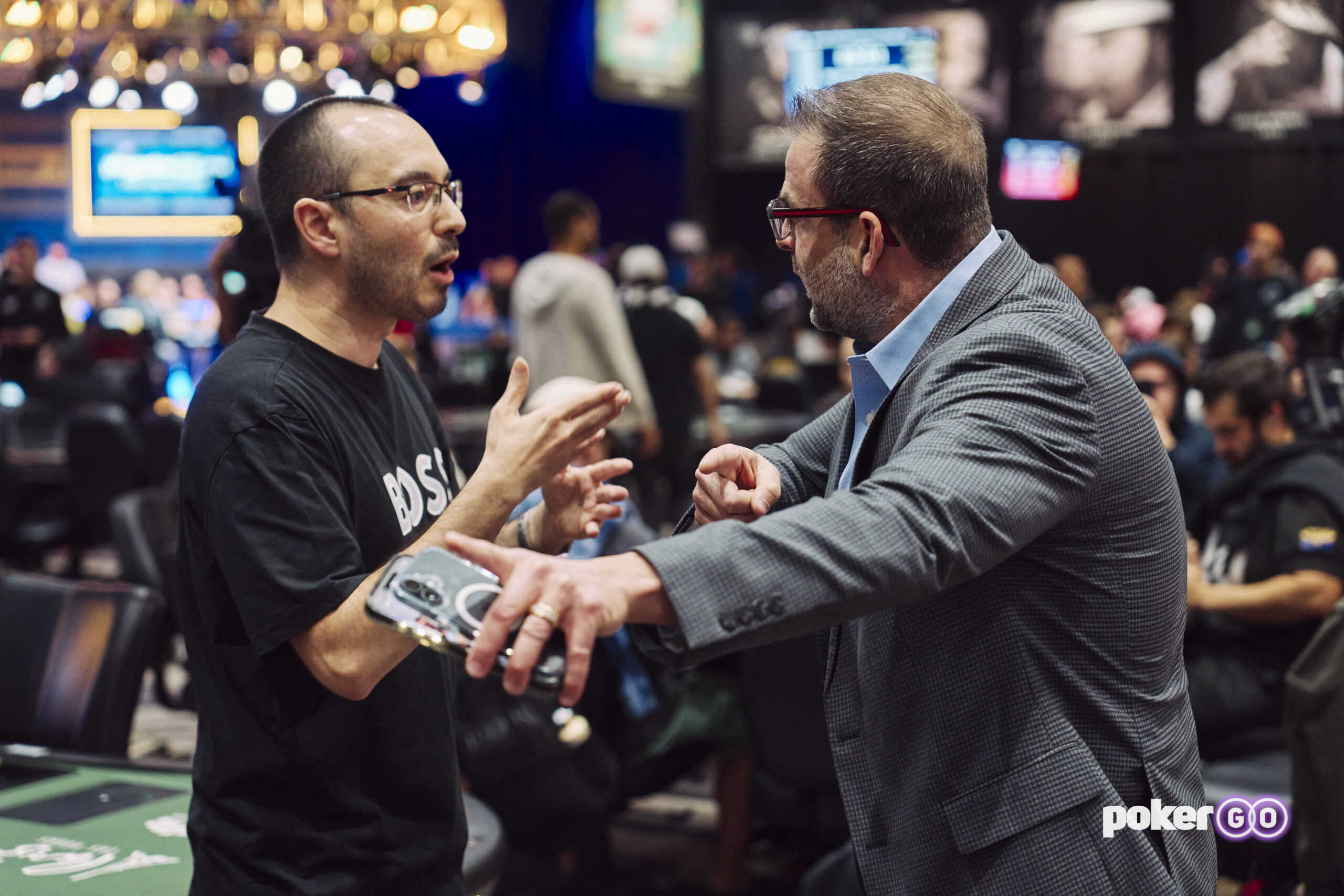
Will Kassouf Argues With Tournament Director Jack Effel
Will Kassouf And The Evolution Of Stalling Penalties
Another modification addresses the situation when, late in a tournament, a player stalls in order to preserve his stack. This tactic was taken to new heights by Will Kassouf in the 2025 Main Event. The overly-chatty player was finally put on a permanent clock to speed him up. Ever the lawyer, Kassouf never let up complaining about the “unfair” treatment he received because there was no rule forbidding this specific behavior.
Rule 80 has always had detailed rules for calling the clock. The only change in 2026 is to the final sentence. It formerly read: “Participants unnecessarily calling the clock or stalling may incur a penalty in accordance with Rules 40, 113, and 114.” Now it reads:
Participants unnecessarily calling the clock or stalling, including purposely depleting time banks to ladder up in the payout, may be subject to a reduced clock or incur a penalty in accordance with Rules 40, 113, and 114.
A future column will discuss modified rules on wearing logos and clarify the rules on phone usage at the table.
 Scott J. Burnham is Professor Emeritus at Gonzaga University School of Law in Spokane, Washington. He can be reached at profburnham@yahoo.com.
- Photos by PokerGO, Card Player