




Aubrey Williams was on the cusp of winning the 2026 WSOP Ladies Championship on multiple occasions, battling heads-up against Skye Chen for her first gold bracelet. Williams, who’s been a fixture on the live tournament circuit in recent years, had one of the loudest groups of friends and well-wishers on the rail.
Williams ultimately fell just short of the title, losing two key flips against Chen, and settled for what was still a career-high payday of $129,692.
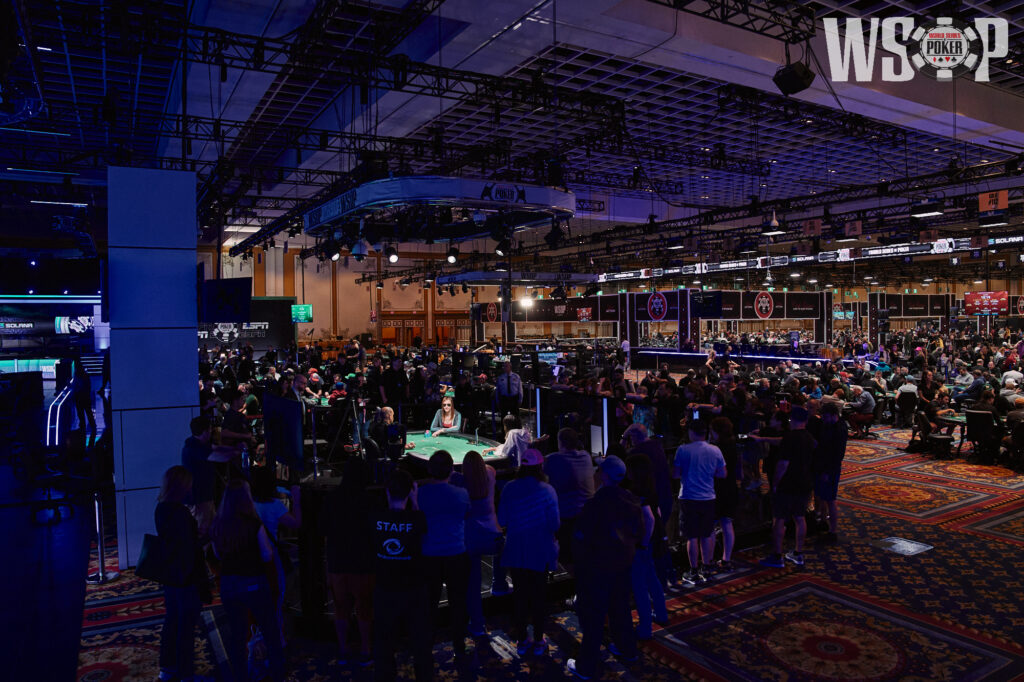
By all accounts, I saw a triumphantly normal experience inside the ballroom at Paris Las Vegas. The action on the felt and the support from the crowd were indistinguishable from any other recent editions of the Ladies Championship we’ve seen at the WSOP. There was a sense of community, rhythmic cheering, and even handmade signs held up between hands.
But the internet is a far less inclusive place than the poker room, it would seem.
A Cesspool In The Comments
Williams, a transgender woman, prompted a sadly all-too-familiar level of hate and vitriol across multiple platforms. The stream of incendiary comments on the official WSOP live stream prompted direct reactions from broadcaster Joe Stapleton, who pointed out that hundreds of anonymous users had to be banned from the live stream chatbox.
During a WSOP Countdown broadcast after the Ladies Championship, Stapleton recounted the online reaction to his positive sentiments towards Williams on the broadcast.
“Poker is a mental game, and acting like someone else doesn’t belong isn’t standing up for women,” Stapleton said. “It’s actually insulting to them, and it’s showing your mental weakness. And this opinion brought me a ton of hate last night online.”
Stapleton went on to share a positive message from a viewer with a trans daughter, and how watching the broadcast and seeing the reactions in the room and on the broadcast were an overwhelmingly positive experience.
But the deluge of negative comments are sadly par for the course for social media. Reactions to any piece of content or social media post involving a transgender subject are often flooded with hate.
For days after the tournament ended, I saw social media comments continue to pile up as poker sites dealt with an agitated group of anti-trans posters, with plenty of vitriolic replies aimed squarely at Stapleton.
The comments on all of WSOP’s official accounts featured similar reactions, as did posts on coverage of the Ladies Championship from a variety of other media outlets. There were ‘jokes’ about genitalia, associating transgender individuals with pedophilia, and a variety of slurs hurled at Williams, Stapleton, and anyone offering support of any kind to Williams during her run.
The Targeting Of Transgender Individuals
Trans individuals attempting to participate in women’s sports and existing in women’s-only spaces has become one of the most divisive wedge political issues of the modern era. Predominantly conservative politicians have made the trans community, and trans women in particular, the primary target of political messaging intended to keep their base angry and engaged, while citing the safety and protection of women as their goal.
Several executive orders from President Donald Trump have directly targeted transgender women in sports. In fact, just days after this tournament played out, the Supreme Court’s conservative majority ruled 6-3 in favor of upholding statewide bans against transgender girls and women from competing on school sports teams.
Of course, this goes beyond sports. “Bathroom laws” have been passed with increasing volume at a statewide level, forcing people to use the restroom that aligns with their gender at birth, with the risk of serious legal consequences. The Equal Employment Opportunity Commission vacated gender identity protections in the workplace. Parental notification laws that prematurely out transgender students to their parents have passed in conservative states, and laws intended to protect those students’ mental health and physical safety in California were temporarily struck down by an emergency order of the Supreme Court.
The exclusion of transgender women has expanded to mind sports, as well. Most notably, FIDE, the International Chess Federation, banned transgender women from competing in women’s-only chess events in 2023. The bans have also reached the esports space in recent years.
Women In Poker

The WSOP Ladies Championship has roots dating all the way back to 1977. While initially designed to recognize the best women players, the tournament also served as a comfortable entry point for those just getting into the game. It has since transformed into an annual celebration of women in poker, with a festive and welcoming atmosphere.
But there’s no denying that the Ladies Championship, and women-only tournaments in general, have served as a lightning rod for controversy at several points over the last 20 years, before you even get to more recent concerns with transgender participants.
I know that everybody immediately thinks back to when Shaun Deeb, now a nine-time WSOP bracelet winner, donned women’s clothing and entered the 2010 WSOP Ladies Championship. But his poorly executed ‘joke’ pales in comparison to what happened in 2011. The ‘joking’ turned ugly the following year, when Jonathan Epstein entered the tournament and finished in ninth place. Marsha Wolak ultimately won the 2011 WSOP Ladies Championship.
There have been a handful of similar instances of men entering women’s events outside the WSOP, too. Abraham Korotki’s 2009 victory in a women’s event at Borgata stands out, and as recently as 2023, David Hughes won a ladies event during the WPT Hard Rock Poker Showdown series in Florida.
The one thing lacking in all of the controversies surrounding women’s events is simple. Not enough people are asking the women involved.

An Evolving Issue
I interviewed Hughes a few years ago for an unrelated story in which Hughes won a satellite into a major event. He couldn’t have been nicer or more polite to me, but I’m a straight, white, male-presenting person. Some of the most misogynistic and transphobic comments tend to come from otherwise seemingly calm and genial individuals who lose their minds in very specific circumstances.
In an effort to stop these kinds of stunts by Epstein, Korotki, Hughes, and others, entry rules for the WSOP Ladies Championship changed in 2013. The buy-in was increased to $10,000, with women getting a 90% discount down to $1,000. In 2016, fueled by prop bets and other incentives, Tony Ruberto put up the $10,000 buy-in to enter the event. To date, he appears to be the only man to have done so since the change to the buy-in rules.
One of the more common themes among the anti-trans crowd was why Williams didn’t have to pay the $10,000 buy-in, rather than the reduced $1,000 rate. The WSOP determines eligibility by the gender listed on your I.D. Williams resides in a state that allows for a gender marker change. As of 2024, 30 states allowed for gender marker changes on driver’s licenses without surgery or a court order. Nine states require proof of surgery, an amended birth certificate, or a court order to do so.
States like Florida, Texas, Kansas, Indiana, Iowa, Oklahoma, and Mississippi have outright banned gender marker changes on driver’s licenses and state IDs. They’ve gone so far as to reverse previous gender marker changes for transgender people in recent years, and the United States Department of State under President Trump has followed suit with U.S. passport holders.
Continued Growth In Ladies Events, But Not Open Tournaments
The WSOP, at least for now, continues to allow transgender women to enter the Ladies Championship with a $1,000 buy-in. Williams was not the only trans woman to enter the 2026 event, though she was the only one to make a deep run and reach the final table.
This latest chapter in the Ladies Championship’s history folds into the complicated dynamics of women in poker. This particular event continues to grow by the year. In 2025, and then again in 2026, there was a record turnout, reaching 1,475 entries in the latest edition of the event.
Women’s participation in open WSOP events, however, remains low in general. In the 2025 WSOP main event, 358 players were identified as women, only about 3.7% of the total field.
On poker’s all-time money list, only six-time WSOP bracelet winner Kristen Foxen cracks the top 100. Foxen is one of two women to win open field bracelet events in 2026, taking down a $25,000 no-limit hold’em event. Michelle Chin won the $1,500 limit deuce-to-seven triple draw bracelet earlier this summer.
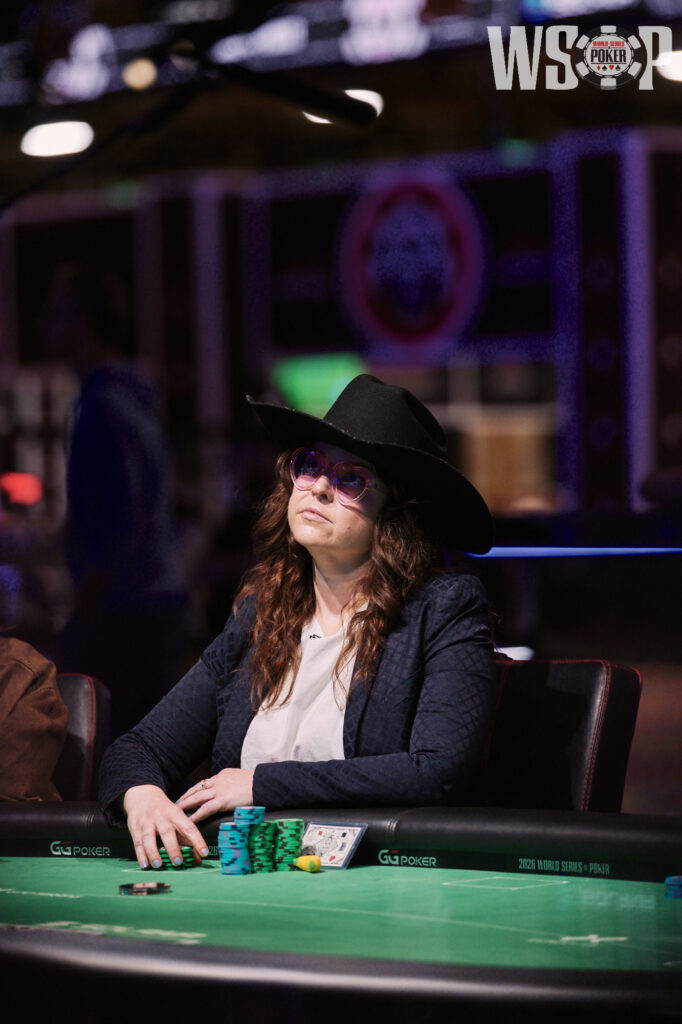
Caitlin Comeskey
Poker Players Step Up
Despite the deluge of online trolls during Williams’ recent run, poker players largely rallied around Williams. That group included Patrick Leonard, WSOP main event champion Joe McKeehen, and Jennifer Shahade, among many others.
Caitlin Comeskey, who also made the final table of the 2026 WSOP Ladies Championship, stood firm in her support for Williams.
“Anyone who dares to mess with Aubrey in person or online publicly will have to deal with me,” Comeskey said. “No one has a problem with her being here, and if you use her for rage bait to help your pathetic online platform, I will come at you with the fire of 10,000 suns.”
For days after the tournament ended, like Stapleton, Comeskey continued to field hate comments on social media and didn’t back down an inch.
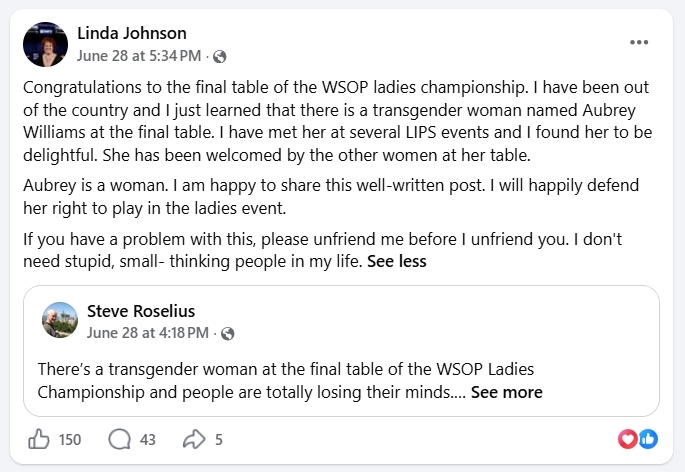
When it comes to women in poker, Linda Johnson has arguably had a tremendous impact on the game for decades. ‘The First Lady of Poker,’ a Poker Hall of Famer, has dedicated much of her life to poker and to women in the game. In the lead-up to the WSOP Ladies Championship, Johnson made her thoughts on the matter clear.
The Joy of Poker
I am not so naive as to believe that if Williams had won this tournament, it wouldn’t have been headline news for days in conservative media. It’s certainly possible that we would have seen more opportunists try to become poker’s version of Riley Gaines, the University of Kentucky swimmer who finished tied for fifth place in a race against Lia Thomas, a former University of Pennsylvania swimmer who is a transgender woman. Gaines has made a lucrative career out of being one of the loudest voices against transgender women in sports.
What I do believe is that the poker community, and women in the poker community, stood firmly behind Williams in this instance. The actual poker players who have sat with Williams, played in women’s events with her, and have gotten to know her while traveling the tournament circuit couldn’t have been clearer in their support.
In a world in which hate, bigotry, and exclusion seem to be the theme of this era, it was nice, for a brief moment, for the noise and the hate to get drowned out. To know that some of the loudest voices in the industry are committed to trying to keep the poker world more inclusive than other sports and competitions. That the hate spewed in online spaces and comments sections doesn’t align with what’s happening in the real world.
The most important part of this conversation is that the women in the actual event were okay with it, so why shouldn’t we all be?
I’m proud that, for at least one night at the WSOP, the noise stayed away from the table.
 Tim Fiorvanti is a senior staff writer for Card Player. His previous work includes writing and editing for ESPN, the World Poker Tour, BLUFF Magazine, Newsday, amNewYork, and Casinos.com.
- Photos – WSOP / Alicia Skillman and Monique Marestein