









While most people immediately think of Texas Hold’em, there are many other poker games to play, each offering unique twists, strategies, and challenges. Some types of poker games suit certain players and styles of play, while others reward a completely different approach.
Types of Poker Games: Key Points
- Poker includes draw games, stud variants, community card games, Chinese poker, and mixed formats – each with unique dealing and betting rules.
- Games are categorized by hand rankings: high-only (best traditional hand), lowball (lowest hand), and split-pot (pot divided between different hand types).
- Texas Hold’em remains the most popular poker game worldwide, while PLO is the second most common variant in both live and online poker rooms.
- Different poker games reward different skills – from postflop strategy in Omaha to board tracking in Stud.
In This Guide
- Types of Poker Games: Key Points
- Different Types of Poker Games
- Texas Hold’em
- Short Deck (6+)
- Pot-Limit Omaha (PLO)
- Double Board Bomb Pot
- Omaha Hi-Lo (8 or Better)
- Big O
- Stud Poker (7-Card Stud, Razz, Stud Hi-Lo)
- 5-Card Draw
- 2-7 (Deuce to Seven)
- Badugi
- Pineapple
- Chinese Poker & Open-Face Chinese (OFC)
- H.O.R.S.E.
- Other Poker Games
- Conclusion
- FAQs
Different Types of Poker Games
For a better overview of different poker games, we can group them into a few categories:
- Draw poker: All cards are hidden, and a player can improve their hand by discarding some cards and drawing new ones.
- Stud poker: Each player receives a mix of hidden and face-up cards over several betting streets.
- Community card games: Players make a hand by combining their hidden cards with community cards that all players share.
- Chinese poker: A type of poker game where hands are arranged in multiple rows, with detailed scoring rules for each row.
- Mixed games: Multiple poker game variations are played consecutively (in rounds) within the same cash game or tournament.
Another way to categorize different types of poker games is by the kind of hands players aim to make:
- High-only games: Try to make the best high hand according to standard poker hand rankings.
- Lowball games: Try to make the lowest possible hand.
- Split-pot games: The pot is split between two hands, each built using a separate set of rules. Many split-pot games are High-Low (like PLO8, Big O, Stud Hi-Lo), but not all (e.g., Dramaha, Badeucey, Badacey).
This is a good start for mapping out the variety of different kinds of poker. Next, let’s dive into the full poker variants list – starting with the classics and then moving on to more exotic poker variations.
Texas Hold’em
Texas Hold’em is the world’s most popular poker game – during the global poker boom of the early 2000s, No Limit Texas Hold’em led the charge. Over 20 years later, it remains king of both live and online poker games, including tournaments and cash games. Texas Hold’em is an easy game to learn but has infinite strategic depth, which is why it continues to captivate players at all levels.
Texas Hold’em Rules
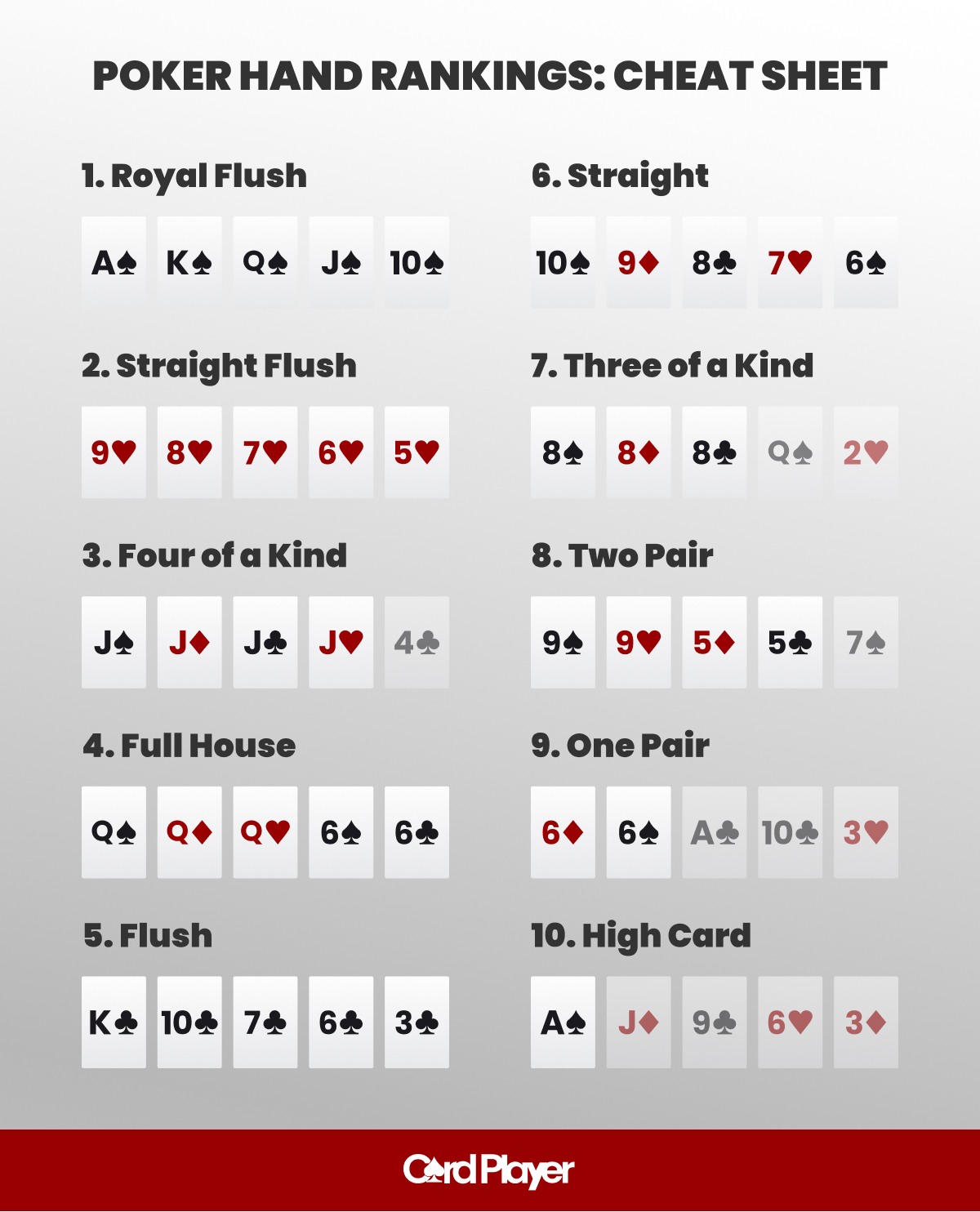
Each player is dealt two hole cards, and five community cards are revealed across three streets: flop (3 cards), turn (1), and river (1). There are four betting rounds – preflop, on the flop, turn, and river. As in most poker variants, a player wins by making the best five-card hand, or by betting other players out of the pot.
By far the most popular variation of Texas Hold’em is No-Limit; this betting structure allows players to bet any amount at any point in the hand. This makes the game exciting and strategically complex. There are many betting lines and sizes, allowing for a wide range of strategies and moves.
Quick Facts:
- Type of Game: Community Card Game
- Limits: No-Limit, Pot-Limit (rare), Limit
- Difficulty to Learn: 3/10
- Game Availability: 10/10
Short Deck (6+)
It was first introduced in high-stakes cash game circles in Asia, notably Macau, Hong Kong, and Manila, around 2014. It gained broader attention in 2015 when notable players like Phil Ivey and Tom Dwan promoted it internationally. By 2019, it became an event at the World Series of Poker. Today, it is available on most online poker sites and is among the most popular poker variants after Texas Hold’em and Pot-Limit Omaha.
Short Deck Poker Rules
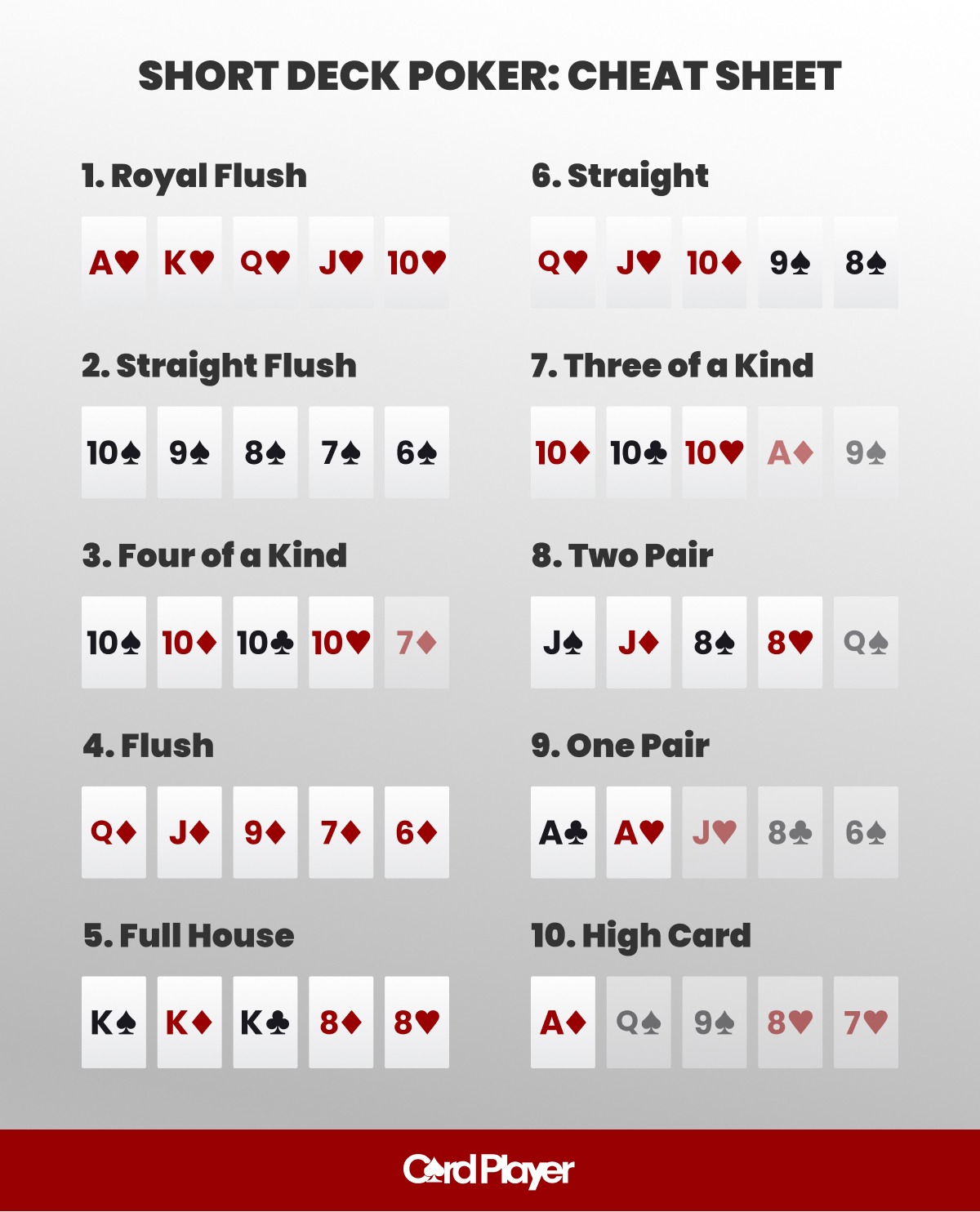
Short Deck, also called Six Plus (6+) Hold’em, plays like Hold’em but with a trimmed 36-card deck.
With all the low cards (deuces through fives) removed from the deck, hand values change – flushes beat full houses, and strong hands come up more often. Short Deck is one of the newest games on this poker games list. Live 6+ Hold’em games are less common outside of Asia.
The game is fast and swingy, appealing to gamblers seeking action-heavy poker.
Quick Facts:
- Type of Game: Community Card
- Limits: No-Limit
- Difficulty to Learn: 4/10
- Game Availability: 7.5/10
Pot-Limit Omaha (PLO)
PLO is the second-most-popular poker variant in the world. It is available daily in many US locations (such as Las Vegas, Florida, and Texas), is very popular in Europe, and is widely offered in online poker games. Many players prefer PLO because it is a postflop game with more hands played, larger pots, and often higher winrates for skilled players.
Pot-Limit Omaha Rules
In Omaha, players receive four hole cards instead of two.
The board and betting structure are the same as in Texas Hold’em – five community cards: flop (3 cards), turn (1), and river (1). The key difference is that in Omaha, players must use exactly two of their four hole cards and three from the board to make the best hand. With many more possible starting hand combinations than Hold’em, Omaha is complex and action-heavy.
Because the game tends to create bigger pots, it is mostly played as Pot-Limit – meaning a player cannot bet more than the current size of the pot.
Omaha has two newer variations: Five-Card Omaha and Six-Card Omaha.
- Five-Card Omaha is very popular and widely available online. Many live card rooms that offer Omaha also feature this variation. In some venues, it is more popular than regular PLO (e.g., Miami, Florida).
- Six-Card Omaha is growing steadily and is now a regular game on many online platforms, though it is less commonly found in live games.
Quick Facts:
- Type of Game: Community Card
- Limits: Pot-Limit, No Limit (rare)
- Variations: PLO, Five-Card, Six-Card Omaha
- Difficulty to Learn: 6/10
- Game Availability: 8/10
Double Board Bomb Pot
In 2026, we can no longer discuss different poker variations without mentioning bomb pots.
This recent trend has quickly spread through live cash games worldwide. Bomb pots are not played every hand. They are typically played once or twice per round of blinds or after a dealer change.
“All-bomb-pot” cash games exist but are rarer.
Double Board Bomb Pot Rules
Each player posts the agreed-upon ante, usually several big blinds. Everyone is dealt a hand — the number of cards depends on the game. The defining rule of bomb pots is that all players see the flop immediately, with no preflop betting.
Most commonly, Pot-Limit Omaha is played, followed by 5-Card Omaha (Hi or Hi-Lo) and Texas Hold’em. Even Pineapple is possible, as well as other formats. Double Board Bomb Pots deal two flops instead of one, splitting the pot between the winners of each board. This generates high-action hands and complex strategies.
Unlike most poker games, study tools and theory for bomb pots are limited, so players must rely on creativity and their own experience to find winning strategies. This has injected new excitement into live cash games, with popularity continuing to grow. The WSOP introduced its first Bomb Pot event in 2024, highlighting the format’s rising appeal.
Quick Facts:
- Type of Game: Bomb Pot, Split Pot
- Limits: Pot-Limit, No Limit (Hold’em)
- Variations: Double Board, Single Board, PLO, Five-Card High, Five-Card Hi-Lo (Big O), Hold’em, Pineapple, etc.
- Difficulty to Learn: 8/10
- Game Availability: 6/10
Omaha Hi-Lo (8 or Better)
Fixed-Limit Omaha Hi-Lo has long been a mixed-game staple like H.O.R.S.E., but rarely appears as a standalone game. WSOP tournaments feature both Fixed Omaha Hi-Lo and PLO8, either alone or as part of mixed-game events. Online and live availability outside mixed games is very limited.
Omaha Hi-Lo Rules
Omaha Hi-Lo (8 or Better) is a classic split-pot game. It plays similarly to standard Omaha, but the pot is divided between the best high hand and the best qualifying low hand (five cards 8 or lower, unpaired). Straights and flushes do not count against the low hand, so the best possible low hand is A-2-3-4-5.
If no player makes a qualifying low hand, the entire pot goes to the best high hand. A single player can make both the best high and best low hand, scooping the pot. That’s why suited aces with wheel cards are premium in Hi-Lo games—they create strong high hands like flushes or straights while also making the best low hands.
Quick Facts:
- Type of Game: Community Card, Split Pot
- Limits: Limit, Pot-Limit
- Difficulty to Learn: 7/10
- Game Availability: 2/10
Big O
Big O is Pot-Limit Five-Card Omaha Hi-Lo (8 or Better). In many locations, Big O has surpassed PLO8 in popularity and availability, particularly in cash games. It is especially popular in the Pacific Northwest of the US and is now available in some Las Vegas casinos. There are some Big O poker online games, but they are not widespread.
Big O Poker Rules
Players receive five hole cards and, as in any Omaha game, must use exactly two of them with three community cards to make their hand. Like Omaha Hi-Lo, the pot is split between the best high hand and the best qualifying low hand (five cards 8 or lower).
That extra card makes a significant difference – equities run closer, and hands often connect to the flop with multiple straight, flush, and low possibilities. This leads to large multiway pots and plenty of split pots. It is possible to get a precise understanding of equities and ranges, which gives a big edge to skilled players.
Quick Facts:
- Type of Game: Community Card, Split Pot
- Limits: Pot-Limit
- Variations: Courchevel (first card of the flop is revealed immediately)
- Difficulty to Learn: 7/10
- Game Availability: 3/10
Stud Poker (7-Card Stud, Razz, Stud Hi-Lo)
Stud poker variants include three popular games:
- 7-Card Stud: A classic game known for its strategic depth and a favorite of many mixed-game players. It was America’s most popular poker game for about a century before Hold’em took over in the early 2000s.
- Razz: A lowball variant. Aces are low, straights and flushes do not count against the low hand, and the best hand is A-2-3-4-5.
- Stud Hi-Lo (8 or Better): A split-pot game combining Razz and 7-Card Stud.
Stud Poker Rules
Players post an ante and receive two down and one face-up card.
The worst face-up card posts the bring-in. Stud is usually a limit game, with up to four bets per street. Streets 4–6 are face-up; the 7th street is face-down. Stud rewards players who can track the board and adjust quickly – visible cards of all opponents — because the balance and equities can shift dramatically from street to street. All three stud variants remain fixtures in mixed games such as H.O.R.S.E., but rarely run independently.
Rare casinos host occasional cash games, and all three feature in WSOP events.
Quick Facts:
- Type of Game: Stud
- Limits: Fixed Limit (traditional), Pot Limit (rare)
- Variations: 7-Card Stud, Razz, Stud Hi-Lo (8 or Better)
- Difficulty to Learn: 7/10
- Game Availability: 2/10
5-Card Draw
5-Card Draw is another classic, and often the first poker variant players learn. It’s popular in casual home games and was commonly featured in older movies like A Big Hand for the Little Lady (1966) and Maverick (1994).
Despite simple rules, it offers strategic depth: knowing how to draw, reading opponents’ bets and tendencies, bluffing, and using position are all important.
Five Card Draw Rules
Players post blinds or antes. Each receives five face-down cards, followed by a betting round. Players may then discard and draw (usually up to three cards, or four if they show an ace), followed by a final betting round. Some games use Jacks or Better, requiring a pair of jacks or higher to raise.
5-Card draw is rarely offered in casinos or online poker games, nor is it a common tournament format. But it’s easy to play with just a deck and a few participants, making it highly accessible for home play.
Quick Facts:
- Type of Game: Draw
- Limits: Limit, Pot-Limit, No-Limit
- Difficulty to Learn: 1/10
- Game Availability: 2/10
2-7 (Deuce to Seven)
There are two popular draw poker lowball variants: 2-7 Triple Draw (limit) and No-Limit 2-7 Single Draw.
Deuce to Seven Poker Rules
Both games start with five face-down cards and a round of betting before the draw(s). The goal is the lowest hand possible, but unlike Razz, straights and flushes count against you. The best hand is 7-5-4-3-2, known as the wheel.
- Triple Draw: With three draws and fixed-limit betting, 2-7 Triple Draw is a WSOP bracelet event and a staple in mixed games like T.O.R.S.E or the 8-Game. It’s less common online or as a standalone cash game, but it is highly regarded among mixed-game players.
- No-Limit Single Draw: With one draw only, this No-Limit variant is a very different game. While Triple Draw is more mathematical, Single Draw emphasizes position, bluffing, and psychological play. It is a part of the 8-game, Dealer’s Choice, and often the lowball choice in Big-Bet Mix games.
It is worth noting that another variant, Pot Limit 2-7 Triple Draw, is also played in some mixed game events, like the Big Bet Mix or Dealer’s Choice at the WSOP, but it is rare.
Quick Facts:
- Type of Game: Draw, Lowball
- Limits and Variations: Fixed Limit (Triple Draw), No Limit (Single Draw), Pot Limit
- Difficulty to Learn: 6/10
- Game Availability: 3/10
Badugi
Badugi is believed to have originated in Asia and is included in some mixed-game lineups, such as the 10-game or Dealer’s Choice. It has slightly different mechanics than other poker games, which makes it interesting for players who enjoy lowball variants and want a bit of a change from games with regular hand rankings.
Badugi Poker Rules
Badugi is a four-card lowball draw game where players aim for the lowest hand with one card of each suit, and no pairs. The best hand is A-2-3-4 of four suits.
Quick Facts:
- Type of Game: Draw, Lowball
- Limits: Fixed Limit
- Difficulty to Learn: 7/10
- Game Availability: 2/10
Pineapple
Pineapple variants are popular in home games, but are rarely found in internet poker games or live card rooms. It’s a fun twist for Hold’em fans wanting more variety.
Pineapple Poker Rules
Pineapple is a Hold’em variant where players start with three hole cards and discard one before the flop. Another popular variant, Crazy Pineapple, has players discarding cards on the flop. This adds more excitement and strategic depth. In Lazy Pineapple, players keep all three hole cards through the river.
Quick Facts:
- Type of Game: Community Card
- Limits: No-Limit
- Variations: Pineapple, Crazy Pineapple, Lazy Pineapple
- Difficulty to Learn: 3/10
- Game Availability: 2/10
Chinese Poker & Open-Face Chinese (OFC)
Chinese Poker is very different from other games we’ve discussed, adding a new dimension to poker game variations. Unlike other poker formats, there are no betting rounds — scoring is purely point-based.
Chinese Poker Rules
Each player is dealt 13 cards and arranges them into three hands: a five-card back hand, a five-card middle hand, and a three-card top hand. The hands must get progressively stronger from bottom to top. Once all players set their hands, they compare them row by row, earning points for each win and for scooping all three.
Open Face Chinese (OFC)
Open Face Chinese takes the same idea but adds a twist: players build their three hands gradually.
Each player is first dealt five cards, which must be placed immediately. Then they receive one card at a time until they’ve set all 13. The tension comes from trying to complete strong hands without fouling (a top hand beating a lower hand), since placements are locked in as you go. Points are awarded at the end in the same way as Chinese Poker.
A signature feature of OFC is Fantasyland, which is reached by making a qualifying top hand (usually QQ+) without fouling. In Fantasyland, players get all 13 cards at once on the next deal, creating big scoring opportunities.
Pineapple OFC
Pineapple OFC is today’s most common version. Instead of receiving just one card per round, players get three cards, place two, and discard one. This speeds up the game, adds more strategic choice, and reduces variance. Fantasyland works the same way but often comes with expanded bonus rules, such as being able to stay in Fantasyland by making trips or better on the top hand.
Quick Facts:
- Type of Game: Chinese poker variants (point-based)
- Limits: Settled in Points
- Difficulty to Learn: 6/10
- Strategic Complexity: 7/10 (higher in Pineapple)
- Game Availability: 3/10
H.O.R.S.E.
H.O.R.S.E. has long been the quintessential mixed poker format. It has a long history in poker’s most prestigious circles – it was once the preferred game in elite Las Vegas cash rooms like Bobby’s Room at the Bellagio, and is still the preferred mixed-game event at many live tournament stops today.
H.O.R.S.E. Rules
The acronym H.O.R.S.E. represents five different poker games played in rotation:
- H – Limit Hold’em
- O – Omaha Hi-Lo (8 or Better)
- R – Razz
- S – Seven-Card Stud
- E – Seven-Card Stud Hi-Lo (8 or Better)
Players switch games after a predetermined number of hands or a set time interval, with all variants using a fixed-limit betting structure. This keeps the focus on technical play and avoids big-bet variance. Mastery of H.O.R.S.E. requires proficiency in both community card and stud games, as well as in high-only and split-pot formats.
While H.O.R.S.E. remains a fixture in tournament settings, its presence in cash games has diminished. Some online platforms offer H.O.R.S.E. cash games, but it is rare.
Quick Facts:
- Type of Game: Mixed (Hold’em, Omaha Hi-Lo, Razz, Stud, Stud Hi-Lo)
- Limits: Fixed Limit
- Difficulty to Learn: 9/10
- Game Availability: 5/10
Following H.O.R.S.E., other mixed games have gained popularity:
- T.O.R.S.E.: Similar to H.O.R.S.E., with Texas Hold’em replaced by Limit 2-7 Triple Draw.
- 8-Game Mix: Adds 2-7 Triple Draw, No-Limit Hold’em, and Pot Limit Omaha to the H.O.R.S.E. rotation.
- 10-Game Mix: Further expands the rotation to include Badugi and No-Limit 2-7 Single Draw.
- Dealer’s Choice: Allows players to select from 20 different games, including Badeucey, Badacey, Pot Limit Hold’em, and Pot Limit 2-7 Triple Draw.
- Big Bet Mix: Focuses on no-limit and pot-limit games. There is no official mix, but common games include No-Limit Hold’em, Pot-Limit Omaha, No-Limit 2-7 Single Draw, Big O, and Pot-Limit Omaha Hi-Lo 8 or Better.
Other Poker Games
Beyond the games covered above, countless other variations of poker games are popular in home games and certain locations. Some notable examples include:
- Badeucy: A split-pot game combining Badugi and 2-7 Lowball.
- Badacey: Similar to Badeucy, but with Ace-to-Five Lowball plus Badugi rules.
- Irish Poker (traditional): Like Crazy Pineapple, but players are dealt four cards instead of three and discard two on the flop.
- Dramaha/Sviten Special: A split-pot game combining Five-Card Draw and Pot-Limit Omaha.
- Follow the Queen: A stud variant, where queens and certain subsequent cards become wild cards.
- Wall Street: A Stud or Stud Hi-Lo variant that lets players buy needed cards from a special board in the middle of the table.
Many other creative variations of poker games continue to emerge, keeping the game fresh and ensuring there’s always something new to explore.
Conclusion
Learning about different poker games is not only fun and engaging, but it also helps us build a versatile skill set and improve as poker players.
Whether it’s reading opponents in draw variants, navigating split pots, calculating odds in stud, or putting pressure on opponents in big-bet poker, different poker games and rules each challenge you in a new way and add new tools to your arsenal. Hopefully, this list of different poker games will help you navigate your next poker adventure.
So, which poker variant will you try next?