







How to Play Chinese Poker in 2026: A Complete Beginner’s Guide to Rules, Scoring & Fantasyland
If you’re looking for a new challenge, we can show you how to play Chinese poker. Popular with pros worldwide and incredibly social, this unique poker variant has something for everyone.
Be warned, though, Chinese Poker rules are unlike anything you’ve seen before, so you can’t rely on your knowledge of Hold’em to get ahead in this game. Don’t worry; we’ll explain everything as we journey through the exciting world of Chinese Poker and up to the mythical Fantasyland.
Chinese Poker: Key Points
- Players arrange 13 dealt cards into three hands of decreasing strength.
- Back hand (5 cards) must be strongest, middle (5 cards) second-strongest, front (3 cards) weakest.
- Each hand won earns one point; winning all three (a scoop) awards six total points.
- Strong hands earn royalty bonuses in Open-Face variants; misarranged hands forfeit all points.
What Is Chinese Poker?
Chinese Poker is a hand-setting game that offers a break from the secrecy and deception found in most forms of online poker, such as Texas Hold’em, Omaha, and other closed-face variants. If you’re unsure what this means, stick around because everything will become clearer as I explain how to play Chinese Poker.
The basic premise of Chinese Poker is that you need to make three hands from one set of dealt cards. This game has gained popularity both in live casinos across the United States and through the rise of certain Asian poker apps, such as PPPoker and PokerBros.
In Chinese Poker, you get a point for each hand you win, and the aim is to score more points than your opponents.
This hand-setting variant can be used for cash games and tournaments. The rules are broadly the same in both formats. However, as we dive deeper into Chinese Poker, you’ll see there are some nuances.
Key Chinese Poker Terms to Know
Before we get into how to play, here are a few terms that’ll come up time and again in Chinese Poker. Don’t worry if they don’t all make sense yet — they will once you’ve delved further into this article.
- Back: Your first and strongest hand, made up of five cards.
- Middle: Your second hand, also five cards, which must be weaker than the back.
- Front: Your final hand – just three cards, and the weakest of the three.
- Foul / Mis-set hand: When you break the strength order or place cards incorrectly. This voids your hand.
- Scoop: Winning all three hands in a round against the same opponent.
- Surrender: Folding your 13 cards before setting hands, giving your opponent a partial win. Note: Surrender is an optional rule and is not always available in every format.
- Royalties: Bonus points are awarded for making strong hands in certain positions.
- Fantasyland: A special bonus round in OFC where you get to see all 13 cards at once, and possibly receive extra cards, depending on which version you’re playing.
- Shooting the moon: A casual house rule, not standard, where you win with jack-high in the back hand. Sometimes scored as a 20-point bonus, but only in home games that choose to use it.
Now that we’ve covered the terminology, let’s talk about how Chinese Poker actually works.
Editor Tip:
Don’t let the 13 cards intimidate you. Chinese Poker is actually one of the most approachable poker variants once you understand the basic rule: strongest hand in the back, weakest up front. Everything else builds from there.
How to Play Chinese Poker
Chinese Poker is a game of hand-setting. At the start of each round, you receive 13 cards and must arrange them into three separate hands. This process remains the same regardless of the number of players at the table. The goal is simple: win more hands than your opponents. This game has gained popularity on several online poker sites as the influence of Asian-based poker mobile apps has increased in the space over recent years.
Unlike games where information is hidden, here you know all your cards from the start. That makes your own decisions more concrete, but the rest of the table still matters. Once all players reveal their hands, each one is compared to every other player’s corresponding hand. So even though you’re working with your own 13 cards, the way you set them affects, and is affected by, how others might be setting theirs.
Each round gives you three chances to score. You earn a point for each individual matchup you win per hand. Let’s break down exactly how that works.
Setting Up a Game
Learning how to play Chinese Poker starts with the basics: number of players, dealing structure, and the way hands are built.
How Many Players in a Chinese Poker Game?
A Chinese poker game can be played by two, three, or four people. Four is the maximum because everyone receives 13 cards from a standard deck of 52 cards. In Pineapple Open-Face Chinese Poker (POFC), the maximum number of players is three. This is because players draw multiple cards per round, which limits the number of available cards in the deck.
How Does a Game Start?
Each round begins with players receiving 13 cards each. In classic Chinese Poker, all 13 cards are dealt face-down at once. In Open-Face Chinese Poker, players start with five cards face-up, then receive one or more additional cards per turn until each has 13 total.
How to Make Chinese Poker Hands
The aim of Chinese Poker is to make three hands from your 13 cards. Chinese poker hands must be set in descending strength order, i.e., your strongest hand goes in the back position. Additionally, each hand has a set number of cards.
How to Win in Chinese Poker
Each of your hands is compared to the corresponding hand of each opponent. You win a hand by having the best-ranked cards. In this regard, Chinese Poker combos follow the rankings used for all popular variants, including Stud, Draw, Hold’em, and Omaha.
You get a point for each hand you win. Chinese Poker scoring is simple in this regard, but there are some twists that shake things up.
These twists are known as royalties and Fantasyland. We’ll take you to Fantasyland later in this guide. For now, just remember that winning a hand is worth one point.
Arranging Hands – Chinese Poker Rules
We’ve mentioned earlier that Chinese Poker hands have a set number of cards and need to be arranged in descending strength order.
How to Set Hands in Chinese Poker
- The Back Hand: This is the first hand in your set. It consists of five cards and must be the strongest.
- The Middle Hand: Your second hand also consists of five cards and must be weaker than the back hand, but stronger than the front hand.
- The Front Hand: Your third and final hand consists of three cards. It must be the weakest of your three hands. Straights and flushes are disregarded in the front hand in most rule sets.
Failing to arrange hands correctly is known as a foul. A foul hand is void, and your opponents receive the maximum number of points according to their hand.
One final thing to mention in this section is surrendering. Certain Chinese Poker rules allow you to fold your cards without making any hands. Doing this gives your opponent more points than winning two hands (two points), but not as many as scooping (six points). When surrender is used, the standard penalty is usually -3 points per opponent.
Chinese Poker Gameplay: Betting
Aside from being enjoyable, one common reason for learning how to play Chinese Poker is the potential of winning. While money doesn’t have to be your sole reason for playing, poker is always about winning pots, regardless of the variant.
The way you win money in Chinese Poker is, as we’ve said, based on points. Before the game begins, everyone agrees on a unit value. This value determines how much each point is worth in real money.
So, let’s say you decide to play for a unit value of $0.10 per point. For every point you score across all rounds, you win ten cents.
At the end of the game, each player adds up the points they’ve won and lost across all opponents. You’re paid based on the total number of points you finish with, relative to each opponent.
Say you score 15 points overall and your opponent finishes with 10. You’ve scored five more points than them, so they owe you $0.50.
Each matchup is scored separately, and your total payout reflects the net result of all those comparisons. The person with the most points comes out ahead financially, even if others won a few hands too.
Chinese Poker Scoring
A Chinese Poker game can last for as many rounds as the players want. You could play 10 rounds, 20 rounds, or until someone gives up. The point here is that Chinese Poker scoring takes place on a hand-per-hand and round-per-round basis.
In each round, players compare their three hands (front, middle, and back) against those of each opponent. For every hand you win against an opponent, you earn one point.
Basic Chinese Poker Scoring
You get one point for every hand you win in a heads-up game. So, if you win the back and middle hands but lose the front hand, the score is 2-1 in your favor.
In games involving three or four players, you earn points for winning hands against individual players. This means you can have a better hand than two players but a weaker hand than another. In this example, you’d win two points, while the player with the strongest overall hand would get three points (i.e., because they beat three players).
Chinese Poker Scoring: Scoops
Scooping is when all of your Chinese Poker combos win. In other words, it’s a clean sweep, and you win all three hands. In addition to winning a point for each individual hand (for a total of three points), you get a three-point bonus. This means you get six Chinese Poker points for scooping.
Chinese Poker Scoring: Royalty Points
Below is a typical royalty schedule for Open-Face Chinese Poker. Some home game variants of traditional Chinese Poker also use royalties as house rules, though this is not standard. They stack on top of the standard 1-unit per row and scoop bonuses, and are paid even if you lose that row, provided you don’t foul your entire 13-card set. Classic (face-down) Chinese Poker does not use royalties.
A fouled hand (mis-set) earns no royalties, and all bonuses in fouled hands are forfeited. Below is a typical royalty schedule for Open-Face Chinese Poker, although it may be even higher in some traditional Chinese Poker games.
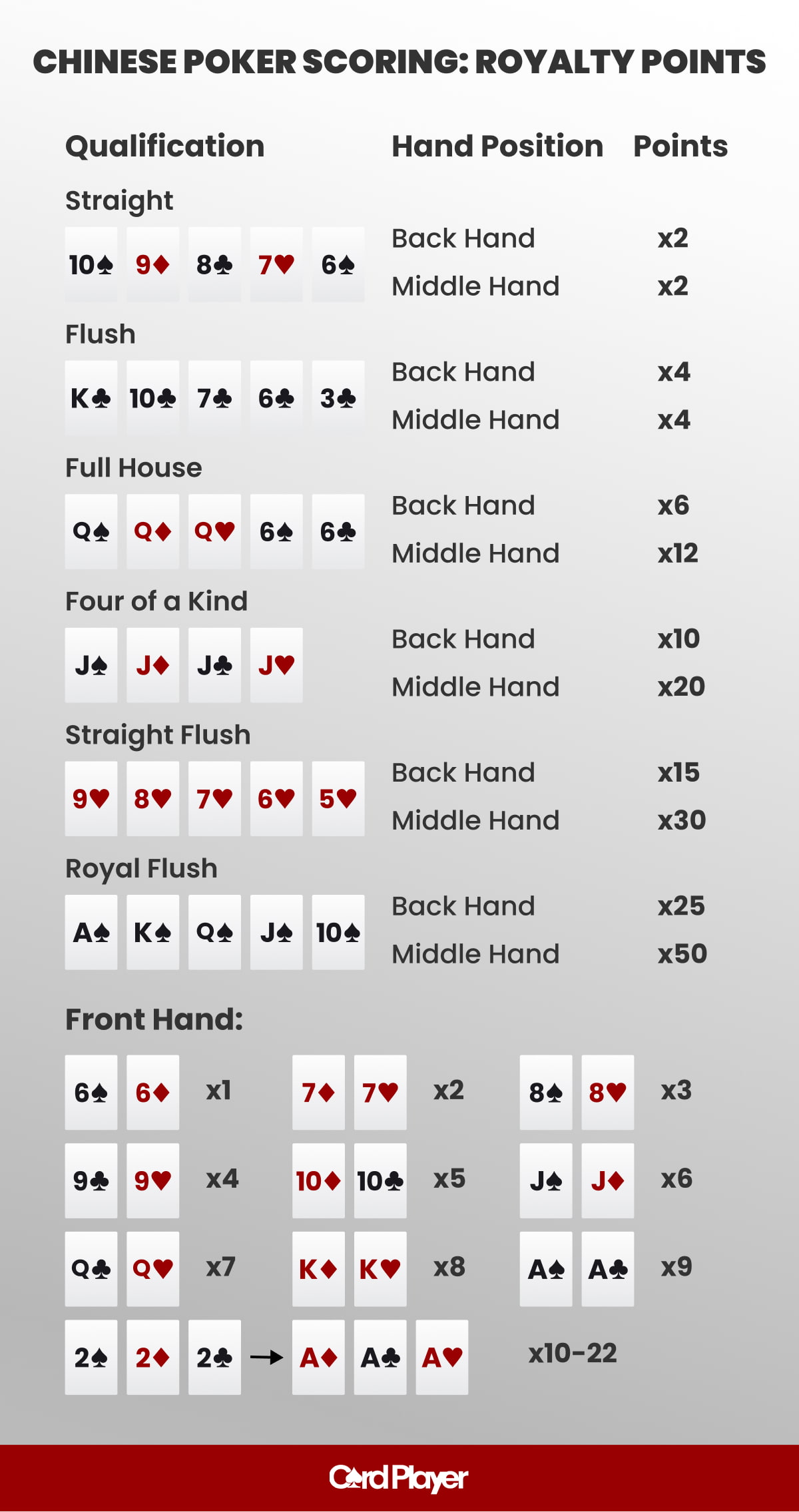
Note: Royalties are paid per opponent; in multi-player games, you collect the bonus against each non-fouling player. House-rule schedules may vary, but the above reflects the most common tournament-grade OFC structure.
Royalties mean that strong hands in any row can swing the score dramatically, making strategy a balance between chasing royalties and avoiding fouls.
Chinese Poker Hand Rankings
If you know how to play poker, you’ll recognize Chinese Poker combos. The image below shows how Chinese Poker hands rank in descending order from strongest to weakest:
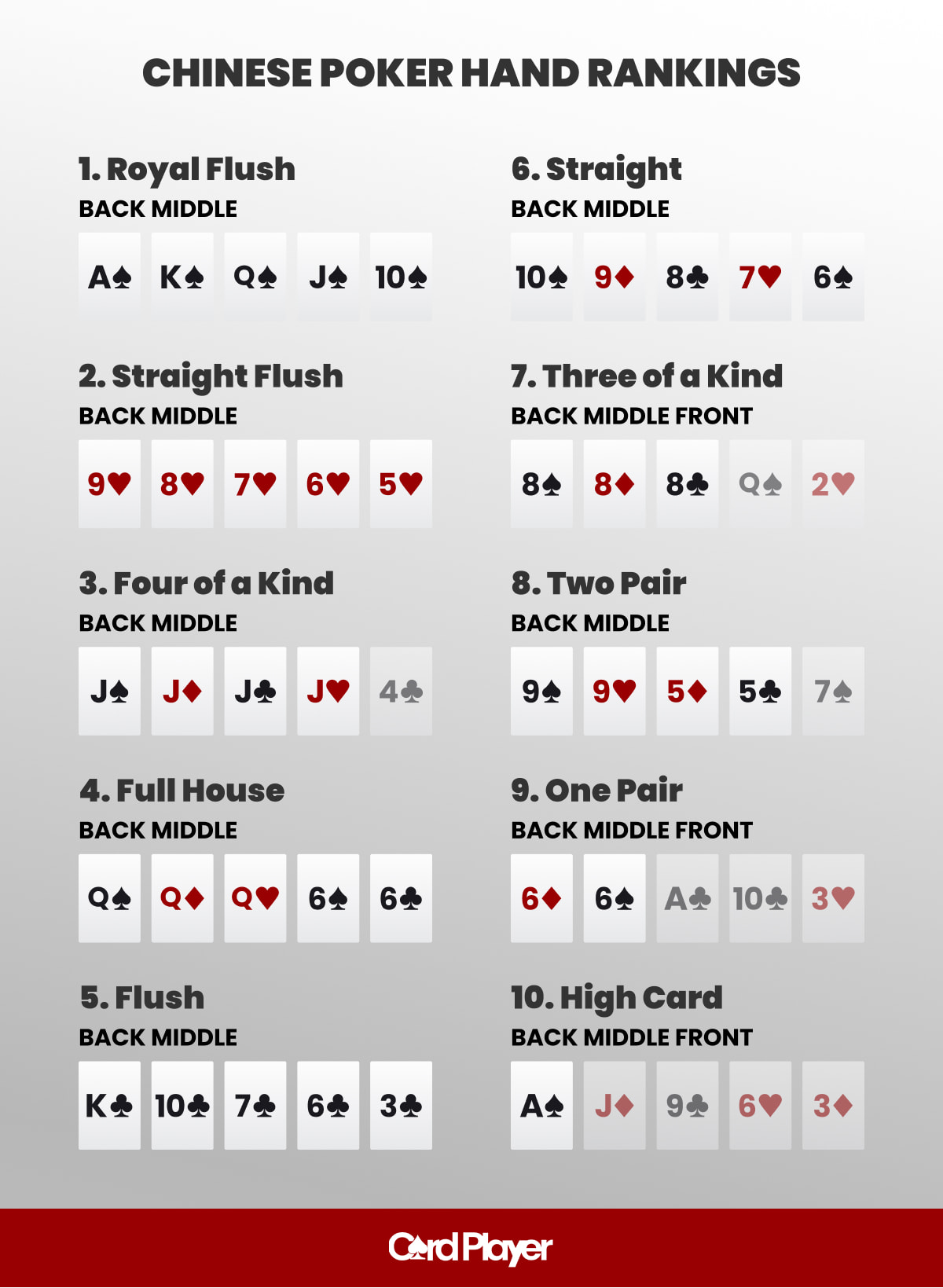
Note: Straights and flushes are disregarded in the front hand in most Chinese Poker rule sets.
Types of Chinese Poker & Fantasyland Variants
The Chinese Poker rules we’ve outlined have been tweaked over the years to create three exciting variants. The following spinoffs are the most popular types of Chinese Poker you can play right now.
Open-Face Chinese Poker
Instead of receiving all 13 cards face down at the start of play, you get five cards face up. You must set them immediately and visibly. Players then take turns drawing one card per round until they’ve built three complete hands.
OFC Variant: Fantasyland
Fantasyland is an optional bonus mode in OFC that allows you to see all your cards at once, a major advantage. You qualify for Fantasyland by placing a pair of queens or better in the front hand, without fouling.
In Progressive Fantasyland formats, you receive extra cards if your front hand exceeds Q-Q:
- Q-Q → 14 cards
- K-K → 15
- A-A → 16
- Trips → 17
You still only play 13 cards — the rest are discarded.
Note: Fantasyland is not always allowed in tournament formats; many disable repeat entry.
How Do You Get into Fantasyland?
When you’ve received your first five cards to enter Fantasyland, you need a pair of queens or better in your front hand, and you must not foul.
This allows you to receive all 13 cards straight away in the next hand. You can set your hands face-down, while other players continue to draw cards one at a time.
Staying in Fantasyland
Some Chinese Poker rules allow you to stay in Fantasyland for the next round if your hands meet these conditions:
- Your front hand contains a set
- Your middle hand contains a full house or better
- Your back hand contains quads or better
*You can’t generally remain in Fantasyland during Chinese Poker tournaments.
OFC Variant: Pineapple
In Pineapple OFC, after the first five cards, players draw three cards per turn, set two, and discard one. This speeds up the deck but adds layers of strategy. It is typically limited to two or three players per game due to deck size.
How to Set Strong Chinese Poker Hand Arrangements
Chinese Poker strategy is so nuanced, and so dependent on royalties, the exact format you’re playing, as well as the presence or absence of Fantasyland, that we thought it best to give you some strategic jumping-off points within the CardpPlayer universe.
First up, let’s take a look at a pro discussing Chinese Poker strategy. Let’s jump straight to the point in this CardPlayer video with Tom Schneider, where he discusses how he approaches arranging his hands in Chinese Poker.
If you’re keen for more after exploring Schneider’s introduction, check out this coverage of the legendary Shaun Deeb’s win in the $2,200 entry Open-Face Chinese Poker Caribbean Adventure Event.
Chinese Poker vs. Texas Hold’em
It’s often said that Chinese Poker is a game of complete information because each player sees all 13 of their own cards and sets their hands without needing to bluff or place bets. That idea holds some weight, especially in the classic version, where gameplay is simultaneous and self-contained.
But in truth, the game isn’t fully open. You never see all of your opponents’ cards until all hands are revealed, and that hidden information can matter. Paying attention to your opponents’ strategies is still part of smart play. Watching exposed cards, tracking which strong hands are still possible for yourself or others, plays a subtle but important role in high-level strategy.
You must also strategize, even in closed-face play, regarding how to divide your cards and whether to compete only for one or two points, or to go for a scoop. This isn’t like Hold’em, where you act based on bets and behavior. But it’s not truly a game of complete information either. You’ve still got to consider cards you cannot see for yourself.
How to Play Chinese Poker Like a Pro: Top 3 Tips for Success
Every player develops their own Chinese Poker strategy over time. To help you get started, here are three essential tips for both online and live play:
Understand Hand-Setting & Opponent Consideration
It’s crucial to know what constitutes a valid hand and how to set your hands in the correct strength order: the back hand must be the strongest, followed by the middle, then the front hand. Beyond this, consider the potential hands your opponents might have. If winning all three hands isn’t feasible, aim to win at least one to prevent an opponent from achieving a scoop, which would grant them maximum points.
Choose Between Aggressive & Conservative Strategies
Decide whether to adopt an aggressive or conservative approach. An aggressive strategy involves chasing royalties and aiming for Fantasyland, which can yield higher points but also increases the risk of fouling your hand. Conversely, a conservative strategy focuses on setting safer hands to minimize fouls and ensure consistent scoring.
Enjoy the Social Aspect of the Game
Chinese Poker is inherently a social game, free from the bluffing and intense betting found in other poker variants. Whether you’re playing online or in a live setting, remember to enjoy the experience and the camaraderie it offers.
Conclusion
That’s how to play Chinese Poker like a pro. As long as you remember to set your hands from strongest to weakest, you’re halfway to becoming a winning player. Of course, there will be plenty of ups and downs, so always play responsibly. Do that, and you’ll enjoy playing at Chinese Poker sites and live card rooms around the world.
FAQs
Why is it called Chinese Poker?
The name “Chinese Poker” is a direct translation of the Mandarin phrase “十三张” (shísān zhāng), which means “thirteen cards.”
How to play Chinese Poker card game?
Chinese Poker is played with 2-4 players, who are each dealt 13 cards. These should then be arranged into a back hand of five cards, a middle hand of five cards, and a front hand of three cards.
How to set hands in Chinese Poker without fouling?
The back hand must be the strongest, the middle hand the second strongest, and the front hand must be the weakest. Otherwise, the hand is fouled, and you will forfeit all points to the other players.
How does Chinese Poker scoring work?
Players are awarded points for each hand they win, and decide on the value of points in advance if playing for real money. Scooping the pot by winning all three hands awards three additional points for a total of six.
What are Chinese Poker royalties and bonuses?
Royalties, sometimes called bonuses, are awarded to players who have particularly strong hands in Chinese Poker, such as three of a kind in the front, a full house in the middle, or a straight flush at the back. “Naturals” are a special bonus for very strong 13-card combinations and are paid immediately.
What is the best hand in Chinese Poker?
The best Chinese Poker hand is a royal flush. You can only make a royal flush in the back and middle hands because you need five cards. Your front hand only contains three cards, so a royal flush isn’t possible in that row.
Is Chinese Poker hard?
There are a lot of Chinese Poker rules to learn, but once you understand the basics, it’s an easy game to play. Put simply, you must make three hands from 13 cards. The best hands score points, and the player with the most points wins.
How long does a typical Chinese Poker game last?
A single round of Chinese Poker typically takes 2-5 minutes in the classic version, or 10-15 minutes in Open-Face variants where cards are dealt progressively. A full session can last anywhere from 30 minutes to several hours.