







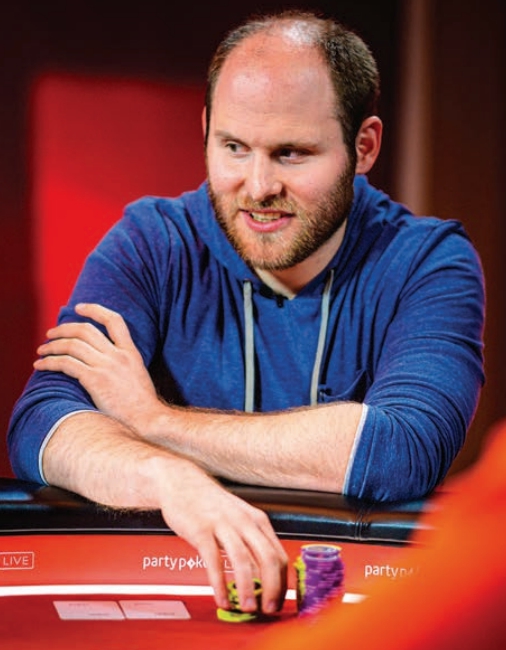
 Even the best players in the world make mistakes. Join Sam Greenwood as he breaks down and analyzes hands played from the high roller circuit on his Punt Of The Day Substack.
After a 15-hour flight from Toronto to Seoul, an airport change and another flight to Jeju, I was ready to play some poker (and get some sleep!)
The first event of the Triton Poker series was a single re-entry $15,000 no-limit hold’em tournament. Not only did I bust that twice, but I also lost a bet with Jesse Lonis about how many people would play the tournament. (I took the under.)
Not the start I wanted, but there’s always another tournament. I slept it off and was ready to play event no. 2, the $20,000 no-limit. It would take me less than one orbit to make a big mistake. On to the hand.
Event: 2025 Triton Jeju – $20,000 No-Limit Hold’em
The Hand
It is early in the tournament in level 1 with blinds of 500-1,000 with a 1,000 big blind ante, and everyone is roughly 200,000 deep. It folds to me and I raise A♣2♠ to 3,000 on the button, and Boris Angelov defends from the big blind.
Flop: Q♠10♥4♦ (Pot: 7,500)
Boris checks, and I bet 2,000. Boris calls.
Turn: J♥ (Pot: 11,500)
Boris checks. I bet 9,000, and Boris calls.
River: 2♣ (Pot: 29,500)
Boris checks, and I bet 29,500. Boris raises all-in, and I fold.
What Was I Thinking?
Preflop and the flop are standard; you always raise ace high on the button, and the flop is a pure continuation bet.
On the turn, I have the nut advantage as I will almost always play straights and sets like this, my opponent will three-bet preflop with 10-10+ and A-K often, and he will usually check-raise sets/two pair on the flop.
When constructing my turn bluffing range, I like to pick a variety of different hands so that I will be able to bluff all rivers. This includes straight draws (A-x, K-x, 9-x, 8-x), flush draws, and some total air like 6♣5♣. Generally, when bluffing one-card straight draws, the computer prefers picking your worst kicker. Since A-2 is my worst ace, I thought it would be a high frequency bet.
On the river, I thought enough money had gone in on prior streets that I would have almost no showdown value. The ace in my hand matches some of my value bets like A-A/A-K/A-Q, and the deuce blocks some rivered two pair like Q-2 and J-2.
I have no showdown, I block some calls from my opponent, and I match my own value bets… so I bluffed.
What I Got Wrong
My preflop and flop logic were sound, but the turn is where my logic falls apart a little.
A-2 is a high frequency turn bet, but it’s not pure or close to it. The computer prefers bluffing our lowest kickers, but it prefers having a heart more than having a bad kicker. I should still bet my hand around half the time, and my bet size is used by the solver.
The river is where I blundered this hand. Many of my assumptions were wrong. I have a lot more showdown than I thought – the solver has me winning the pot ~9% of the time I check. I beat A-9 and turned flush draws that check-call the turn.
Betting full pot with A-2 doesn’t really match my value bets. The only hands I have with an ace in them that value bet the river are A-A/A-Q/A-K. A-A and A-Q are a small chunk of my value betting range and are thin value bets that can only bet half pot. A-K is a hand that mixes a lot of sizes on the river, but also often overbets. A-2 is too strong to bluff with a half-pot size, so if I wanted to match a value bet with a bluff, I’d prefer overbetting, like I’d often do with A-K.
My logic on the turn was that I should bluff my worst ace high. I thought I should continue to bluff my worst ace high on the river, and I’d rather not have a heart. This logic is sound, as A-3 without a heart almost always bluffs. However, A-2 is no longer my worst A-x, not even close.
That A-3 mixes checks on the river shows some more things I got wrong about this hand. An ace blocker is not a good bluff card for me. I’ll often have an ace in my hand when I have the nuts, but when the big blind has an ace in their hand, they’ll often have A-4/A-9 that will check-fold.
A-3 has 1% equity on the river, and I thought hands with no showdown that weren’t missed flush draws would pure bluff the river. I have lots of strong hands in my range, and waving the white flag with no equity and reasonable blockers was not on my radar. However, non-flush draw hands with less than 1% equity, such as 8♦6♦, still purely give up.
Types Of Errors I Made
- Bluffing with too much showdown
- Misunderstanding blocker effects
- Misunderstanding range strategy
- Sizing errors
Grade
I really made a meal out of this one with four total decisions and two bad ones. My river play loses a lot of EV vs. the solver. Since I was jet lagged, it was one of the smaller tournaments of the series and it only cost me 25% of starting stack.
Plus, it’s my inaugural POTD, so I’ll generously give myself a D+.
 Sam Greenwood is one of the winningest tournament poker players ever and is third on Canada’s all-time money list, having cashed for $42 million and counting in high roller events all over the world. The former stock trader-turned-champion has played millions of poker hands and is breaking them down street by street on his Punt Of The Day Substack. You can reach out to the Run It Once coach on Twitter/X for private coaching @SamGreenwoodRIO.