







 At every final table there are usually a couple of key hands that act as inflection points, those that either completely change the momentum and dynamics of the table or ultimately propel a player to a commanding position where the win seems so destined that playing it out appears to be formality.
Michael “The Grinder” Mizrachi won his first pivotal hand of the WSOP main event final table when his A-K cracked the kings of John Wasnock. Had the Grinder lost that flip he would have finished in seventh place, but after spiking an ace on the river, he claimed a big chip lead which he certainly knew how to leverage.
The next potential inflection point occurred with five players left, blinds of 1,000,000-2,000,000 with a 2,000,000 big blind ante, and the following prizes left to play for:
1st – $10,000,000
2nd – $6,000,000
3rd – $4,000,000
4th – $3,000,000
5th – $2,400,000
The various chip counts and corresponding ICM values of the stacks were as follows:
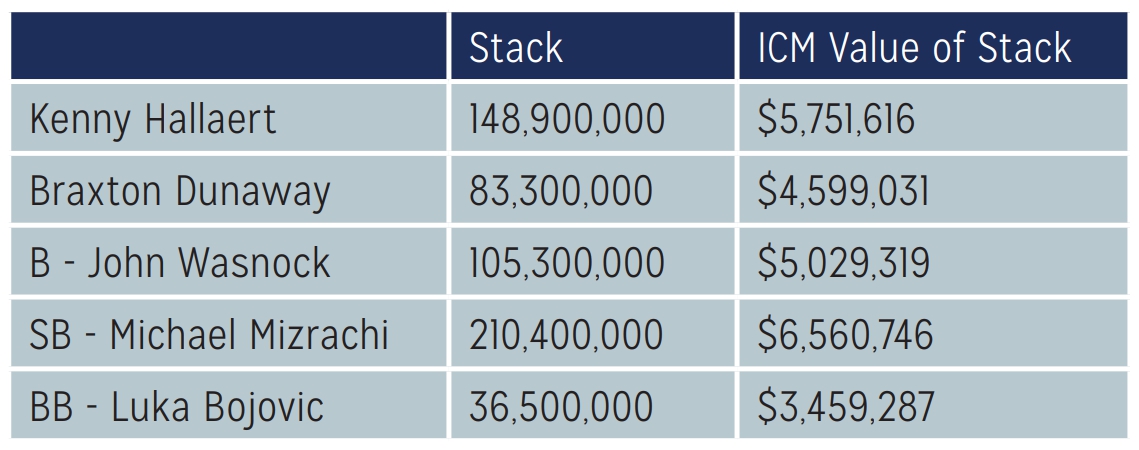
As a reminder the Independent Chip Model (ICM) uses stack sizes to estimate a player’s overall equity in a tournament based upon how often a player is expected to finish in each position. It approximates how much each player’s chip position is currently worth assuming all players are equal in skill. While ICM has its shortcomings, all serious tournament players are aware of the implications of winning or losing a big pot.
Kenny Hallaert opened to 4,000,000 from first position with A♠K♥, Braxton Dunaway three-bet to 11,500,000 holding 7♠7♣, and the action folded to the Grinder in the small blind who glanced down at two jacks. Within ten seconds he double-fisted two stacks of the peach chips forward making it 40,000,000 to go.
This was just a brutal spot for Kenny. Yes, he was holding A-K, but he also realized that Mizrachi had a very good hand since he pot committed himself against Braxton, and 83,000,000 chips is too many to gift away. The Grinder’s large sizing made the situation particularly awkward, as Kenny had to consider the possibility that even his all-in wager would frequently get called. And it’s clear that finishing in fifth place for $2.4 million is a relative disaster given that his stack is currently worth around $5.75 million.
Kenny understandably tanked for quite some time and at one point turned in the direction of the dealer as if he was about to declare himself all-in, but those words were never spoken, and he ultimately folded.
There was a ton of discussion of this hand in the online forums and social media with several pundits suggesting that Kenny erred by not moving all his chips into the middle. To my knowledge there wasn’t any type of ICM analysis performed, so I was curious and crunched some numbers under various assumptions, which I will share here.
Kenny’s ICM Consequences
ICM Value of Stack When Folding: $5,734,165
Going All-In and Winning Uncontested: $6,510,700
Going All-In and Winning Showdown: $7,738,754
Going All-In and Losing Showdown: $2,400,000
If Kenny had moved in and the Grinder folded, he would have gotten a bump of $776,535 in the ICM value of his stack. From the safety of my couch, I thought Kenny had no choice other than to fold as the risk involved wasn’t worth the potential rewards, but if Mizrachi is capable of mucking some good hands, then this increase is quite substantial.
The big question is, would Mizrachi have folded the jacks? He was getting a little less than 2:1 on his money and therefore needed around 35% equity from a chip perspective. However, it’s clear there is far more to consider than the pure pot odds. In the final stages of a tournament the chips you lose are worth less than those you win, and when you have a big stack it’s easier to build upon it.
It’s unclear whether the Grinder would have called or not. On one hand he was running white hot, and he doesn’t strike me as the type to abandon 40,000,000 of his chips in the middle. But on the other hand, he might figure Kenny was at the very pinnacle of his range possibly meaning a pair of queens or better.
It’s a huge swing. If pocket jacks hit the muck Kenny increases the value of his stack by $776,000. But when he gets called, Kenny only has a 43% chance to win and on average loses over a million dollars in expectation:
Expected ICM Value of Stack when called by Jacks
= [(Probability Win)*(ICM after win) + (Probability Loss)* (ICM after loss)]
= [(43%)*(7,738,754)+(57%)*($2,400,000)]
= $4,695,664
Reduction in ICM
= $4,695,664 – $5,734,165 (ICM if Kenny folds) = ($1,038,501)
The Grinder also could have had queens where the expected loss would be the same. And while A-K does help block aces and kings, someone can still get them and in these cases the amount lost in expectation would have been massive.
We can put together a grid of the various hands the Grinder could be playing here and the associated probabilities of having been dealt them along with an assumption on whether he calls or folds. We then multiply the probabilities by the ICM results and sum it all up.
It’s going to be assumed that Mizrachi would have called with A-K but raise-folded with A-Q and pocket tens. Had he called with pocket jacks the result could have been a sizeable loss in expected ICM value for Kenny of around $263,000.
On a side note, it’s interesting that under these assumptions the ICM implications were almost neutral (slight reduction in expectation of around $21,000); a tournament altering pot, but from an ICM sense it’s as if nothing happened.
What about other hands such as pocket nines or A-J suited? Expanding the range to include more hands that would have raise-folded would support an all-in move. The Grinder was probably envisioning Dunaway as his most likely opponent, and he was playing quite loose and aggressively, thus it’s possible other holdings would be in the range. From a theoretical perspective, other hands have to be included in order to make a jam from Kenny correct.
But at the end of the day, it probably came down to Kenny’s assessment on whether he could get a fold from a hand like pocket jacks, which was the exact holding he was up against. A major confrontation was avoided, and it’s hard to find fault in that decision other than being results oriented in how the tournament ended up.
- Photo by PokerGO – Enrique Malfavon