







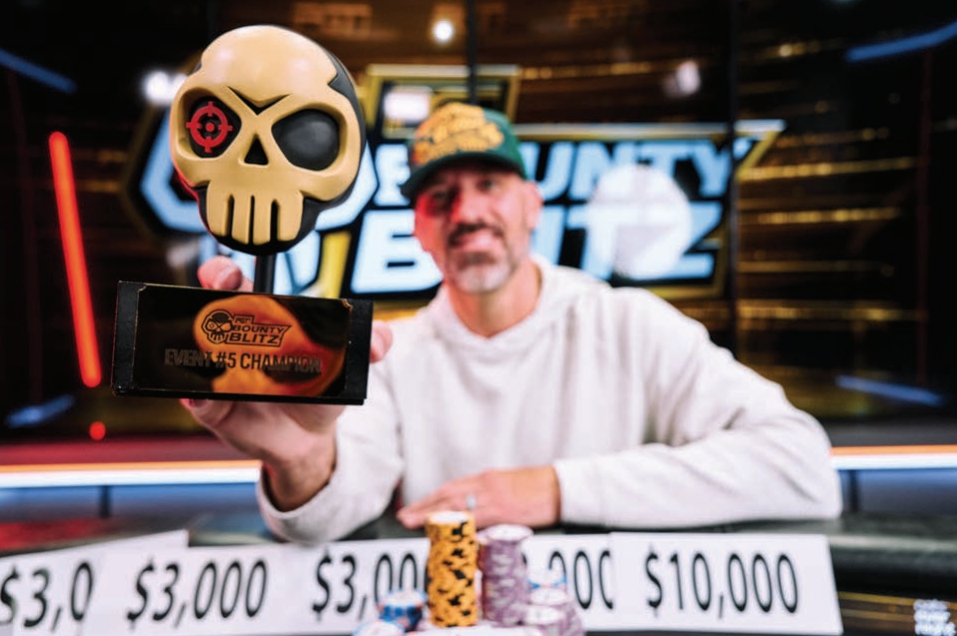
Two decades after finding the game, Jason Hickey is rounding into form as a poker player. The Austin, Texas resident has been racking up significant results over the last four years on the tournament circuit, most recently finding the winner’s circle in Las Vegas during the PokerGO Tour Bounty Blitz series.
Hickey has made some deep runs at the WSOP, including final tables in the Millionaire Maker and the $5,000 no-limit hold’em events, along with six-figure scores at the Venetian and Wynn. Earlier this year, the husband and father of two also final tabled The Lodge Championship main event.
It all adds up to nearly $1.8 million in tournament cashes. Quite an impressive haul for someone who spent the majority of his poker career cornering fish at the cash game tables.
Card Player caught up with the former college baseball standout to discuss a couple of key hands he played in his most recent win.
Craig Tapscott: When did you decide to pursue poker as a profession?
Jason Hickey: I was an athlete from when I was four years old. My dad was my coach my whole childhood, and I played three sports competitively. All I knew was competition. But then I almost lost my arm in a skiing accident in college, lost my scholarship, and also my identity.
I was introduced to poker, like many, during the Moneymaker WSOP. After playing a few times, the game just took me. I started studying a bunch via books like Super System and within two years had built a $40,000 online bankroll while finishing my degree.
After I graduated, I didn’t look back. I started playing live and traveling. I wrecked my life pretty badly from 2008 to 2012, though. I got hurt again and was addicted to painkillers. I took three years off from poker to learn how to live life sober and healthy.
But deep down, I always knew I had unfinished business with poker and wanted another opportunity to do it the right way. I came back to cash games in 2015 and was fortunate to end up in some great private games for a few years. Once 2020 came and those games dried up, a good friend exposed me to tournaments, and I fell in love with the game all over again, going deep down the strategy rabbit hole with solvers.
Event: PGT Bounty Blitz Mystery Bounty
Buy-In: $5,100
Entrants: 59
Prize Pool: $177,000
First-Place Prize: $50,000 +$47,000 in bounties
CT: The bounty aspect of the event adds a whole other dynamic from start to finish. Please touch on that.
JH: That’s true. In this hand, there were some “bounty-specific” dynamics that are worth noting. There were four bounties remaining valued at $25,000, $10,000, $3,000, and $3,000.
With a bit of math, we can see that each bounty is worth an average of approximately $10,000. With the next pay jump being only $7,000, this is a crucial stage of the tournament to not only fight for bounties but, for me, to maintain second chip position while covering the other two opponents.
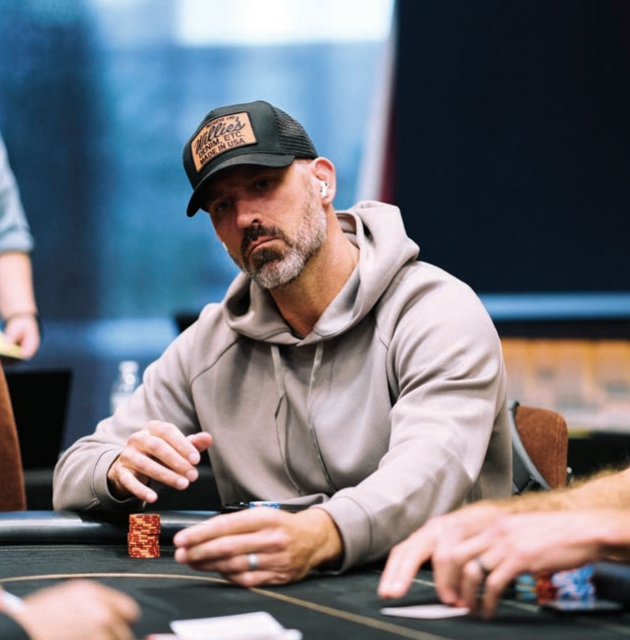 CT: What advice do you have when it comes to approaching bounty MTTs? What do players need to pay more attention to, and what mistakes do they make?
JH: This format was a mystery bounty, which is a bit different, but for the standard bounty format, where the bounty counts for 20 percent to 50 percent of the prize pool, it’s important to understand what that is worth in terms of chips, especially when you get deep.
You will end up in situations where, for example, you may be getting close to the correct odds to call off in a spot, but because of the bounty, you will add x amount of chips to the pot, which makes a break-even or slightly losing call worth money.
Hand No. 1
Stacks: Jason Hickey – 1,850,000 (31 BB) Bryan Swanson – 475,000 (8 BB) Anthony Marquez – 3,800,000 (63 BB)
Blinds: 30,000-60,000 with a 60,000 big blind ante
Players Remaining: 4
CT: Let’s talk preflop.
JH: The cutoff (Steve Zolotow) folded, and I looked down at pocket tens on the button with 31 big blinds. The small blind (Swanson) had eight big blinds. My first decision was whether I wanted to limp or raise.
I ultimately decided to raise because the big blind (Marquez) had a propensity to see flops the cheapest way possible unless he had very strong hands. He would call very wide versus opens, but just check when he had the opportunity to preflop.
Hickey raised to 125,000 holding 10♦10♥.
JH: I also liked raising because I was at the top of my range, so if the small blind went all in and the chip leader wanted to try and isolate, I was happy to call off with that strong of a hand.
CT: Let’s talk a bit about bet sizing. What are some of the biggest leaks you see from players?
JH: Non-professionals tend not to stick with a standard open size and will fluctuate it based on strength. I try to determine my sizing decisions preflop by who is in what positions and ultimately what I want to accomplish.
A lot of players use the same sizes on flops regardless of flop texture. When you use the solver a lot, you can see that certain textures determine sizings. Equally important is whether you’re in position or out of position.
Many players don’t factor this in and use too small bet sizes when out of position and also too big of sizes in position. There is also a lot of checking out of position with range on certain textures, which a lot of players rarely do.
Swanson called from the small blind, and Marquez called from the big blind.
JH: I was surprised by the small blind’s call, but here we went, three ways to the flop.
FLOP: 8♠5♠5♥
Swanson checked. Marquez bet 80,000.
JH: The chip leader bet 80,000 into 435,000 or 1/4 pot.
CT: Did you have any reads to fall back on after he donked out here?
JH: I had only seen him lead or donk out of position in one hand the previous day, where he had flopped a flush. Every other hand I had played with him, he had played “in flow,” meaning when he called versus a preflop raiser, he checked to them.
CT: So what’s the best way to proceed with your overpair?
JH: This was alarming to me, but the main point is I would rarely raise this bet, especially with the short stack behind, because we wouldn’t want him to fold an eight, for example. So…
Hickey called, and Swanson folded.
TURN: [invalid notations]
JH: Now the flush came in and he bet…
Marquez bet 225,000.
JH: He bet 225,000 into 595,000 (about 1/3 pot). In theory, as played, I can never fold my hand. I am completely under-repped, and he had been way too loose aggressive (LAG) throughout the final table.
CT: What else was on your mind after he bet this turn?
JH: The dynamics here with the bounty made an exploitative fold have more merit, because even if I was being bluffed, I still maintain a covering stack over the other two opponents.
Hickey folded, and Marquez won the pot of 595,000.
JH: We ultimately folded, and he had A-5 offsuit. These kinds of decisions can be either really good or really bad, and I have experienced both firsthand. Luckily, this time I was correct.
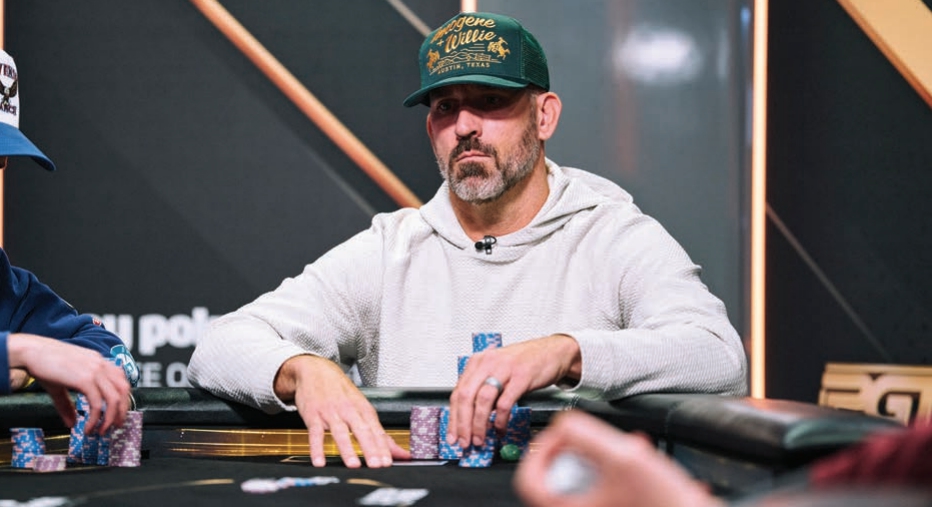
Hand No. 2
Stacks: Jason Hickey – 3,600,000 (60 BB) Anthony Marquez – 3,200,000 (53 BB)
Blinds: 30,000-60,000 with a 60,000 big blind ante
Players Remaining: 3
JH: We were now chip leading, which is critical in a bounty format, especially because the $25,000 bounty is still in play.
Another essential part to mention is that during the previous break, I was made aware of how wide or loose the button player was opening and given a bunch of examples.
Marquez opened to 125,000 on the button, and Zolotow folded from the small blind.
JH: We are in the big blind with 9♥9♦.
CT: It’s a very strong hand in this dynamic.
JH: Yes, this is obviously a strong hand in full ring, but three-handed, this is a massive hand. Added to the fact that I had the chip lead and had received the new information during the break.
CT: What’s the plan, then?
JH: In theory, there is a lot of flatting here from me because we are so deep and there’s a short stack that’s still in play. However, I felt like in-game three-betting was non-negotiable.
It’s also important to note that we were over 50 big blinds effective with a very short stack still in. So, there was a fair amount of ICM implications to consider.
Hickey raised to 560,000.
CT: Can you share why you chose that size?
JH: If we were shallower, I would have chosen a smaller size potentially, but because we are deep, I went with a larger size. This would not be a fun spot if he jammed.
Marquez called.
JH: I want to note that he called after some deliberation.
FLOP: 5♠3♠2♥
CT: How did you go about pinpointing his range?
JH: When trying to range someone LAG, I usually start with what they don’t have. I didn’t think he would slowplay almost ever against me in this particular spot. But we never say never, so I thought A-A, and that is probably it. I discounted pocket kings through tens, because I think he four-bets or jams those preflop a high frequency of the time based on how he played.
It also felt like A-K and maybe A-Q go in a lot preflop. So, it felt like pocket deuces through eights range and suited A-x, suited Broadways range most likely.
CT: I’m assuming this is an easy continuation bet.
JH: Well, on this board, with our hand having a lot of vulnerability on many turn cards, I am betting a bunch. I went back and forth between sizes but eventually decided on a two-third pot bet.
Hickey bet 775,000.
JH: I thought the bigger size would hopefully cause him to make a mistake with some pairs I’m beating, and he would also maybe jam some wheel A-x hands that have pairs now and a gutshot.
If he had a hand like K♠Q♠, J♠10♠, etc., we would just have to be all-in against a hand with a ton of equity, but he may have called with these sometimes to see turns instead.
Marquez moved all-in, and Hickey called. Villain showed 6♠6♣.
TURN: Q♠
RIVER: A♥
Hickey won the pot of 6,430,000.
JH: He ended up going all in, and we called. This ended up being the most important pot of the tournament for me, and I won it all three hands later for my first PGT title.
Hickey is also a poker coach and can be contacted on IG @jasonthomashickey and on Twitter/X @jason_hickey.
- Photos by PokerGO – Antonio Abrego