





May 2, 2013 — Leading or donking out is often best with big hands because you want to take the line with the least amount of fold equity
Fold equity, in its most simple form, refers to the chance that your opponent will fold. Usually we think of this term when we are bluffing and factor it in to a decision on how to play a hand. If we are bluffing, we want to maximize our fold equity as we want someone to release the best holding. But what if we know that we have the best hand? Do we want fold equity? Of course not. We want to find the line that will give us maximum value and not have our opponent fold. So the key is to find the way to bet and keep our opponent in the hand.
When you flop monsters, because so many people check-raise the flop or turn, it can sometimes be better to “donk lead” out at the preflop raiser. The term donking comes from a time when people who led out at the pot very rarely had a strong hand so their bet was considered weak or “donkish.” Because this is often times still the case, the best way to approach flopping a big hand is by leading. Let us take a look at an example. Say an under-the-gun (UTG) player with A 10 raises to $25 in a $2-$5 no-limit hold’em game with $800 effective stacks. The button calls and we call in the big blind with pockets fours. The board rolls out A
 J
J 4 We decide to check, the preflop raiser bets out $50, the button calls, and we check raise to $175. The preflop raiser hems and haws before finally folding, and the button mucks 9 8 face up. Is this the result that we wanted? Obviously the preflop raiser was concerned about his A-10 versus a cold-call and a check-raiser. At this level, A-10 would rarely ever be good. But, what if we decided to take another line? Instead of check-raising, let us say that we lead out for $50. The UTG player at this point figures there is a very good chance that he still has the best hand and calls. Now the button calls. Pot $225. The turn is a 2 and once again we bet, this time $125. The preflop raiser calls again and the button folds. Pot $475. The river pairs the deuce, non-diamond. We now bet $250. The preflop raiser tanks for a long time, convinces himself that we have a busted flush draw and makes the call. Do you see how much more money we make by taking a line that diminishes the chance that our opponent will fold?
You would be amazed how often leading out wins the most money in hands like this, as people would never believe that you would play a monster hand fast because they would not. In fact, I’ve seen guys win enormous pots by just coming out and leading for pot on each street. It often polarizes your range, but what your opponents don’t realize is that if you fire the third barrel your hand is very skewed towards value holdings and not bluffs.
I observed the following hand go down at a $5-$10 no-limit hold’em game at the Bicycle Casino last week. A very tight player opened from early position to $55 with a stack of $2,000 and the small blind, a very good player and a friend of mine, covered and called. The board came out Q 2 3. My friend led out at the pot for $100 and the tight player called. The turn was the 3. My friend led out again, this time for $300 and the tight player called. The river brought the 2 , double pairing the board. My friend led out for $1,000. At this point I was very interested in the hand, because I thought that this was a terrible spot for my friend to bluff with a hand like say A 4 or 5 6. This tight guy had shown that he was calling down and I thought he was definitely going to call the river, especially when the draws busted out. But, because the board was double paired, there were only two combinations of low sets. I also thought that there was a possibility that my buddy could have gotten tricky with pockets aces or pocket queens. Sure enough he rolled over 3-3 for quads. The tight player proudly pronounced that he thought it was quads or nothing and flipped over J-J into the muck. Now, on the surface this looks like this guy lost a ton of money with an underpair to the board — but in reality, if my buddy is never playing a queen this way, this is literally a busted draw or a monster. I am not getting on the guy for calling with J-J, but you can see how much money was made from the hand by my friend’s lead, lead, leading. One of the other things that you can learn from this hand is that by taking the initiative and betting out when strong, you do not give your opponent a chance to pot control his medium-strength hands. Now, we are playing no-limit, and you could always overbet a later street after one has been checked, but in reality this rarely ever happens. When is the last time you have seen someone bet $1,000 into a $300 pot? And you are much more likely to get maximum value by betting pot-sized amounts throughout the hand.
If my friend had gone for a check-raise here, most likely the flop would have been checked back and he would have only been paid on two streets — if the guy had even decided to call down after not putting much money in early on. The point is you do not want your opponent to fold in these situations when you are strong, so make the best plays that keep him in the hand but also build pots.
On the flip side of this, if you are trying to obtain maximum fold equity through a semi-bluff, then lead, lead, leading is probably not the best plan, as you can see, because your opponent is likely to call down. Here, check-raising is a decent idea because it gives you the maximum amount of fold equity.
One other quirk to this advice that I have noticed is that I would be more apt to donk all three streets with monsters on boards that contain a high card that hits the preflop raiser’s range, and possibly check-raise ragged boards. There are several reasons for this. First off, a lot of players are just incapable of folding overpairs no matter what the situation is. If you flop a set of nines on a 9 3 2 board and your opponent will not fold K-K to a check-raise, then check-raising is a better play, as it will get more money in the pot. But betting out is better on ace or king high boards when it is likely that the villain has top pair, especially if he could have a hand like A-10 or K-J. This lends us to our second point — it looks scarier when we, as the preflop caller, check-raise these boards because it is supposed to hit the preflop raiser’s range, hard. We will get a lot more of the hero folds with top pair, medium-strength kicker, hands that we instead want to induce to bluff catch for three streets and maximum value. ♠
Want Card Player and Bart to provide analysis on a cash game hand you played? Send full hand details (blinds, stacks, street-by-street action) to @CardPlayerMedia. If we choose your hand, we’ll send you a Card Player subscription.
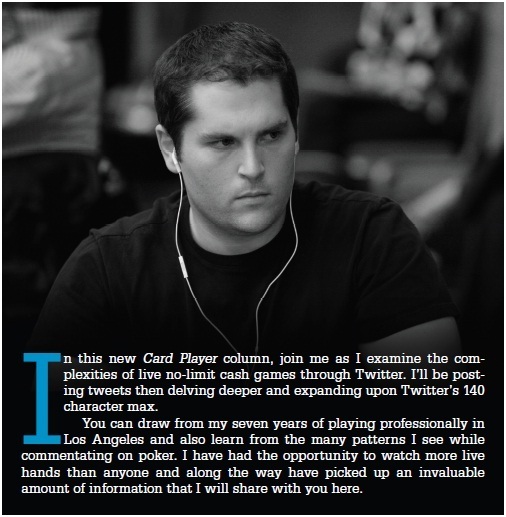
Follow Bart for daily strategy tips on twitter @barthanson. Check out his podcast “The Seat Open Podcast” on seatopenpoker.net and his video training site specifically for live No Limit players —CrushLivePoker.com. He also hosts Live at the Bike every Tuesday and Friday at 10:30 pm ET at LiveattheBike.com
Chris Moneymaker Vol. 26, No. 12
-
Plan C: Pot-Limit Omaha
-
Session Notes: Part IV
-
Winning Poker Tournaments III – Hand No. 24
-
Proper Practice
-
Evaluating Your Play: Spy vs. Spy
-
Five Reasons You Should Not Game Select
by Reid Young
-
Beating Online Poker 2.0
by Ed Miller
-
How To Call Down With Eight-High
by Matt Matros
-
The Whats, Whens, and Hows of Pot Control
-
Avoid Common Betting Mistakes at the WSOP
by Bernard Lee
-
Shoulda, Woulda, Coulda
by Roy Cooke