







Even the best players in the world make mistakes. Join Sam Greenwood as he breaks down and analyzes hands played from the high roller circuit on his Punt Of The Day Substack.
An important skill in poker is pattern recognition. You can’t possibly remember every detail of your own play, your opponent’s play, or a solver output. So, you look for a natural human shortcut — you find patterns and extrapolate what you think should happen in a similar situation.
I am blessed with a good memory and good pattern-mapping skills, which is helpful when using empirical information to improve at a game, but can be very annoying when doing other things, such as writing ~100,000 words on the same subject in a short period of time while hoping you are not being repetitive.
If there are tics, word choices, and arguments that you, the reader, have noticed I keep returning to, I assure you, I have noticed them as well and am trying my best to not make this column monotonous. My biggest stylistic challenge is mixing it up and not repeating the same poker jargon within an individual newsletter, and sometimes I resort to a trick I learned from my days as a lazy university student, which is using ‘ctrl+F’ to see just how many times I used a specific word.
If I had to guess, the most common poker word I use is ‘range.’ Often, first drafts will have dozens of ‘ranges’ in them, and I’m torn about removing them, because ‘range’ really is the best word to describe what I am trying to say. The concept of playing a range of hands instead of an individual hand is one of the most important concepts for any poker player to understand. So, I should be using the word ‘range’ a lot, but it still feels like too much.
If you master how to play your range, you will be an excellent poker player, but the goal of the game is not to ace a poker quiz about your range. It’s about executing the best strategies in the moment under time constraints and stress. Part of that is knowing how to play your range, but part of that is knowing how to play the hand you are holding at any given time.
Today, we go back to 2018 for Triton Jeju to look at a hand where I was so interested in playing a perfect range strategy, that I forgot how to play my actual hand and got all-in with a draw, when a more passive approach would have been ideal.
Event: 2018 Triton Jeju $500,000 HKD High Roller
The Hand
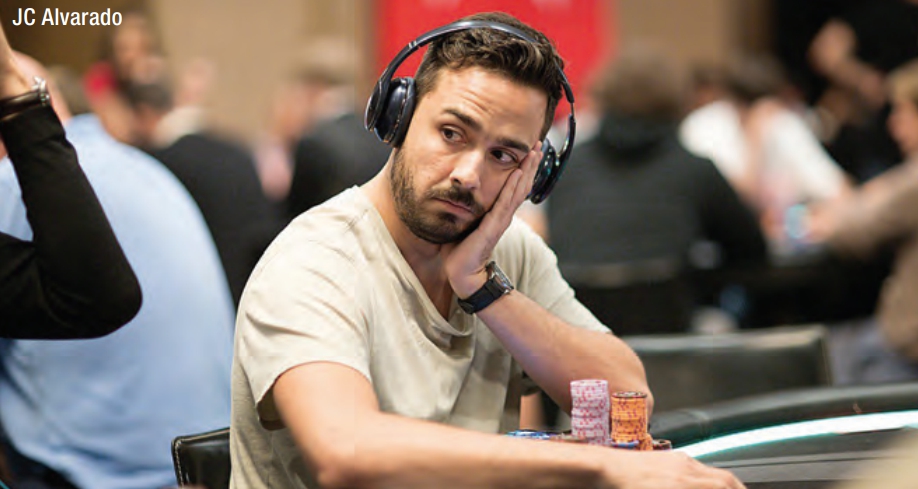
With a stack of 205,000 and blinds at 1,000-2,000 with a 2,000 big blind ante, I raised on the button to 4,000 holding 5♦4♦. JC Alvarado, sitting with 105,000, made the call from the big blind.
Flop: 8♦6♥2♦ (pot: 11,000)
JC checked, and I bet 8,000. He check-raised to 20,000, and I shoved. He called all in with 8♥6♠.
Turn: K♣
River: 10♥
JC’s two pair holds and he doubles up to 216,000.
What Was I Thinking?
I remember learning that low-card boards with lots of potential straight draws were often played as a big bet or check for the preflop raiser. I only had five high, but I had a monster draw, and I wanted to start inducing folds right away.
Once I got check-raised, I figured I’d have enough equity to get all-in vs. anything and decided to shove over his flop check-raise and try to hit my 15-outer.
What Did I Get Wrong?
The preferred bet size on low boards where no flopped straights are possible is often a large polar size, but it is not always a large polar size. I have a wide array of hands here, and while vulnerable one-pair hands like 9-9 and A-8 want to bet big so they can get all-in before scare cards can roll off, they do not comprise my entire range.
I have a range advantage and a whole host of hands like sets, flush draws, or middle pair, that are happy to use a smaller size on the flop. One of those hands is 5♦4♦.
It’s an odd hand because it the second nut low and on many runouts will remain second nut low, but it often improves into a very strong hand. It’s the type of hand that has 40% equity vs. a set, but only has 68% equity vs. J♣10♣. It’s a very powerful hand that I am happy to play in position, value bet when I hit, bluff when I miss, and try to win as much money as possible with.
Do you know what is a bad way to maximize my earn with this hand? Getting all in with 48% equity and collecting my share of the overlay from the pot. 5-4 also has poor all-in equity vs. his semi-bluffs, which are hands that often give up on the turn or river if they miss, and which I could bluff later in the hand.
Bluffing ten high with five high is as good a bluff as there is, and getting all-in and losing to ten high is as bad a feeling as there is.
Additionally, since a lot of my opponent’s value range is top pair, having one or two overcards to an eight is an appealing quality for a hand that wants to get all in on the flop. So, I’d rather have a 10♦9♦, 10♦7♦, 9♦7♦ type of hand to three-bet shove the flop with.
5-4 is not a hand that wants to bet big and not a hand that wants to shove over a flop bet. It’s a big draw, but on the flop it’s a bad hand, and you’d rather wait to see how the board runs out before getting all-in with a bad hand.
Grade
Today, the type of mistake I wrote about was fundamentally about trying to play my range instead of trying to play my hand. In this situation, I believed my range would play a big bet or check, without thinking about what my actual hand wanted to do.
I was wrong in many ways; this board does get small bets with range, and if I could only play big bet or check, my hand would want to check.
The goal is not to play your hand or range well; it is to play both well. In this hand, I didn’t do either, and while my flop big bet is not that costly, shoving over the check-raise is.
I never thought getting all-in with a double gutter and a flush draw could be such a bad play, but I continue to find ways to surprise myself. This one is a C-.
 Sam Greenwood is one of the winningest tournament poker players ever and is third on Canada’s all-time money list, having cashed for $42 million and counting in high roller events all over the world. The former stock trader-turned-champion has played millions of poker hands and is breaking them down street by street on his Punt Of The Day Substack. You can reach out to the Run It Once coach on Twitter/X for private coaching @SamGreenwoodRIO.