







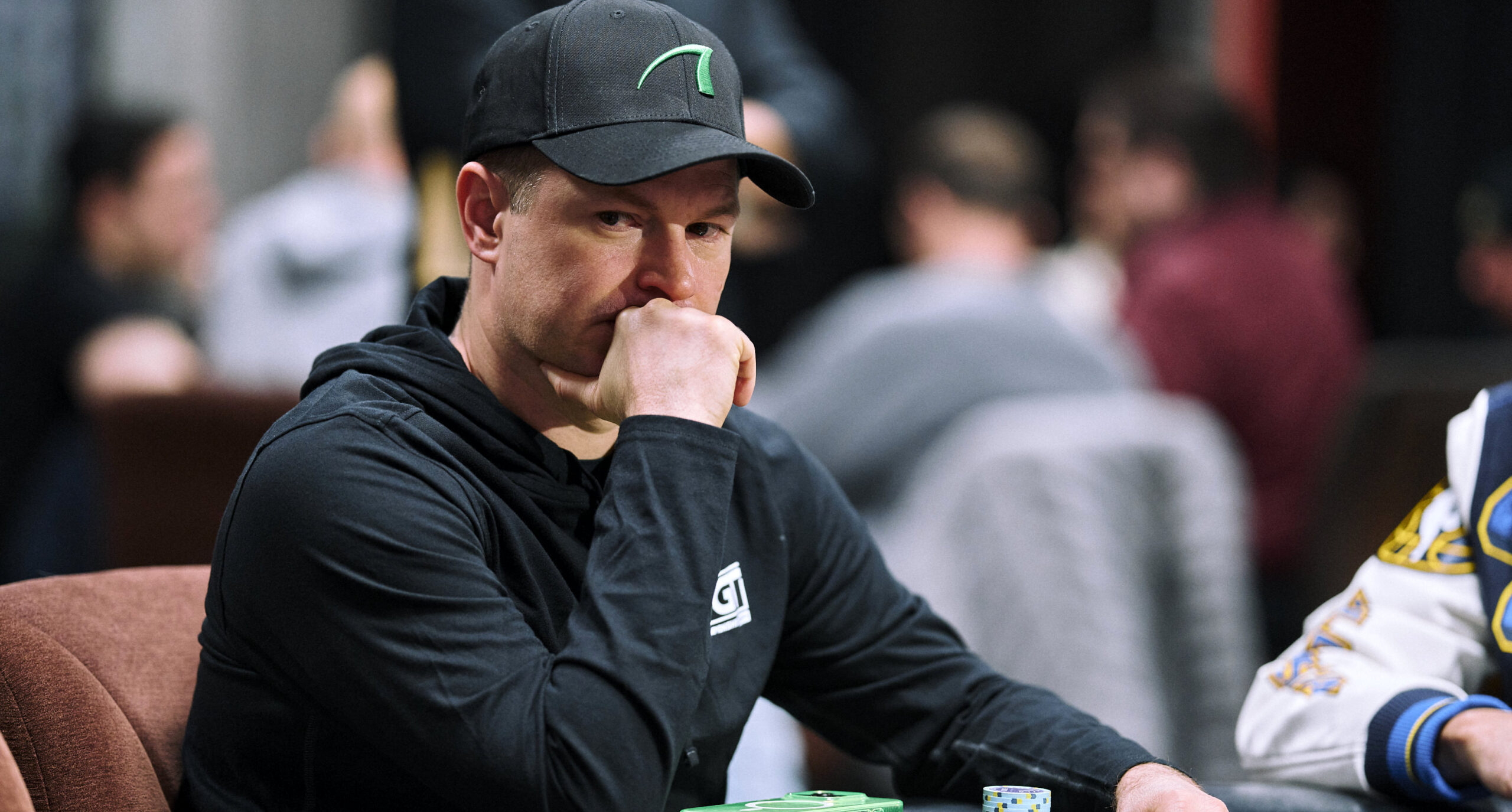
 If you want to increase your poker skills and learn to crush games, check out Jonathan Little’s elite training site at PokerCoaching.com.
Early in a $500 buy-in poker tournament with blinds at 25-50, our Hero raised to 150 out of his 5,000 stack from second position with J♣J♠. Only a strong, loose, splashy player called on the button.
Flop
The flop came K♥K♦8♣. Hero bet 200 into the 375 pot and his opponent raised to 600.
I like Hero’s flop bet. If the stacks were shorter, I would prefer a smaller bet of 125, although when playing 100 big blinds deep, half-pot is fine.
When raised, given the read that the opponent is loose, splashy, and more than capable of bluffing, calling is mandatory. While Hero could easily be crushed by trip kings, if he folds J-J, he is folding almost every hand in his range, especially if he continuation bets with most of his range on this uncoordinated board.
When playing against competent players, you must be aware of which hands make up your range. If you fold too many of them when raised or bet into, your opponent can profit by blindly applying aggression.
Overly aggressive players fare well in small and medium stakes games because their opponents fold too often. Overly aggressive players become significant losers in high-stakes games because their opponents know they cannot fold too often, resulting in them defending correctly.
In this situation, the opponent is risking 600 to win a 575 pot. This means that if he steals the pot more than 51% of the time (600/1175), he will immediately profit.
If Hero folds J-J, he is certainly folding more than half of his range, making a fold not a viable option. In fact, depending on how wide Hero is continuation betting, he may have to defend with hands as weak as ace-high or backdoor draws like Q♥10♥ in order to not let his opponent immediately profit by raising with any two cards.
Turn
Hero called, and the turn was the 2♠. Hero checked and his opponent bet 700 into the 1,575 pot.
Using the same logic that resulted in Hero calling on the flop, he has to call on the turn. If he folds this hand, he is folding almost his entire range.
Notice that if Hero opted to reraise his full houses and trips on the flop (which I do not recommend), A-A, Q-Q, and J-J are the absolute best hands in his range. You never want to be in a spot where you are tempted to fold the best hands in your range when facing a competent opponent. Even if Hero calls with all his trips on the flop, J-J is still quite high in his range.
River
Hero called, and the river was the 4♣. Hero checked and his opponent checked behind, showing down 5♥4♥, giving Hero a nice pot.
Had the opponent not rivered a hand with a bit of showdown value, he may have pushed all-in for a bit more than the size of the pot. This would have put Hero in a nasty spot.
Depending on how his range is comprised, he may be able to fold to a river all-in. If the opponent pushed for the size of the pot, he needs to steal it roughly 50% of the time to show a profit. This means that Hero must call with at least 50% of his range.
If his range only contains decent pairs and trips, perhaps J-J is close enough to the bottom of the range to justify folding. If his range contains lots of ace-highs though, folding J-J would be much too tight.
Especially when playing against strong opponents, always think about the composition of your range and play it in a manner that leads to difficult spots for your opponent. Do not play in a manner that allows your opponents to win simply by betting whenever you show weakness.
Level Up Your Game
If you want more resources to help you improve your game, I put together a course called Five-Day Preflop Challenge. This course is completely free inside Card Player Poker School!
When you join the Card Player Poker School (it’s free to join), you’ll also get:
- Free Downloadable Preflop Charts
- GTO Preflop Charts
- Video Classes
- Interactive Hand Quizzes
- Free Course: Master The Fundamentals
- Free Course: The 25 Biggest Leaks And How To Fix Them
- Free Training Every Week
 Jonathan Little is a WSOP bracelet winner, two-time WPT winner, and the 2024 PokerGO Cup champion with $9 million million in live tournament earnings. He is a best-selling author of 15 educational poker books, and the 2019 GPI Poker Personality of the Year. If you want to increase your poker skills and learn to crush the games, check out his training site at PokerCoaching.com/cardplayer.
Photo by PokerGO