
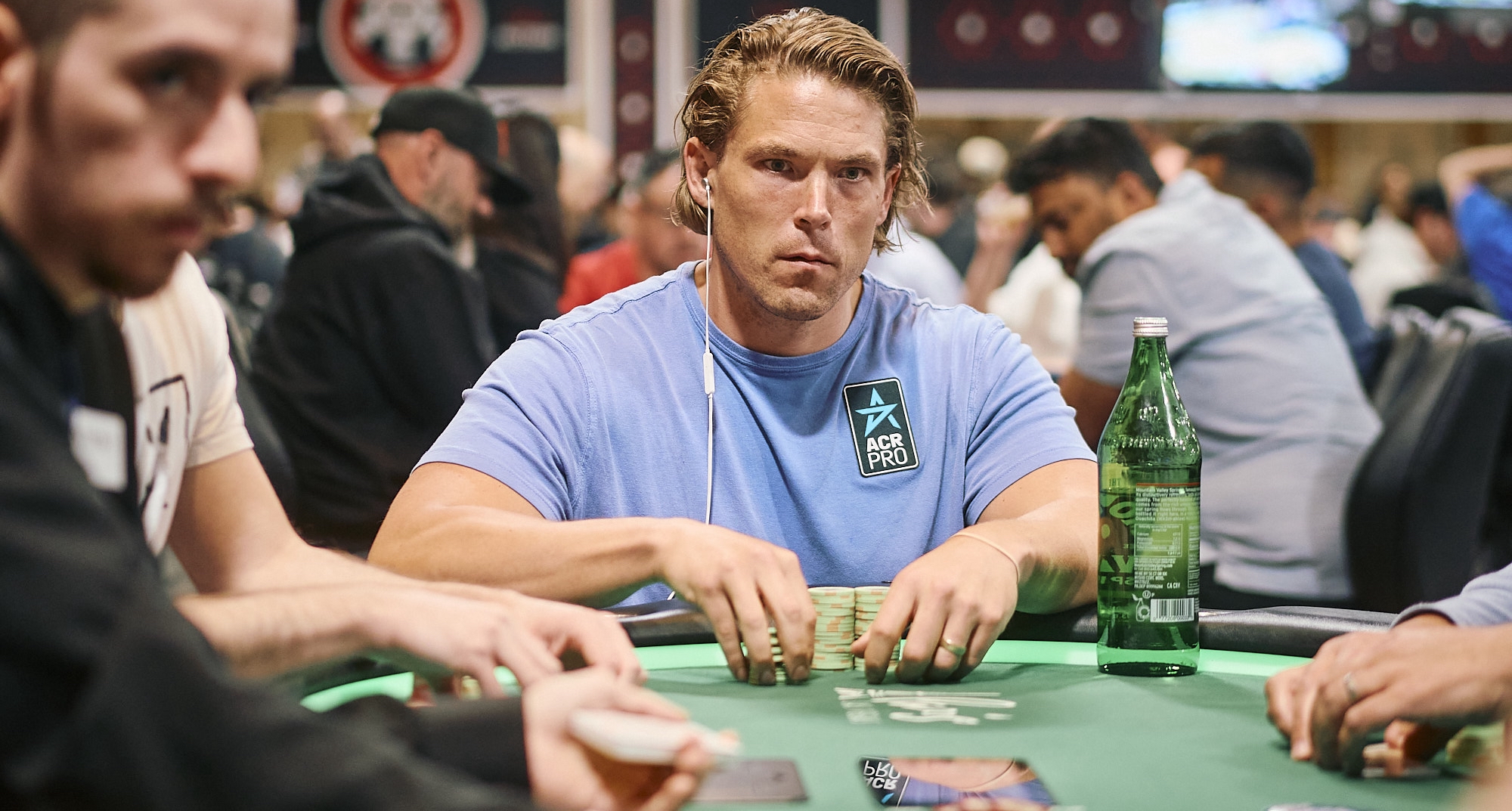
Perennial Card Player Player of the Year contender Alex Foxen has unexpectedly also found himself in the thick of the World Series of Poker POY race after putting together one of the strongest summers of his career.
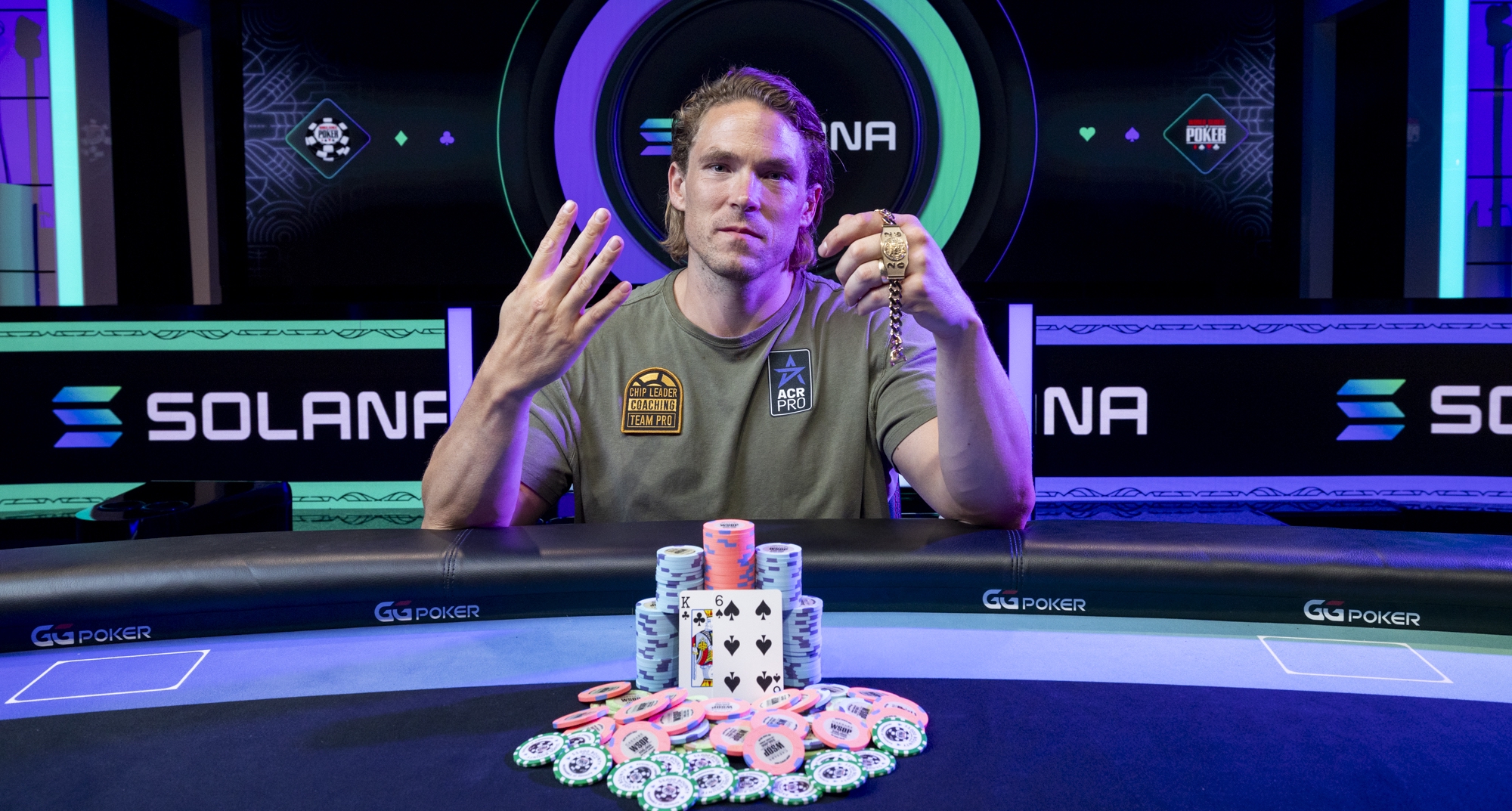
The 35-year-old ACR Poker pro took down the $10,000 super turbo bounty for his fourth WSOP bracelet while adding several deep runs in high rollers and championship events, turning an early surge into a legitimate POY campaign.
The New York native, who now resides in Las Vegas, now has $61 million in career live earnings. The Foxen household enjoyed a memorable summer overall, with wife Kristen also capturing a sixth WSOP bracelet.
Was this year’s World Series of Poker Player of the Year race something you aspired to prior to the series? Or was it just the case that you had a great start, so you went for it?
Alex Foxen: It wasn’t something that I set out to do. Going into the series, I’ll have the intention of just playing the tournaments that I want to play, and working in some time off. I just try to play to the best of my ability.
But as you get closer and Player of the Year becomes more of a realistic potential outcome… sure, it sways you in the favor of playing a couple tournaments where maybe you would have taken the day off on instead. It’s always an interesting balance because the days off are very valuable for your performance for the on days. So, I don’t necessarily think that playing every day, at least for me, is necessarily the best way to achieve something like that.
Given that the Player of the Year race concludes at WSOP Paradise, which is much more high roller-centric, do you think that gives you the edge this year on the leaderboard?
Alex Foxen: The high roller PLO and NLH events at WSOP Paradise definitely favor me.
The people that are close to me in [the race] — Shaun Deeb, Naoya Kihara, and Josh Arieh — are not all high roller regulars [outside of the summer], and most of the points that they’ve generated have come from a lot of the mixed games tournaments. I think that with it being as close as possible, that gives me a pretty significant advantage.

Should The POY Points System Be Changed?
What do you think of the idea floated this year that the Player of the Year winner should be required to have a profitable series to be eligible?
Alex Foxen: The debate is an interesting one. I think that’s a reasonable requirement to have it be necessary to be profitable to be considered. However, there’s a fine line that we walk with a rule like that. For example, ‘Texas’ Mike [Moncek] is obviously a focal point of this type of question. Him winning Player of the Year as a result of a lot of blind shoving and multi-tabling… running up stacks by means that aren’t just playing good poker… its suboptimal. That’s not necessarily the way that Player of the Year should be won.
However, it’s really good to have somebody just blasting three or four buy-ins in every tournament. He’s helping the prize pools out quite a bit, giving away a lot of money to the community. I wouldn’t necessarily want to discourage something like that, or discourage someone from chasing in that regard.
You also run into the other issue of imagining a player who plays a full schedule of tournaments, and they could theoretically brick the $250k, all the $100ks, the $50k, and be a million in the hole. They could then win three $10k championship bracelets and still have a losing summer. That’s a real possibility. And I think someone winning the $10k six-max no limit hold’em, the $10k no-limit deuce, and the $10k stud, or whatever it might be… that’s probably a résumé that’s worthy of consideration.
So, I don’t know if being profitable should really be the metric. I really do think it’s impossible to “buy the POY.” You can’t win a tournament by having five starting stacks when reg closes. That only gets you so far. So even if someone like Texas Mike won, I would feel like he is at least somewhat deserving, because he does still have to play the tournament from the point of reg closing, just like everyone else. There’s no monetary advantage there.
I think the perfect solution to that would just have it be where each entry that you make has some kind of detraction from your overall score. I don’t know exactly how I would structure that, but I think that’s a better solution than specifically requiring profitability.
Shaun Deeb has been very forthcoming about his profits and losses competing for the leaderboard. Is that something you’d share too?
Alex Foxen: Deeb has shared his PNL publicly, and I wouldn’t really have any problem doing the same. It already has been done by one of those Twitter accounts that tracks everything. The funny thing about that Twitter account is I looked through some of the numbers that they had for both myself and Kristen, and they baked in a bunch of buy-ins that we didn’t actually have.
It had me in for three bullets in the $25k HORSE, I was only in for one. It had her in for three in the $50k, she was only in for one. There were a few other examples of that, and every mistake that it made was on the side of adding buy-ins, which of course makes sense — it’s impossible to get the cashes wrong, because that’s all very public. So, there are some errors in that, but I wouldn’t have any real problem sharing that.
The Buy-In Doesn’t Affect His Decision Making
This year was the first-ever example of a husband and wife separately winning open bracelets at the WSOP. The support and study that comes with being married to a fellow poker crusher must be very helpful, but does it also create pressure? Do you both feel a sense of obligation to do as well as each other? Or to play the same level of events?
Alex Foxen: Being married to another top poker player is something I consider myself extremely lucky for. Poker is a very unique game. It has a lot of demands on you as a person, both on and off the table. Having someone that I’m able to share that with on such a deep level is, I think, a very unique experience that not many poker players get to have. I consider myself very lucky in that regard.

This year, you made back-to-back final tables. One buy-in was $600 and the other buy-in was $100,000. What does this do to your mindset to compete in a tournament where the buy-in is more than some of the top prizes in the other?
Alex Foxen: The difference between a $600 and $100k tournament is actually nothing. This is kind of fundamental to my approach to poker in general, and to my approach to especially tournament poker. The dollar amount on the tournament has no bearing on my decisions.
The only thing that has a bearing on my decisions is the stack depth, the player type, the structure of the tournament, the position that I’m in, the recent dynamic — all of the things that might affect my opponent’s play style. Sometimes the buy-in will play a role in that, but only from the standpoint of me believing that my opponent will play a certain buy-in in a different manner.
So it’s just a pretty straightforward calculus of: What does this person’s range look like? How will they play these hands? What does this bet, or check, or whatever mean about their range? And how do I take best advantage of that with the hand that I have, or the range that I might have?
For me, it’s just chips and cards and players… and the players differ a lot.
Obviously, the average lineup in that $600 is quite a bit different than in the $100k. So from that standpoint, my play style and my strategy will shift pretty drastically. However, it’s not because the tournament is a different price point — it’s because the players are different. The puzzle that I’m being given has different pieces, and I’m really just trying to put the puzzle together.
Foxen Is A Big Fan Of Shot Clocks
The main event introduced a shot clock very deep this year, and it led to a lot of debate about whether that favored the professionals. What are your views on a shot clock in the main event, and who do you think it gives an edge to?
Alex Foxen: I think the main event adding shot clocks is a long time coming. I see shot clocks as similar to big blind ante, in that once they’re finally ubiquitous, we will look back on it as ridiculous that it took so long to [implement].
I think playing poker without a time restriction on your decision-making is completely ridiculous. Again, when it becomes more common, everyone will feel the same way. When I go from playing a series of high rollers that are all on shot clocks to a non-shot-clock tournament, it’s absolutely torturous — just from people who abuse the time that they’re given.
In the main event, it’s particularly bad. I understand that people are acting within the rules, so I don’t think they should necessarily be punished. Shot clocks are not necessary day one in its current format. We don’t have good enough dealers to manage this, and there’s a lot of logistical issues. So not having it on day one, fine. Not having it on day six, even five, I think is ridiculous.
As far as who it benefits, I don’t really know. I think it’s player by player. It might benefit some pros. But some pros are worse under the shot clock than recs would be.
I don’t think it’s clear-cut who it benefits. To me, it’s completely irrelevant who it benefits. The rules aren’t designed to make the game good for one player or bad for the other. The rules are designed to make the gameplay experience as positive and enjoyable, and as fair for everyone as possible. It’s just a question of what is better for the game, and I think that’s clearly to introduce shot clocks.
You signed with ACR just before the series. Now that the WSOP is in the rearview mirror, what are you looking forward to competing in on the site?
Alex Foxen: Signing with ACR Poker right before WSOP was great. I was glad to be able to get some exposure for ACR this summer. Now that that’s over, I’ll have a lot more time to play online.
I’m excited to promote the upcoming Venom. I want to try to get more people playing on the site, and also put in some more volume myself. I’m excited to be able to sit down with Phil [Nagy] and the rest of the team and try to make the site as great a place to play as I possibly can.
- Photos – Card Player, WSOP – Tyler Abrams