









Poker: Definition, Types & Misconceptions
What Is Poker?
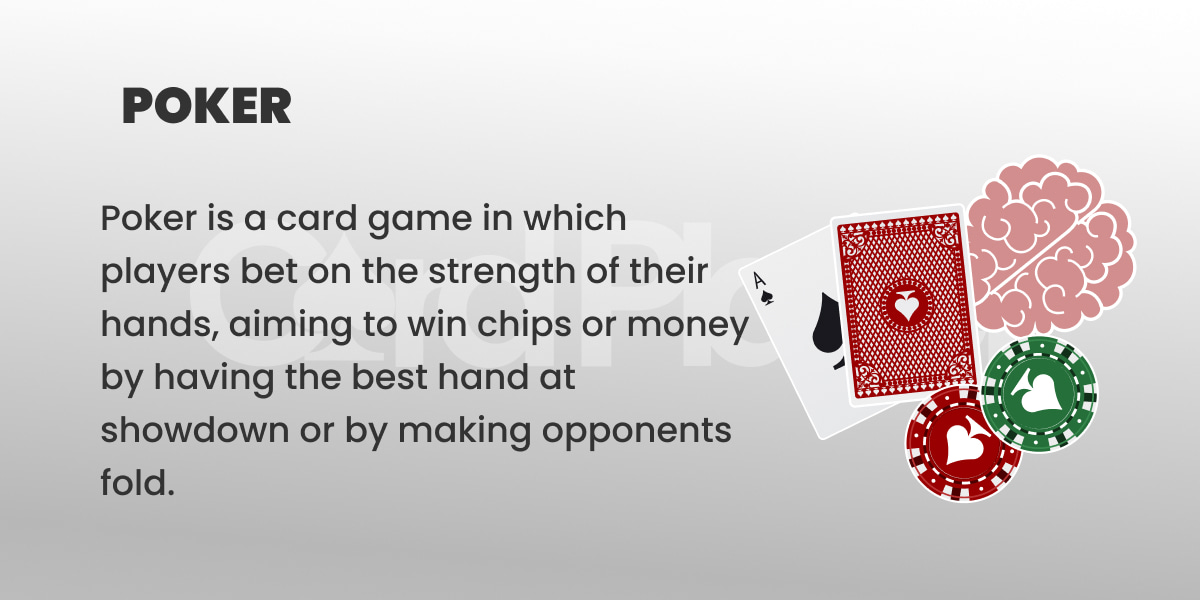
Poker is a card game, usually played for money, that can be played in various formats.
It’s generally considered a skill game with an element of variance, involving decision-making with limited information, both on online poker sites and in live action.
At its core, poker involves players betting on the strength of their hand across multiple rounds, with the aim of winning the pot. Unlike traditional casino games, players compete against each other — not the house — making skill and strategy the defining factors over the long run.
What Is Poker: Key Points
- Poker is a card game normally played for money.
- Comes in various forms, with two main game types: cash games and tournaments.
- A skill game involving variance rather than pure gambling.
- Players compete against each other, not the house.
History of Poker
Poker in its modern form originated in the United States in the 1800s, although card games were played in ancient China, Egypt, and Persia.
In the late 19th-20th centuries, poker clubs and tournaments began to appear, and the creation of Las Vegas as a gambling mecca made poker widely available in the 1960s.
The World Series of Poker began in 1970, bringing prestige to a game previously played primarily in smoky backrooms.
An online boom occurred with the internet age, followed by a surge in popularity following Chris Moneymaker’s 2003 World Series of Poker Main Event win.
Poker Rules & How It’s Played
Different rules apply to different poker games, but in general, poker involves rounds of betting based on a starting hand, and then as cards are drawn or as community cards are dealt face-up.
The object of the game is to make the strongest possible hand within the specific game rules, but bluffing allows you to win pots without the best hand.
There are differences between tournaments and cash games, the most important being that in tournaments, players pay a set fee for a set amount of starting chips, with blinds increasing at defined intervals. Chips do not have a direct cash value.
In cash games, players can buy in for varying amounts, normally up to a set maximum, and blinds stay at a set level unless all players agree otherwise. Chips have a direct cash value.
Poker vs. Traditional Gambling Games
Poker is different from traditional gambling games, such as roulette, slots, or craps, in the following ways:
- In poker, players play each other, whereas in traditional gambling games, players play the house.
- Long-term outcomes in poker are influenced by a player’s decisions and skill, whereas outcomes in traditional gambling games are random with no skill component.
- The house holds an edge in traditional gambling games that cannot be impacted by an individual’s decisions.
- Poker involves making decisions based on incomplete information, whereas there is no hidden information or variables in traditional gambling games.
- You can win with the worst hand in poker, whereas whether you beat the house in traditional gambling games is a factual issue.
In short, poker and traditional gambling games share little beyond the element of money — the role of the player couldn’t be more different.
Is Poker Gambling?
Poker is a form of gambling when played for money, but it is fundamentally a skill game that involves decision-making under incomplete information and an element of variance.
The long-term outcomes for a player across a large sample will be directly influenced by their skill level, as their decision-making, knowledge of game theory, and emotional control will affect their profitability.
Traditional gambling involves no skill component. Once you choose 12 at a roulette table, nothing you can do impacts the chances of the wheel landing on 12.
What Makes Poker Unique
Poker is a complex game because it involves a unique blend of competition, mathematics, psychology, and decision-making with limited information.
Strong players will generally beat weaker players over a reasonable sample, but any player, no matter their skill level, can win any hand or, indeed, any tournament or cash session.
You can play theoretically perfect poker and lose, and play terrible poker and win, both in any individual hand and across any session. This is variance in action.
Types of Poker Games
There are numerous types of poker games, with the main types as follows:
- No-Limit Texas Hold’em.
- Limit Texas Hold’em.
- Pot-Limit Omaha.
- Pot-Limit Omaha Hi-Lo.
- Stud.
- Stud Hi-Lo.
- Razz.
- Badugi.
- 2-7 Triple Draw.
Any of the above games can be played in the two main poker formats: tournaments and cash games.
Mixed games combine the above game types within a single game.
Common Misconceptions About Poker
Common misconceptions about poker include:
- Poker is pure gambling: As discussed above, a poker player’s long-term outcomes are directly affected by their skill level.
- Poker is pure luck: Variance is a factor, as are variables beyond your control, such as the actions of opponents, but skill is more critical in the long run.
- Poker is solved: While solvers have changed the landscape, No-Limit Hold’em is not fully solved, and humans cannot replicate perfect play in real time.
Poker is also widely recognized as a mind sport, requiring the same cognitive discipline, strategic thinking, and focus under pressure as chess or bridge.
FAQs
What is poker and how is it played?
Poker is a card game played for money in which players bet across multiple rounds based on the strength of their hand, aiming to win the pot.
Is poker gambling or skill?
Poker is primarily a skill game, though it involves an element of variance that can affect short-term results.
Is poker good for your brain?
Poker is a mind sport that involves decision-making under incomplete information.
What makes poker different from gambling?
In poker, players do not play the house; they play each other, and their decision-making directly affects the outcome. Pure gambling involves variance with no skill factor.
Is poker gambling or math?
When played for money, poker is a form of gambling, but it is primarily a skill game involving mathematical decision-making based on limited information.
What is the definition of poker game?
A poker game is a card game of various types, played in cash games or tournament formats.
Why is poker not considered gambling?
Poker involves skill and decisions that impact outcomes, whereas gambling is pure variance with no skill factor.