







Pot Odds in Poker: Definition, How They Work & Why They Matter
What Are Pot Odds in Poker?
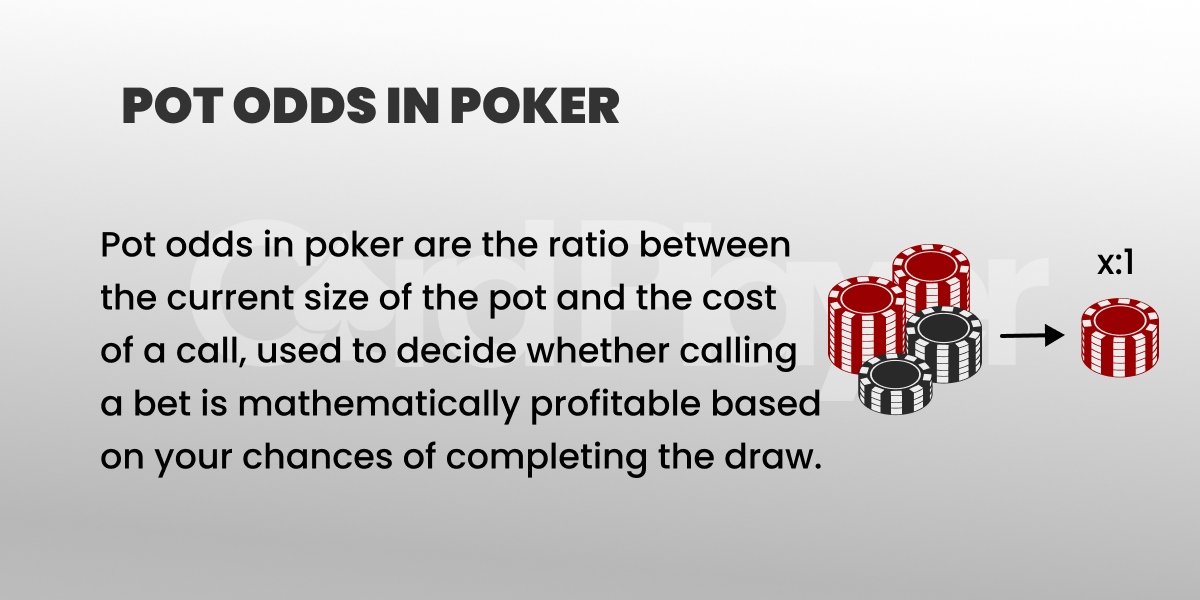
Pot odds in poker describe the relationship between the size of the pot and the cost of a call. In simple terms, pot odds tell you how much you have to risk compared to how much you can win.
The general rule of thumb:
- If the pot is large and the bet you must call is small, your pot odds are good.
- If the pot is small and the bet is large, your pot odds are worse.
Pot odds in poker do not tell you whether you will win the hand. They tell you whether calling is mathematically justified based on the price you are being offered.
Pot Odds in Poker: Key Points
- Pot odds compare the cost of a call to the total pot size.
- You use pot odds to calculate whether your call is profitable in the long run.
- Pot odds work best when combined with your chance of completing a draw.
Pot Odds vs. Implied Odds
Pot odds in poker focus only on what is already in the pot. They assume no more money will be added after you call. In practice, this assumption is often wrong.
Implied odds take future betting into account.
If you expect to win more money on later streets when you hit your hand, your implied odds are better than your immediate pot odds. For example, you might be drawing to a flush. The pot odds alone may not justify a call.
However, if you think your opponent will bet a lot of chips (or call your big bet) when you complete your flush on future streets, then the potential money you could win later makes it worth calling now – even if the pot odds aren’t quite right at the moment.
However, if you believe your opponent will make a large bet or a big call on the river that you can win after hitting your flush, the implied odds can make the call correct.
Pot odds are concrete and visible. Implied odds require judgment and experience. Beginners should focus on pot odds first, then gradually incorporate implied odds into their calculations.
Pot Odds Formula & Calculations
The pot odds formula is straightforward and always the same.
You compare the amount you must call to the total pot after you call. Knowing how to calculate pot odds properly is important to ensuring your survivability at the tables, as it helps you protect your stack and bet smartly.
Pot Odds Formula: Call Amount ÷ Total Pot After Call
Let’s walk through a full example step by step:
- The pot is $60.
- Your opponent bets $20, making the pot $80.
- You need to call $20.
- After your call, the total pot is $100.
Calculation:
20 ÷ 100 = 0.20 (20%)
This means you are risking 20% of the final pot to stay in the hand. Pot odds can also be shown as a ratio. In this case, you are risking $20 to win $80, which is a 4:1 payout.
Using a pot odds calculator at an online poker site can perform these steps instantly, but understanding the manual process helps you recognize good spots without relying on tools.
Converting Pot Odds to Percentages
Once you know how to calculate pot odds, the next step is using them to decide whether calling makes sense.
New example (different outcome):
- The pot is $100.
- Your opponent bets $50, making the pot $150.
- If you call $50, the final pot will be $200.
Calculation:
50 ÷ 200 = 0.25 (25%)
This means you need at least a 25% chance of winning for the call to be profitable over time. Now compare that number to your hand.
- If your draw wins more than 25% of the time, calling is correct.
- If it wins less than 25% of the time, folding is usually the better option.
Pot odds charts can help you memorize common situations, but the math behind pot odds never changes.
How to Use Pot Odds to Make Decisions
Pot odds in poker are most useful when you are facing a bet with a drawing hand.
To make a decision, you compare your pot odds with your chances of completing the draw. For example, suppose you have four cards to a flush after the flop. There are nine remaining cards in the deck that complete your flush. With two cards to come, your chance of hitting the flush by the river is about 35%.
Now compare that number to your pot odds:
- If your pot odds require only a 20% chance to call, the call is profitable.
- If your pot odds require a 40% chance, calling is usually incorrect.
In some cases, implied odds can make a call acceptable. This occurs when you expect to win more money on later streets after completing your hand.
Pot odds also apply when facing all-in bets. Even when an opponent moves all in, the process is the same: compare the cost of calling to the total pot and decide whether your hand wins often enough to justify the call.
Quick Pot Odds Calculation Methods
In live games, there is not always time for detailed math. Instead, many players use shortcuts:
- Use rough percentages: If you are calling $25 into a pot that will be around $100, your pot odds are roughly 25%.
- Rely on common benchmarks: Calling one bet to win four bets is about 20%. Calling one bet to win two bets is about 33%.
- Combine pot odds with the Rule of 4 and 2: On the flop, multiply your number of outs by 4 to estimate your chance of winning by the river. On the turn, multiply your outs by 2 to estimate your chance of hitting on the river.
These methods are not exact, but they are accurate enough for most real-time decisions.
Common Mistakes with Pot Odds
- Forgetting to include the size of your call in the pot: Pot odds are always based on the final pot size after your call, not the pot before you call.
- Overvaluing draws and miscounting outs: Not all outs are clean, and some cards may complete your draw while also giving your opponent a stronger hand.
- Ignoring implied odds when the value is limited: Even when pot odds are technically correct, a call can still lose money if you cannot win additional chips after hitting your hand.
- Relying on feelings instead of math: Many beginners ignore pot odds altogether and make decisions based on hope. Poker rewards consistent, math-based decisions over time.
FAQs
What are pot odds in poker?
Pot odds in poker are the ratio between the amount you must call and the total pot after your call. They help determine whether a call is mathematically profitable.
What is the formula for calculating pot odds?
The pot odds formula is the call amount divided by the total pot after the call. This result is often converted into a percentage.
How do I calculate pot odds quickly?
You can estimate pot odds by rounding numbers and using common ratios. Many players also use a pot odds calculator or a simple pot odds chart.
How do I use pot odds to make decisions?
You compare your pot odds to your chance of winning the hand. If your winning chance is higher than the required percentage, calling is usually correct.
What are implied odds in relation to pot odds?
Implied odds consider future bets you might win after hitting your hand. They supplement pot odds when more money is likely to go into the pot later.
Can you mathematically win at poker using pot odds?
Pot odds alone do not guarantee winning sessions, but using them correctly improves long-term decision-making and reduces costly mistakes.
When do you use pot odds in poker?
Pot odds are used whenever you face a bet and must decide whether to call, especially when drawing to improve your hand.
What is the rule of 4 and 2?
The rule of 4 and 2 is a shortcut for estimating drawing odds. Multiply your outs by 4 on the flop and by 2 on the turn to estimate your winning chances.