







Flush in Poker: Definition, Key Hands & Strategy
What Is a Flush in Poker?
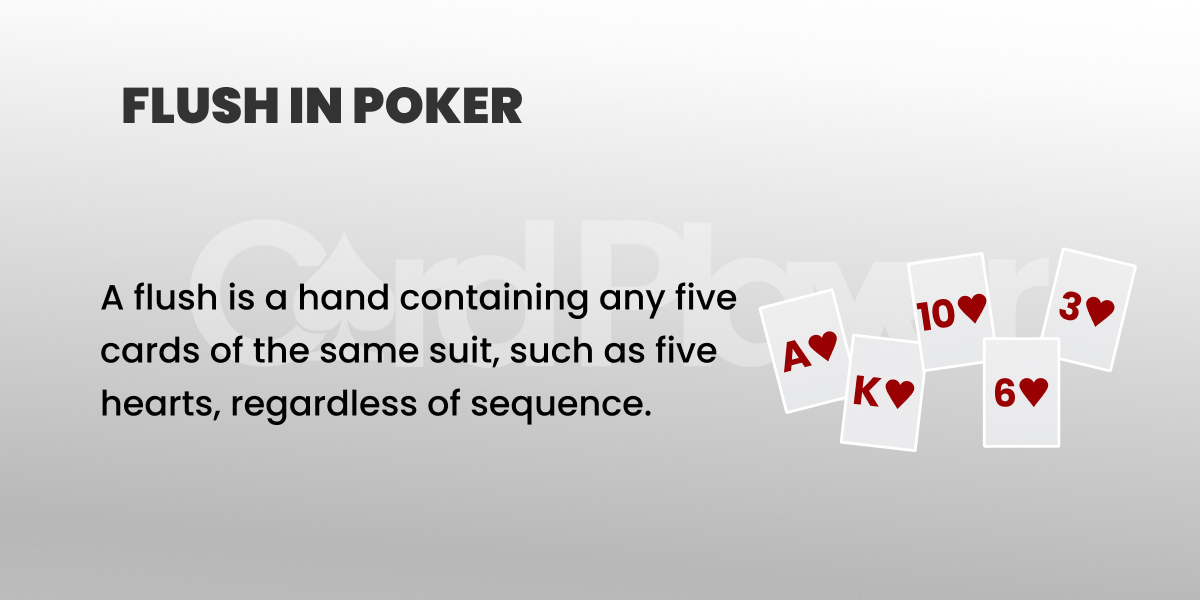
A flush in poker is any five-card hand where all cards share the same suit.
The ranks do not need to be in order. A hand like A 9-7-4-2 of hearts counts as a flush, and the only thing that determines its strength compared to another flush is the highest card.
If both players’ flushes share the same highest card (because it’s on the board), then the second-highest card breaks the tie, and so on. In rare cases where all five flush cards are on the board, the pot is split.
At first glance, a flush seems easy to hit, but most new players misunderstand the odds.
Understanding the flush strategy starts with knowing how high a flush ranks compared to other hands. It ought to help to provide a comprehensive understanding of where a hand ranks in relation to other hands.
A Flush in Poker: Key Points
- All flushes use five cards of the same suit, and the highest card in the flush determines which one wins.
- A flush ranks above a straight and below a full house in the hand hierarchy.
- Suited starting cards improve your chance of making a flush, but the actual odds remain low enough that most flush draws will miss.
Where the Flush Ranks in the Poker Hands Hierarchy
A flush ranks above a straight but below a full house.
In other words, a flush is one of the top-tier hands in poker. A simple memory hack is to group hands by whether they depend on suits or ranks. A straight involves five consecutive ranks in order, and a flush involves five cards of the same suit.
There does not have to be a connection between all of the ranks, which makes it easier than a straight flush but harder than a straight.
That middle ground is how a flush usually wins a good-sized pot. A player with a low made hand usually calls a little too often when facing a possible flush, especially with a coordinated board with many middle-of-the-road cards.
When looking at the full ranking list, it comes out like this:
- Royal Flush
- Straight Flush
- Four of a Kind
- Full House
- Flush
- Straight
- Three of a Kind
- Two Pair
- A Pair
- High Card
This ranking is especially important in Texas Hold’em, as many pots involve competing draws. A pair can feel strong pre-flop, yet a flush will always dominate it by showdown. This is why the poker hand rankings system is the backbone of every strategic decision you make at the table.
Royal Flush as the Ultimate Hand
A royal flush represents the highest straight flush, consisting of A-K-Q-J-10, all of the same suit.
This has a very low probability of occurrence, but this significance goes beyond mere probability. This stands as the strongest possible hand in poker. Even playing ten thousand hands, which you might manage to do in a single day if multi-tabling on online poker sites (especially if you play Zoom cash!), you’d only expect to hit a straight flush once by the river.
That’s how rare they are.
How Often Flushes Occur in Texas Hold’em
To avoid disappointment, players must understand the likelihood of making a flush.
When starting with suited cards in Hold’em, you’ll hit a flush on the flop only around 0.8% of the time. However, you are much more likely to have a flush draw – when two of your hole cards match the suit with two community cards.
After you flop a flush draw, the probability of making it on the turn or river is approximately 35%.
These are not bad odds, but a long shot nevertheless. Beginning poker players are often misled when they see four cards of the same suit and mistakenly believe that a flush will come sooner rather than later.
While there may be a lot of outs, two-thirds of all flush draws are busts, and this realization affects how you should play your hands.
Strategy for Playing Strong Flushes
When you finally make a strong flush — especially the nut flush — your focus should shift to extracting value.
A strong flush has a high potential for winning large pots, as such flushes usually occur on draw-heavy boards. In situations where you are dealt a board with cards such as J♣9♣5♣, with A♣Q♣ in your hand, you will find yourself with a hand that beats all inferior flushes. If someone has a top pair or a straight draw, they may also choose to call several bets, believing that their hands are strong enough to win.
One way to conceptualize deep flushes is to think about where your best card is.
If you have the nuts with a flush, your goal now becomes getting as much value as possible from the table. A bet for value plays well on most boards, as relatively few hands can beat you, and many subpar hands will call.
But you also have to pay attention to when a pair appears on the board.
A paired board can mean someone just made a full house — a hand stronger than your flush. This is a point where experienced players are likely to slow down and consider whether a player who has been pressing has been bluffing or not.
Weak Flushes & Common Pitfalls
An example of a weak flush, where flushes are usually established with low and/or middle suit cards, can be quite deceptive.
For example, 7-3 suited might look playable, but even if you hit a flush, you can lose a big pot to higher flushes. Then, if your rival has a better suited card, your flush becomes second best as soon as the fifth suit card appears on the board. A common mistake of beginners is that they overestimate these low flushes.
Players forget that poker involves comparative analysis. A flush stands only as long as it wins.
One of the ways beginners often find themselves in trouble quickly is when they bet too often with a flush draw when paired or with a four-flush. If there are four cards of a certain suit on the board, then their opponents can make a flush with a single hole card.
Without the Ace, your flush might not be the best one on the board. That explains why players talk about their nut flush so much, and it represents how safely you can play this hand across many types of runouts.
Cash Game and Tournament Situations With Flushes
Flushes appear in both ring games and tournaments, but the strategies in playing them differ in terms of stack size, aggression, and how many players are likely to play aggressively. New players often think all flushes are the same, forgetting that position and board texture matter.
Cash Games
In a cash game, stacks are deeper, and a good flush has great value.
Players with sets, straights, and high card draws usually continue to play as they know they can improve their hands. This also gives you multiple opportunities to bet as you know that you can bet bigger to charge your draws.
Tournaments
In Tournament play, everything is tighter.
With shorter stacks, increasing blinds, and payouts, players must be more selective with their medium to low flushes. High flushes are still rewarded, but survival becomes a factor in every move, even with paired boards and proximity to the bubble. Players with decent hands may fold to avoid being sent to the rail, while short stacks often take more risks.
FAQs
What does flush mean in poker?
A flush definition means having five cards of the same suit, for example, five hearts. The cards do not need to be in sequence.
What beats a flush in poker?
The poker hand ranking of a flush stands below a full house, four of a kind, a straight flush, and a royal flush.
How strong is a flush in poker?
A flush is a very strong hand, ranking above a straight. It’s the 5th strongest card combination in poker.
Why is flush better than straight?
In standard hand rankings, a flush beats a straight.
How are flushes ranked against each other?
Flushes are ranked by their highest card — for instance, an Ace-high flush beats a King-high flush.
Is it statistically harder to get a flush or a straight?
A flush is statistically harder to make than a straight. There are fewer possible flush combinations than straight combinations in a standard deck, making flushes rarer and more valuable.